Food & culture· 18 min read· Explore Africa editorial · Published October 2026 · Updated 30 Oct 2026
Cape Town's Food Scene: The Restaurants, Markets and Flavours Every Australian Traveller Should Know
Cape Town is quietly one of the world's great eating cities — a place where Cape Malay spice traditions, open-fire cooking, and world-ranked fine dining share the same table. Here's where to eat, what to order, and why the food culture here runs far deeper than a great view.
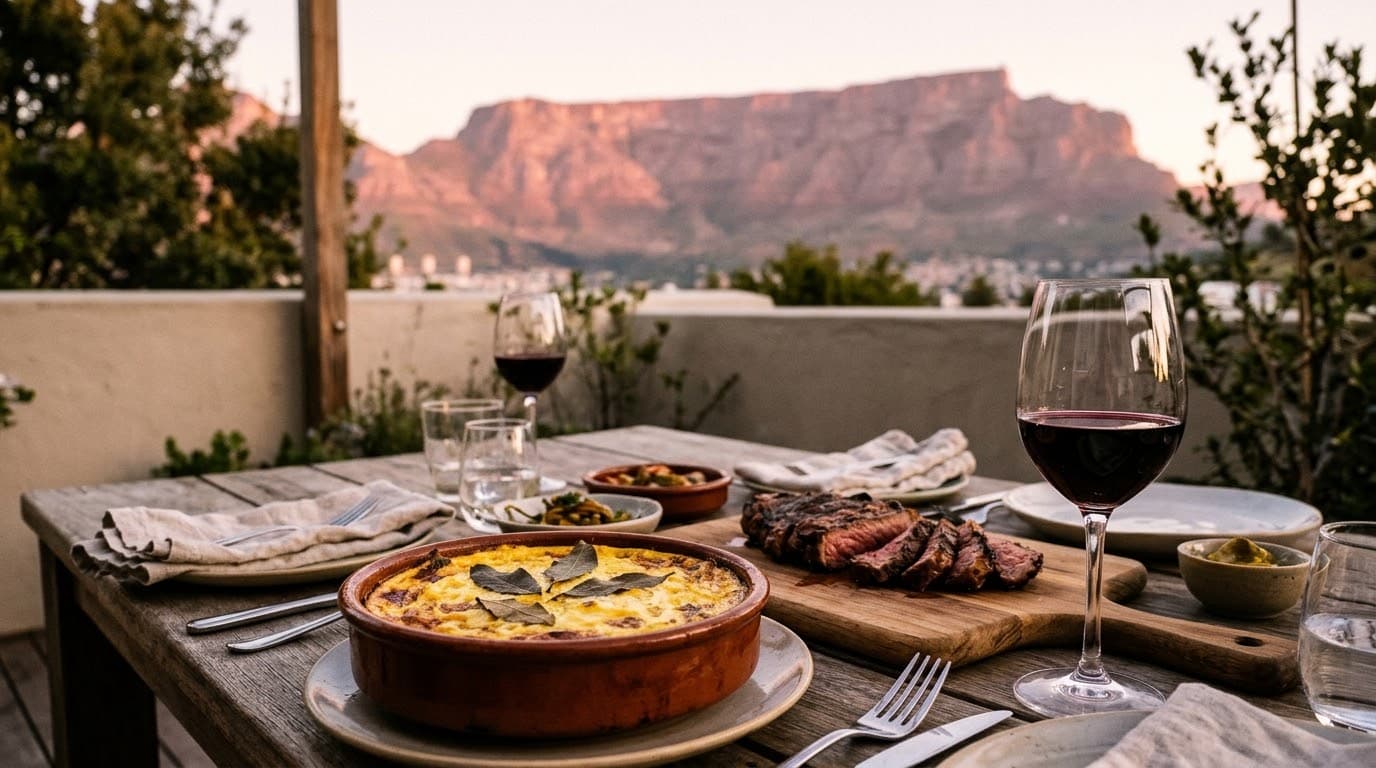
There's a moment that happens to most visitors somewhere around their second or third meal in Cape Town. It might be a spoonful of bobotie in a Bo-Kaap kitchen still fragrant with cardamom and cloves, or a char-edged piece of local Wagyu lifted off a wood fire with views of Table Mountain turning pink behind it. The moment is the realisation that this city's food scene is not a happy accident — it is the product of centuries of cultural collision, extraordinary local ingredients, and a community of chefs who take all of it seriously.
For Australians, Cape Town tends to inspire immediate comfort. The outdoor culture, the farmer's market habit, the obsession with good coffee and honest produce — it all feels familiar. But the flavours underneath are unlike anything on offer at home, and that's precisely why a few days spent eating your way through this city is worth planning properly.
The Big Picture: Why Cape Town Eats So Well
Cape Town's food culture is a direct product of its history. The Cape was a Dutch East India Company waystation from the seventeenth century, a stop-off point between Europe and Asia that brought together enslaved and exiled people from the Malay Archipelago, India, Madagascar, West Africa, and Sri Lanka. The culinary traditions they carried — and merged over generations — form the foundation of what people now call Cape Malay cuisine. Layered on top of that is the legacy of European settlement, the rich agricultural output of the Winelands just forty minutes inland, and a new generation of South African chefs determined to define what African fine dining actually looks and tastes like.
The result is a city where a bowl of slow-braised lamb bredie carries as much cultural weight as anything on the tasting menu at a world-ranked restaurant — and where both of those things can happen within the same twenty-four hours. For Australians planning their first visit, it helps to understand that food here is not just about eating well. It is one of the clearest lenses through which to understand the city itself.
World-Class Fine Dining: Cape Town's Global Standard
In 2025, three Cape Town restaurants appeared on the World's 50 Best Restaurants extended list — the only South African establishments to do so — confirming what regular visitors have long suspected: this is a serious fine-dining city.
La Colombe claimed 55th place on its sixth appearance on the list, a remarkable record of consistency. The restaurant sits on the Silvermist Wine Estate in Constantia, and chef James Gaag's tasting menu draws on French technique and Asian flavour in a way that feels elegantly considered rather than gimmicky. Book early; this one fills up fast.
FYN came in at 82nd and climbed 17 places to No. 65 in 2026, inspired by the fynbos biome unique to the Cape and guided by a Japanese philosophy of restraint and seasonality. Chef-founder Peter Tempelhoff and his team draw from African land and sea, then frame each dish with the kind of precision that earns global rankings. Advance bookings of up to two months are required for weekend dinners — visit fynrestaurant.com as soon as your travel dates are confirmed.
Salsify at the Roundhouse debuted on the list at 88th (climbed 17 places to No. 71 in 2026) and took home the Eat Out Restaurant of the Year award for 2025, set in Camps Bay with sweeping ocean views and a seasonal menu built around local and foraged produce. Executive chef and co-owner Ryan Cole, alongside head chef Nina du Toit, have created a younger, more relaxed energy than the other two, but no less technically impressive.
One more worth knowing: Ouzeri, on Wale Street, has earned recognition on the World's 50 Best Discovery List for its contemporary small-plates approach to Cypriot and Greek regional cooking. Chef Nic Charalambous and head chef Aidan Zieff have created something genuinely convivial — the kind of restaurant you go to for a quiet dinner and stay two hours longer than planned. You can reach them on 061 533 9071 or +27 21 010 4110.
Bo-Kaap and Cape Malay Cuisine: The Heart of Cape Town's Food Identity
No honest conversation about Cape Town food begins anywhere other than Bo-Kaap. This steep, cobblestoned neighbourhood — famous for its pastel-painted houses — is the historic centre of Cape Malay culture, and its culinary traditions have shaped the city's palate more profoundly than most visitors realise.
The Cape Malay community traces its origins to the enslaved people and political exiles brought to the Cape Colony by the Dutch East India Company from the seventeenth century onward. They came from across the Indian Ocean world, and what bound them together over generations was Islam and a shared kitchen vocabulary built from the spices of their diverse homelands — coriander, cardamom, cloves, turmeric, dried apricots, fresh ginger — combined with local Cape ingredients.
The fingerprints of that tradition are everywhere in Cape Town's broader food culture: the use of dried fruit in savoury dishes, the preference for slow-braise over quick-grill in lamb cooking, the prominence of ginger and coriander in dishes that have nothing to do with Bo-Kaap. Spend an afternoon in the neighbourhood around Atlas Trading, the decades-old spice shop, and the influence becomes impossible to miss.
For a meal, Bo-Kaap Kombuis (affectionately called "The Kombuis") at 7 August Street is the most celebrated address in the neighbourhood — a restaurant that has drawn politicians, ambassadors, and curious travellers from around the world. Visit bokaapkombuis.co.za for bookings; they are open for lunch Tuesday to Sunday and dinner Tuesday to Saturday. Biesmiellah is the other essential stop, renowned for its halal-certified Cape Malay curries and the full breadth of South African flavours.
Perhaps the most meaningful way to understand Cape Malay food, though, is to cook it. While the late culinary pioneer Faldela Williams remains the tradition’s literary icon — her book, The Cape Malay Cookbook, is still the definitive text on the cuisine — today’s most celebrated hands-on experiences are led by local Bo-Kaap hosts like Faeeza Abrahams (Faeeza’s Home Kitchen) and Gamidah Jacobs (Lekka Kombuis). A session in their kitchens is not a standard cooking school; it is the oral transmission of a culinary culture, with prices ranging from ZAR 600–1,200 per person depending on the format.
GOLD Restaurant and SPYCED: Cape Town's Most Immersive African Dining Experiences
If there is a corner of Cape Town's food scene that feels genuinely unlike anything available in Australia, it is the immersive pan-African dining experience — and two restaurants in particular have built serious reputations around exactly that.
GOLD Restaurant, at 15 Bennett Street in Green Point, Cape Town, is the original and most theatrical of the two. Open daily from 6pm to 11pm, an evening here unfolds as a 14-course taste-safari through food from across the African continent — dishes drawn from the Cape Malay kitchen, from West Africa, from the Swahili coast — served alongside live entertainment that plays out across the entire meal. Expect djembe drumming, traditional dance, Malian puppetry, and storytelling woven through the courses. An interactive drumming session before dinner, where guests learn to play the djembe, is worth arriving early for. GOLD also offers the Spice Experience — a more intimate, storytelling-led dinner format for those who prefer a quieter read on the same kitchen. All meat, poultry, and fish dishes on the menu are halal-certified, and vegetarian or vegan substitutes are available for every course — worth knowing for travelling companions with dietary requirements. Contact: +27 21 421 4653 or visit goldrestaurant.co.za.
SPYCED Restaurant, GOLD's sister restaurant, takes the same ethos into a sharper focus on Cape Malay cuisine and Cape Town jazz culture. It sits at Silo 4 in the V&A Waterfront — open daily from 11am to 11pm — and runs two distinct experiences under one roof.
At lunch, SPYCED is part cooking class, part feast. Culinary guide Fayruza Abrahams leads guests through the open kitchen, greeting them with a fragrant welcome drink before sharing stories of Bo-Kaap spice merchants and ocean crossings. Guests learn to fold samoosas, blend spices, and pickle — then sit down to a three-course meal made in part with their own hands. The cooking experience is priced at R1,500 per person; lunch ("Masala Stories" 3-course set menu) is R650 per person (à la carte is also available at lunch). Cooking classes (including lunch) run Monday to Saturday at 11h30. After dark, the mood shifts: a multi-course set menu arrives alongside live djembe drumming and Cape Town jazz, making SPYCED one of the more genuinely entertaining dinner options in the city. Dinner (Cape Dining Experience set menu with live jazz): R750 per person (or R910 per person for the 18:30 seating with the interactive djembe drumming session).
Signature dishes include Denningvleis (slow-roasted lamb in tamarind sauce with confit mash), kingklip coconut curry, and fresh mosbolletjie rolls. SPYCED operates a fully halal kitchen. SPYCED works well for groups. Verify current pricing at spyced.co.za or call +27 21 007 1220.
New Openings Worth Knowing: The Class of 2025–26
Cape Town's dining scene moves quickly, and several openings in the past eighteen months have already earned serious attention.
Veldt, which opened in February 2025 at 35 Main Road in Hout Bay, is one of the most distinctly South African dining experiences currently on offer. An upmarket wood-fired braai restaurant and artisanal deli, it focuses on generous sharing platters, dry-aged steaks, Wagyu dripping burgers, and heritage sides like braaibroodjies and Durban mutton curry, paired with fynbos botanical and rooibos cocktails in a menu that reads like a love letter to the landscape.
Ongetem, just off Kloof Street in the Canopy by Hilton Cape Town Longkloof hotel, opened in May 2025 under chef Bertus Basson. The name means "untamed" in Afrikaans, and the menu delivers on that: small plates packed with South African nostalgia, wood-fired flatbreads, and punchy mains made entirely in-house or sourced locally. It is casual enough for a relaxed dinner but precise enough to hold your full attention (website: ongetem.com, phone: +27 21 569 8880).
Marble at the V&A Waterfront, co-founded by chef David Higgs, brings the group's signature fire-focused cooking philosophy into a spectacular setting inside the historic Union Castle building. Signature starters include snoek pâté with magwenya and lamb and beef tartare with pickled waterblommetjies — dishes that are unmistakably South African and technically assured.
Seebamboes is the most intimate of the new arrivals: a 16-seater with an open kitchen where chef Adél Hughes reimagines surf and turf with quiet confidence. The nostalgia in the dishes is real, not performed.
Le Bistrot de Jan at the InterContinental Table Bay brings French bistro classics — chicken pie with truffle sauce, sole meunière, beef tartare — into a Cape Town context under chef Giles Edwards. It is the younger sibling of the Michelin-starred Jan restaurant in France, and it earns its own reputation here. Open daily for lunch (12pm–3pm) and dinner (6pm–10pm); contact 021 821 4180.
For something more experimental, Tambourine on Harrington Street cooks over open fire, sources ingredients from small-scale farmers, uses family-run dairy, and composts its food waste — sustainability that is genuinely built into the operation, not bolted on. And East City Grill & Yakiniku at 84 Harrington Street, District Six, offers two dining experiences under one roof: South African fire-cooking on one side, interactive table-top yakiniku grilling on the other. Open Tuesday to Saturday, 6pm–9.30pm; contact 021 518 3366.
Finally, for those heading into the Winelands, The Restaurant at Precious Hidden Valley in Stellenbosch — co-created with Dr Precious Moloi-Motsepe — is cooking some of the most purposeful New African Gastronomy in the country: biltong-cured kudu, beeswax-cured buffalo, lamb and duck, paired with estate wines on Annandale Road.
Beloved Stalwarts: Restaurants That Have Earned Their Reputation
Alongside the new openings, several long-established restaurants continue to set the standard and are worth booking specifically, not just stumbling into.
Chefs Warehouse at Beau Constantia is suspended above the vine-clad Constantia valley and serves a frequently changing set menu of fine-dining-calibre shared plates. Chef-patron Ivor Jones draws heavily from the farm's own gardens, then adds global influences with a confident, inventive touch. Call 021 794 8632 to book.
The Pot Luck Club, Luke Dale Roberts' small-plates restaurant at the top of the Old Biscuit Mill in Woodstock, remains one of the best arguments for sharing everything on the table. Panoramic city views and bold, inventive flavours — it draws a local crowd as much as a tourist one, which tells you something.
Bukhara in the city centre recently celebrated over 30 years in business, and its status as Cape Town's finest Indian restaurant is entirely deserved. It is an institution in the truest sense — a place that has outlasted trends by simply being very good.
Grub & Vine on Bree Street, where chef Matt Manning offers a seasonal six-course tasting menu and a well-constructed à la carte alongside three different local wine pairing options, is one of the more elegant rooms in the city. The view over Bree Street toward Lion's Head from the dining room is quietly spectacular. Contact 021 216 0035.
COY at the V&A Waterfront, led by chefs Teenola Govender and Geoffrey Abrahams, takes indigenous South African ingredients and ancient cooking techniques and uses them to tell authentic culinary stories. The seven-course dinner tasting menu is the full experience; walk-in lunches are also encouraged, which is a rare generosity for a restaurant of this quality.
Markets: How Cape Town Eats on a Saturday Morning
To understand what Cape Town actually eats — not just what it serves to visitors — spend a weekend morning at one of the city's markets. These are not tourist attractions. They are where locals shop, graze, and catch up.
The Neighbourgoods Market at the Old Biscuit Mill in Woodstock is the largest and most famous: a weekly Saturday gathering of artisan food producers, small-batch coffee roasters, fresh produce vendors, and street food stalls that draws an enormous local crowd. Arrive early.
The Bay Harbour Market in Hout Bay has a different character — slightly more relaxed, set in a converted fishing warehouse, open on weekends. It is worth the short drive from the city for the atmosphere alone.
The Oranjezicht City Farm Market at the V&A Waterfront runs on both Saturday mornings (8:15 AM – 2:00 PM) and Sunday mornings (9:00 AM – 2:00 PM) year-round, plus Wednesday night markets (5:00 PM – 9:00 PM) during the warmer summer months (November to March). It is probably the most focused on sustainability and local provenance of the three. The farm itself is a working urban agricultural project; the market is its most visible expression. If you want to understand Cape Town's serious farm-to-table culture, this is the place to start.
Cape Town Dining at a Glance
World Rankings
3 restaurants
FYN (65th in 2026), Salsify at the Roundhouse (71st in 2026), and La Colombe (55th in 2025) lead South Africa's presence on the World's 50 Best Restaurants extended lists.
FYN Booking Lead Time
Up to 2 months
Weekend dinner at FYN requires advance booking of up to two months. Visit fynrestaurant.com as soon as your dates are set.
Cape Malay Cooking Classes
ZAR 600–1,200 pp
Bo-Kaap cooking classes with local hosts like Faeeza Abrahams (Faeeza’s Home Kitchen) or Gamidah Jacobs (Lekka Kombuis) range from around ZAR 600 to ZAR 1,200 per person depending on format and whether meals are included.
Bukhara's Milestone
30 years
Cape Town's most celebrated Indian restaurant recently marked over three decades of continuous service — an extraordinary record in any city's dining scene.
Bo-Kaap's Origins
17th century
The Cape Malay community traces its roots to enslaved people and exiles brought to the Cape Colony by the Dutch East India Company from the 1600s onward.
GOLD's Feast
14 courses
GOLD Restaurant's pan-African tasting menu spans 14 courses served alongside live drumming, dance, storytelling, and Malian puppetry — one of Cape Town's most theatrical dining experiences.
Cape Town Food & Restaurants: Frequently Asked Questions
What is Cape Malay food and where should I try it?
Cape Malay cuisine is a fusion of Southeast Asian, African, and Dutch influences, developed over centuries by the Cape Malay community in Bo-Kaap. Key dishes include bobotie (spiced baked mince with an egg topping), bredie (slow-cooked stew), and koeksisters (syrup-soaked doughnuts). Bo-Kaap Kombuis at 7 August Street and Biesmiellah are the two most celebrated restaurants in the neighbourhood. SPYCED at the V&A Waterfront offers both a Cape Malay cooking class at lunch (R1,500 per person) and a multi-course Cape Malay set dinner with live jazz. While the late Faldela Williams' The Cape Malay Cookbook is the essential read on the tradition, an intimate Bo-Kaap cooking class with Faeeza Abrahams (Faeeza’s Home Kitchen) or Gamidah Jacobs (Lekka Kombuis) is the most immersive way to experience it firsthand.
Which Cape Town restaurants are on the World's Best Restaurants list?
Three Cape Town restaurants have led South Africa's entries on the World's 50 Best extended list across 2025–2026: FYN (which climbed 17 spots to No. 65 in 2026), Salsify at the Roundhouse (which climbed 17 spots to No. 71 in 2026 and won the 2025 Eat Out Restaurant of the Year award), and La Colombe (No. 55 in 2025). All three require advance bookings, with FYN recommending up to two months' notice for weekend dinners.
What is GOLD Restaurant and is it worth going?
GOLD Restaurant at 15 Bennett Street, Green Point, is one of Cape Town's most distinctive dining experiences — a 14-course pan-African tasting menu served alongside live drumming, traditional dance, storytelling, and Malian puppetry. Open daily from 6pm to 11pm, it is theatrical by design, and that is the point. An interactive djembe drumming session before dinner is a genuine highlight. All dishes are halal-certified, with vegetarian and vegan substitutes available throughout. Its sister restaurant, SPYCED at the V&A Waterfront, takes the same team's passion for African food culture into a sharper focus on Cape Malay cuisine and Cape Town jazz. Both are well suited to groups and travellers who want food and culture woven together. Contact GOLD on +27 21 421 4653; book SPYCED at spyced.co.za.
Is Cape Town suitable for vegetarians or people with dietary requirements?
Cape Town's food scene has become increasingly accommodating of diverse dietary needs. FYN and La Colombe both offer alternatives for non-meat eaters on request. GOLD Restaurant provides vegetarian and vegan substitutes for every course on its halal-certified menu. SPYCED Restaurant operates a fully halal kitchen and caters to vegetarian and vegan diners across both its lunch cooking class and dinner menus. The Neighbourgoods and Oranjezicht City Farm markets are excellent for plant-based produce and food. Always communicate your requirements at the time of booking at fine-dining venues.
What is the best food market in Cape Town?
The Neighbourgoods Market at the Old Biscuit Mill in Woodstock (Saturday mornings) is the largest and most varied. The Oranjezicht City Farm Market at the V&A Waterfront is more focused on sustainable local produce. Bay Harbour Market in Hout Bay is a relaxed weekend option with a fishing-village atmosphere. Each has a distinct character and all are worth visiting if time allows.
How far is Stellenbosch from Cape Town, and is it worth going for a meal?
Stellenbosch is roughly 45 minutes to an hour from central Cape Town by car, making it a very manageable day trip. The Restaurant at Precious Hidden Valley on Annandale Road is one of the most compelling reasons to make the drive — New African Gastronomy with estate wine pairings and serious culinary intent. The Winelands also offer numerous wine estate restaurants worth exploring while you're there.
What is a reasonable budget for dining in Cape Town?
Cape Town offers a wide range of price points. A tasting menu at a world-ranked restaurant such as FYN or La Colombe will typically cost ZAR 1,675–2,600+ per person before wine (approx. AUD 140–225+ at mid-2026 exchange rates). A very good dinner at an established restaurant like Grub & Vine or Ouzeri might run ZAR 400–700 per person. The SPYCED cooking class experience is R1,500 per person; the three-course lunch set menu alone is R650 per person (with dinner set menus from R750 to R910 per person). Markets and casual spots in Bo-Kaap are significantly cheaper. Tipping 10–15% is standard and always appreciated.