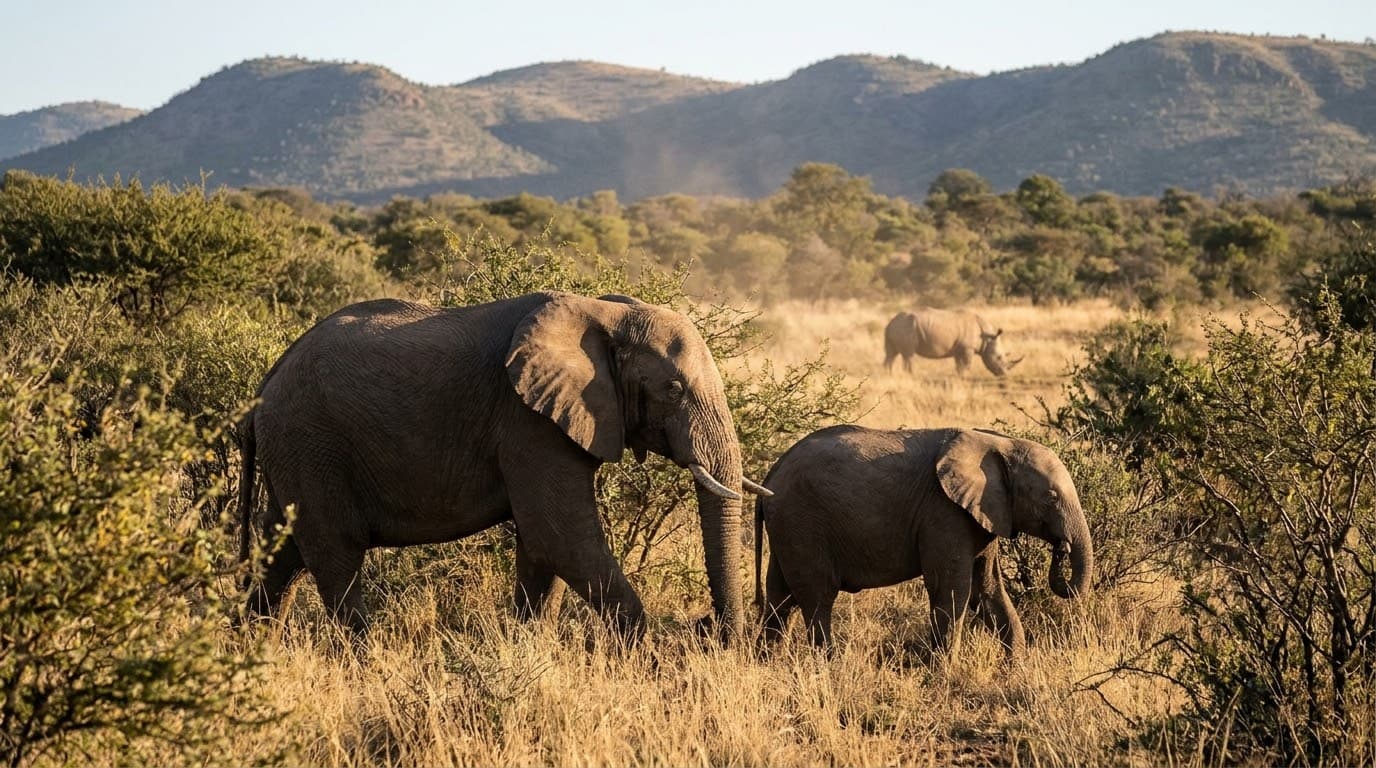
1. Operation Genesis: Breathing Life Back into the Crater
The story begins in 1979. The land that is now Pilanesberg had spent decades as fragmented cattle farms. In what was dubbed "Operation Genesis"—at the time, one of the largest game translocation projects in history—conservationists flooded the cleared land with thousands of animals to restore the ecosystem.
Among the arrivals were young elephants. Logistically, moving fully grown, multi-tonne adult elephants in the late 1970s was an immense, near-impossible challenge. Consequently, conservationists translocated young orphans rescued from culling operations elsewhere in South Africa, primarily from Kruger National Park.
At first, the introduction seemed like a triumph. But as these young elephants grew into adolescence, a quiet crisis began to brew within the crater walls.
2. The Mystery of the Broken Rhinos
In the early 1990s, park rangers and ecologists made a horrifying discovery: white rhinos across Pilanesberg were turning up dead.
Over the course of a few years, more than 40 rhinos were killed. Their bodies were severely mutilated, their backs broken, and their horns ripped out. Initially, poachers were suspected. However, the rhino horns were left intact, ruling out illegal trade. The wounds pointed to a massive, blunt force—one that only another large animal could inflict.
Suspicion soon fell on an unexpected culprit: the park’s teenage elephants.
At the same time, these young bulls began displaying unprecedented aggression toward tourists, charging safari vehicles and destroying park infrastructure. In 1993, two teenage bulls attacked and killed a tourist. Pilanesberg's elephants were rapidly gaining a reputation as an aberrant population of "savage beasts".
3. The Science of Trauma: Why Were They Acting Out?
Park ecologist Gus Van Dyk launched an intensive detective mission, tracking and cataloging the behavior of individual young male elephants. The root cause of the crisis turned out to be a profound sociological failure.
Elephants are intensely social, matriarchal animals with complex hierarchies. In a natural, stable wild population, young male elephants go through musth—a periodic surge of reproductive hormones that spikes their aggression. However, in a healthy herd, older, massive dominant bulls act as disciplinarians. When a youngster enters musth prematurely or steps out of line, an elder bull physically and socially puts him in his place, suppressing excessive testosterone spikes and teaching respect.
The Pilanesberg youngsters had no elders:
They had grown up entirely as orphans without fathers, uncles, or older role models.
Without senior bulls to suppress their hormones, these teenagers entered musth up to 10 years earlier than normal and stayed in it for months at a time.
Overwhelmed by unmanaged testosterone and a complete lack of social boundaries, they lashed out in deep confusion.
Why rhinos? When a rampaging teenage elephant wanted to pick a fight, most animals fled. But territorial white rhinos tended to stand their ground—making them tragic, static targets for the delinquents' displaced frustration and misplaced sexual aggression.
4. Operation Father Figure: The Fix
Park authorities realized that culling or destroying the troubled youngsters wouldn't solve the underlying issue; any future generation of males would likely hit adolescence and follow the same destructive path. They needed to reintroduce social structure.
By the late 1990s, heavy-duty transport capabilities had advanced. In early 1998, wildlife officials orchestrated the capture and translocation of six mature, massive adult bull elephants from Kruger National Park, moving them 800 kilometers to Pilanesberg.
The results were instantaneous and dramatic:
The moment the giant Kruger bulls stepped out of their transport crates, they immediately established absolute dominance.
Within hours and days, the swaggering teenage "thugs" were instantly humbled, disciplined, and put back in their place.
The overwhelming musth cycles of the younger males dropped back to normal parameters under the watchful eye of the new patriarchs.
As if a switch had been flipped, the rhino killings stopped overnight. Tourist attacks ceased, and the once-erratic youth integrated smoothly into a balanced, peaceful elephant society.
5. Why Pilanesberg Matters Today
The incredible story of Pilanesberg became a landmark case study in behavioral ecology and mammalian psychology. It proved a profound, humbling truth: for complex, intelligent species like elephants, saving them requires more than just protecting their physical habitat—it requires preserving their culture, social structure, and family order.
Today, when travellers explore Pilanesberg National Park—watching herds wander peacefully against the backdrop of its ancient green hills—they are witnessing a living testament to a park that looked its toughest challenges in the eye, listened to nature, and found its balance.
Sources & Reference Material
Scientific & Ecological Documentation: Research papers, field studies, and behavioral analyses regarding adolescent elephant musth dynamics, social collapse, and the 1998 Kruger bull elephant translocation are documented in behavioral ecology literature, including studies by park ecologists such as Gus Van Dyk. An overview of these findings and case studies can be found in conservation archives and scientific journals covering African mammal behavior, such as research highlighted by The Elephant Sanctuary and academic studies on pachyderm social structures.
Conservation History Archives: Historical records of "Operation Genesis" (1979)—the massive game translocation project that transformed fragmented cattle farms into Pilanesberg National Park—and subsequent wildlife management reports are maintained by the North West Parks and Tourism Board and documented in South African conservation history archives.