Stories· 10 min read· Explore Africa editorial · Published July 2026 · Updated 30 Oct 2026
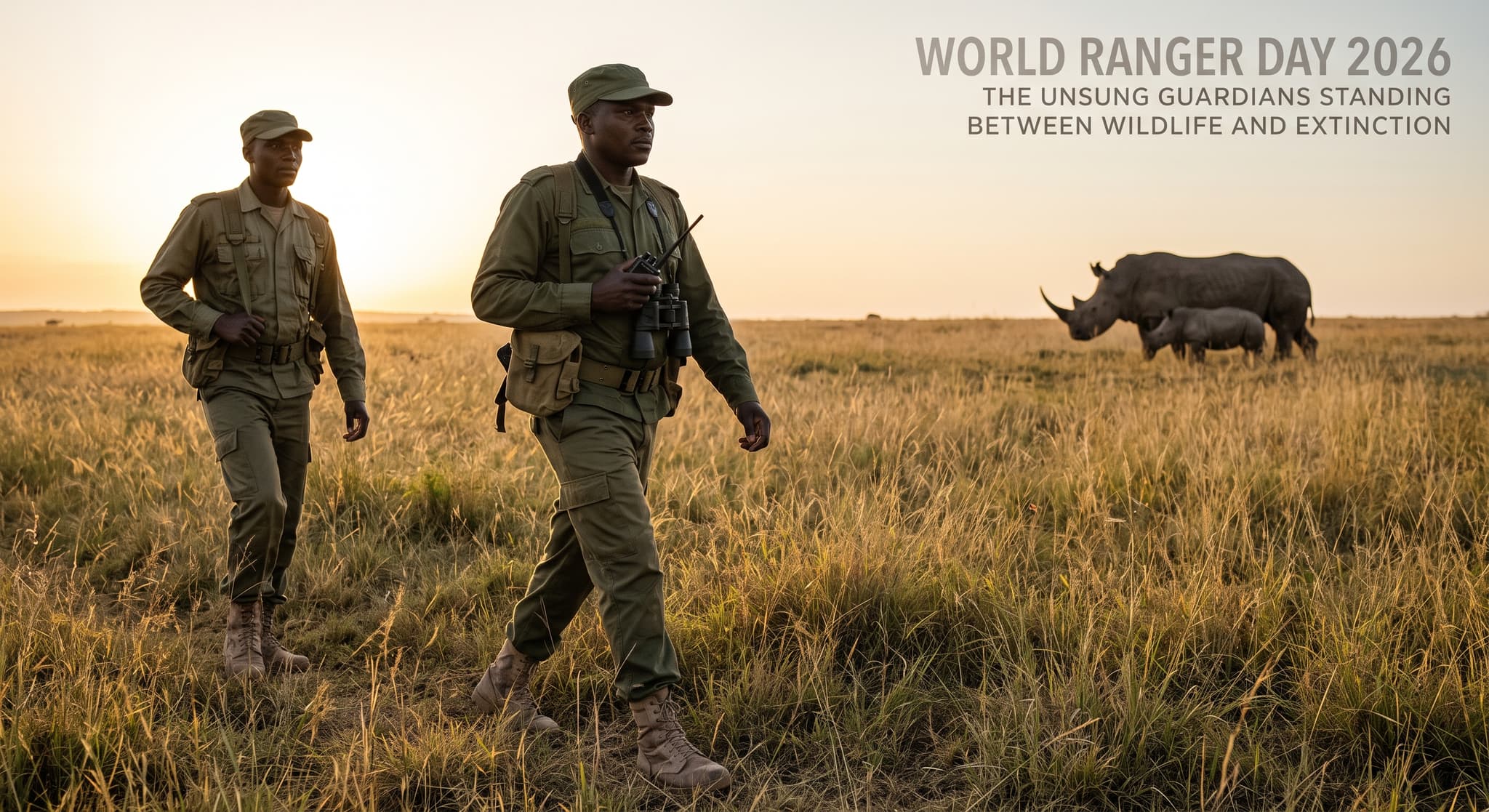
World Ranger Day 2026: The Unsung Guardians Standing Between Wildlife and Extinction
Every game drive you take in Africa is protected by people you'll likely never meet. On 31 July — World Ranger Day — we honour the rangers who risk everything to keep the wild alive, and show Australian travellers exactly how their safari choices can support them.
Picture your best moment on safari. Maybe it was a leopard draped across a fever tree at dusk, or a tower of giraffe moving silently through the golden grass. What you almost certainly didn't see was the ranger who'd been on foot patrol since 3am, removing snares from that exact stretch of bush before you arrived. On 31 July, the world pauses to acknowledge those people — the rangers, trackers, and wildlife guardians who make every unforgettable safari moment quietly possible. This year marks the 20th anniversary of World Ranger Day, and the 2026 theme — Rangers: Guardians of a Changing Planet — feels more urgent than ever. Here's what Australian travellers need to know, and why it matters long after you've landed back in Australia.
What Is World Ranger Day — and Why Does It Exist?
World Ranger Day has been observed on 31 July every year since 2007, a date chosen deliberately: it marks the anniversary of the founding of the International Ranger Federation (IRF) on 31 July 1992. The day has two purposes that sit in tension with each other — celebration and grief.
On one hand, it's a chance to recognise the extraordinary breadth of what rangers actually do: wildlife protection, law enforcement, fire management, environmental education, disease prevention, community engagement, and sustainable resource stewardship. On the other, it's a day of sober remembrance. On World Ranger Day 2025, 175 rangers who had lost their lives in the preceding year across 42 countries were honoured. As recently as March 2026, seven conservation staff — including rangers and a veterinarian — were killed in a rebel attack at Upemba National Park in the Democratic Republic of Congo.
These aren't abstract statistics. They are people who chose to stand between the wild and those who would destroy it, often armed with little more than commitment and a pair of worn-out boots.
The 2026 theme, Rangers: Guardians of a Changing Planet, was developed in collaboration with the Thin Green Line Foundation and the Universal Ranger Support Alliance (URSA). It acknowledges that the job has never been harder — rangers today navigate escalating climate extremes, biodiversity collapse, organised wildlife crime, and shifting political landscapes, all simultaneously.
Rangers by the Numbers
Rangers Worldwide
~286,000
Current estimated number of rangers globally (Appleton et al., 2022). To meet the 30×30 conservation targets, that number needs to reach 1.5 million.
Lives Lost in 2025
175
Rangers honoured on World Ranger Day 2025, killed in the line of duty across 42 countries in the preceding 12 months.
Anniversary in 2026
20 Years
World Ranger Day was first observed in 2007. 31 July 2026 marks two decades of global recognition.
IRF Founded
31 July 1992
The International Ranger Federation was established on this date — the anchor for the annual commemoration.
The Thin Green Line — an Australian Story at the Heart of Global Ranger Welfare
Here's something most Australian safari travellers don't know: one of the most important ranger-support organisations on the planet was founded by an Australian.
The Thin Green Line Foundation was established by Sean Willmore, an award-winning conservationist and former ranger whose documentary — also called The Thin Green Line — brought the reality of ranger sacrifice to audiences worldwide and sparked the foundation's creation. Today, Thin Green Line is the official charity arm of the International Ranger Federation and, crucially, the world's only charity solely dedicated to protecting wildlife and ecosystems by supporting rangers.
What does that support look like in practice? Anti-poaching equipment and training, financial assistance for the widows and orphans of rangers killed in the field, and co-founding the LEAD Ranger training programme — a leadership and skills initiative delivered predominantly by African trainers, in local languages, across the continent.
For Australian readers, there's a practical detail worth knowing: The Thin Green Line Foundation holds Deductible Gift Recipient (DGR) status in Australia, meaning donations of A$2 or more are tax-deductible. If you're looking for a meaningful way to mark World Ranger Day this year — or to offset some of the footprint of your African adventure — a donation to Thin Green Line is one of the most direct ways to put money into the hands of the people guarding the wildlife you travelled to see.
How African Safari Lodges Are Funding the Frontline
Responsible safari tourism has always had a conservation dimension, but the most forward-thinking lodges in East and Southern Africa have moved well beyond token gestures. They've built genuine financial pipelines from guest beds to ranger boots on the ground.
Singita and the Grumeti Fund (Tanzania): When Singita took over management of the Grumeti Reserve in 2003, the land was severely depleted — rampant illegal hunting, unchecked wildfires, and invasive vegetation had taken a heavy toll. The non-profit Grumeti Fund was established to reverse that, and it has — across more than 350,000 acres of the greater Serengeti ecosystem. Funding comes from Singita guest contributions, NGO partnerships, and philanthropists, and goes directly into anti-poaching operations, community development, and wildlife monitoring.
Mara Elephant Project (Kenya): Operating in the Maasai Mara ecosystem — Kenya's most critical wildlife area and an extension of the Serengeti — the Mara Elephant Project focuses on elephant tracking, human-wildlife conflict mitigation, and cross-border conservation in partnership with Grumeti Fund rangers.
The underlying principle in both cases is the same: your choice of lodge is a conservation vote. Choosing a property with a verified, transparent link to an anti-poaching trust means your accommodation budget is doing more than buying you a comfortable bed. It's paying ranger salaries, supplying field equipment, and funding the kind of long-distance patrols that keep keystone species — elephants, rhinos, big cats — alive in the landscape.
What Travellers Often Miss: The Ranger Behind the Guide
On a game drive, your guide is the person you interact with — answering questions, reading tracks, positioning the vehicle for the best sightline. But the ecosystem of knowledge and protection that makes that experience possible runs far deeper.
Many of Africa's most exceptional safari guides and trackers began their careers in community ranger programmes — working snare removal patrols, monitoring wildlife corridors, and managing the delicate boundary between human settlements and wild habitat. That background gives them something no training manual can teach: an intimate, unedited understanding of the bush they work in.
Community rangers also play a role that's easy to underestimate from the outside. Human-wildlife conflict — elephants raiding crops, lions taking livestock — is one of the most complex and politically charged aspects of conservation in Africa today. Community rangers operate at that friction point every day, mediating between the needs of villages and the survival of wildlife. Get it wrong, and local communities lose faith in conservation entirely. Get it right, and you build the kind of ground-level support that no government policy or international NGO can manufacture.
When you ask your guide about their background, you may well be hearing a ranger's story.
Five Ways Australian Travellers Can Support Rangers — Before, During, and After Safari
Supporting rangers doesn't require a huge budget or a charity background. Here are five practical actions that make a genuine difference:
- Donate to the Thin Green Line Foundation. As an Australian DGR-registered charity, your donation of A$2 or more is tax-deductible. Funds go to ranger equipment, training, and support for families of rangers killed in the field. Give here.
- Choose lodges with verified conservation partnerships. Ask your travel consultant specifically which anti-poaching trust or community conservation fund a lodge supports, and how guest fees are allocated. Vague answers are a signal; transparent, specific answers are a green flag.
- Pay your park fees without complaint. Entry fees and concession levies to national parks and protected areas contribute directly to ranger salaries and anti-poaching operations. They are not a bureaucratic inconvenience — they are a direct funding mechanism for wildlife protection.
- Share the story, not just the photographs. On World Ranger Day — 31 July — use the official hashtags #WorldRangerDay #WorldRangerDay2026 #WRD26 #IStandWithRangers to amplify ranger stories on social media. The more visibility rangers have, the stronger the political and financial case for proper resourcing becomes.
- Tip your guide and tracker generously, and ask about their background. Many trackers and guides have ranger histories. Acknowledging that work — and compensating it fairly — sends a signal about the value the safari industry places on the people who carry it.
World Ranger Day — Frequently Asked Questions
When is World Ranger Day 2026?
World Ranger Day is observed on 31 July every year. In 2026, it also marks the 20th anniversary of the day, which was first observed in 2007.
What is the 2026 World Ranger Day theme?
The official 2026 theme is 'Rangers: Guardians of a Changing Planet,' developed by the International Ranger Federation in collaboration with the Thin Green Line Foundation and the Universal Ranger Support Alliance (URSA). It focuses on the increasingly complex challenges rangers face — from climate change and biodiversity loss to organised wildlife crime and human-wildlife conflict.
Who founded World Ranger Day?
World Ranger Day was established by the International Ranger Federation (IRF), founded on 31 July 1992. The Thin Green Line Foundation is the IRF's official charity partner and was co-creator of the 2026 World Ranger Day social media campaign.
Is the Thin Green Line Foundation an Australian charity?
Yes. Founded by Australian conservationist and former ranger Sean Willmore, the Thin Green Line Foundation is registered in Australia (ABN: 22 126 573 779) and holds Deductible Gift Recipient (DGR) status, meaning donations of A$2 or more are tax-deductible for Australian donors.
How do my park fees actually help rangers?
National park entry fees and private concession levies are a direct revenue stream for protected area management, which includes ranger salaries, patrol equipment, and anti-poaching operations. The exact allocation varies by country and park authority, but paying these fees in full — and in the right channels — is one of the most consistent funding mechanisms available to travellers.
Are there enough rangers in Africa to protect wildlife?
Not currently. Global estimates suggest there are approximately 286,000 rangers worldwide. To meet the 30×30 conservation targets — protecting 30% of the planet's land and ocean by 2030 — that number would need to grow to around 1.5 million. Funding, training, and political will are all limiting factors.
What hashtags should I use on World Ranger Day?
The official 2026 hashtags are #WorldRangerDay #WorldRangerDay2026 #WRD26 and #IStandWithRangers.