Inspiration· 11 min read· Explore Africa editorial · Published October 2026 · Updated 30 Oct 2026
Your First African Safari: What to Expect, Where to Go, and Why You Shouldn't Wait Any Longer
An African safari isn't just a holiday — it's a complete recalibration of what travel can be. Here's your honest, practical guide to taking the leap and making your first time in the African bush truly unforgettable.
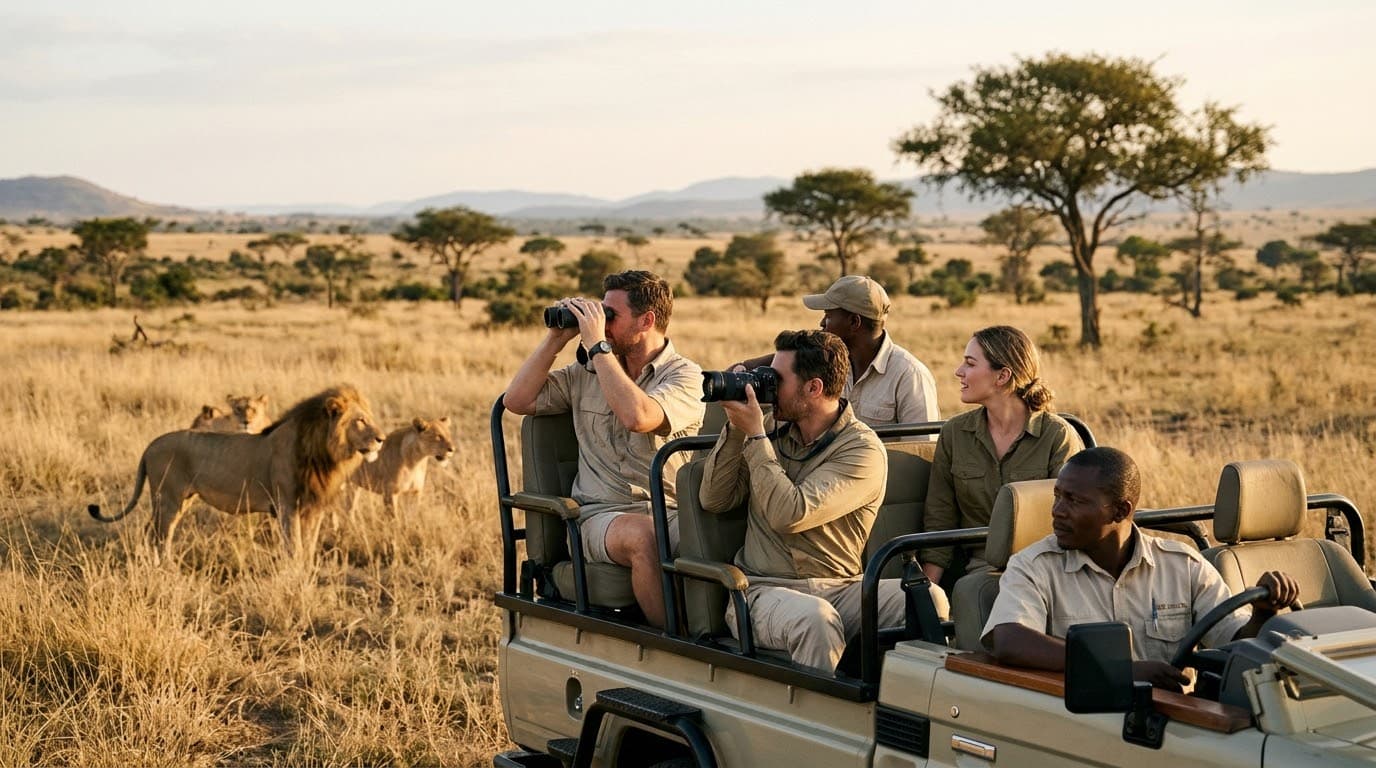
There's a moment — usually somewhere around dawn on your first game drive — when the engine cuts out, the guide raises a hand, and a lion lifts its head from the golden grass twenty metres away. Your breath catches. You forget about the 5am alarm, the long-haul flight, the jet lag. All of it evaporates. That moment is why people come back to Africa again and again — and why almost every first-timer returns home quietly devastated that they didn't go sooner.
An African safari is unlike almost any other journey you'll take. There's no resort pool to default to, no tourist strip to wander down. Instead, you are genuinely, thrillingly in the wild. But planning it doesn't have to be overwhelming. This guide covers everything an Australian traveller needs to know — from where to go and when, to what it costs, what to pack, and what no one thinks to mention until you're already out there.
Why a Safari Belongs on Every Australian's Bucket List
Australians already understand the scale of wild places and the deep satisfaction of sitting still in nature. A safari takes both of those instincts and amplifies them to a level that is genuinely hard to put into words. You are not looking at wildlife through a fence or a zoo enclosure — you are inside the ecosystem, on its terms.
The numbers back up the hype. Africa welcomed over 74 million international visitors in 2024 — a record high surpassing even pre-pandemic levels — and the vast majority of first-timers return home saying it was the best trip of their lives. Most also say they wish they had done it sooner.
For Australians specifically, the timing works beautifully. Our winter months of June through September align almost perfectly with Africa's dry season — the prime period for wildlife viewing — and they overlap with school holidays, making it an ideal window for families and couples alike.
From Australia, getting there is easier than many think: you can fly direct to Johannesburg from Sydney or Perth in 11 to 14 hours, or route from major eastern states through hubs like Doha or Dubai to East and Southern Africa in 20 to 26 hours. A long way, yes — but once you're watching elephants dust-bathe at sunset, you'll barely remember the flight.
Where to Go: The Three Best Destinations for First-Timers
Africa is enormous — 54 countries, wildly diverse ecosystems, and enough outstanding wildlife destinations to fill a lifetime of travel. The key advice for first-timers is simple: choose one region and do it properly. Africa rewards those who slow down, and trying to cover both East Africa and Southern Africa on a single trip means spending too much time in airports and not enough time in the bush.
Kenya is arguably the classic first-safari choice. Kenya would suit a first-time safari goer perfectly — most people begin in the Maasai Mara, where you can tick off the Big Five and, between July and October, witness the Great Migration herds. The infrastructure is strong, guides are exceptional, and the iconic savannah landscapes feel exactly like Africa is supposed to look.
Tanzania is excellent for first-timers who want enormous scenery and a real sense of wilderness sweep. The Serengeti and Ngorongoro Crater combination is especially compelling — the Serengeti received the top rating among Africa's safari parks in a 2025 expert and traveller review analysis, scoring 4.86 out of 5. Tanzania also allows you to end your trip on the beaches of Zanzibar, making it a natural safari-and-sand combination.
South Africa is the most logistically approachable option for Australians and remains one of the most affordable, thanks to a favourable rand-dollar exchange rate. Kruger National Park and the private Sabi Sands reserve offer outstanding Big Five game viewing, world-class lodges, and the kind of safari infrastructure that makes the whole experience seamless for first-timers. It also pairs beautifully with Cape Town and the Winelands for a well-rounded trip.
First Safari Fast Facts
Flight Time from Australia
11–26 hrs
Fly direct from Sydney or Perth to Johannesburg (11–14 hrs), or connect via Doha, Dubai, or Abu Dhabi to East and Southern Africa (20–26 hrs). Many travellers build in a 1–2 night stopover to break the journey.
Best Season for Australians
June – September
Our winter = Africa's dry season. Wildlife congregates at waterholes, vegetation thins out, and sightings are at their most reliable. Conveniently aligns with Australian school holidays.
Mid-Range Safari Cost
USD 250–600/day
Per person, all-inclusive of lodging, meals and game drives. A solid 10-day trip including international flights typically runs AUD 12,000–20,000 per person.
The Big Five
5 iconic species
Lion, leopard, African elephant, rhinoceros and Cape buffalo — the most sought-after wildlife sightings on any African safari, found across Kenya, Tanzania and South Africa.
The Great Migration
Over 2 million animals
he annual movement of around 1.5 million wildebeest, alongside hundreds of thousands of zebra and gazelle across the Serengeti and Maasai Mara, is one of Earth's greatest wildlife spectacles. Best witnessed in Kenya July–October.
A Day on Safari: What to Actually Expect
Forget everything you think you know from wildlife documentaries. A real safari is messier, more unpredictable, and far more rewarding than a sixty-minute edit.
Most African safaris follow a rhythm built around the animals. Expect to wake up early for sunrise wildlife sightings — game drives typically depart before dawn when big cats are still active and the light is extraordinary. You'll ride through the wilderness in a custom 4x4 — typically an open-sided vehicle in Southern Africa or a pop-top Land Cruiser in East Africa — often for three to four hours, then return to camp for breakfast and a rest during the midday heat. A second game drive departs in the late afternoon; while national parks require you to return by sunset, private reserves and conservancies allow you to stay out after dark with a spotlight to catch nocturnal species.
The vehicles themselves are a revelation. Drivers and guides navigate terrain that seems impossible — bumping over barely-there tracks, reading animal signs, and interpreting behaviour with a depth of knowledge that will permanently change how you watch wildlife. The dusty, jolting, exhilarating experience of sitting in an open Land Cruiser with the African bush rushing past is something no screen can replicate.
Back at camp, don't be surprised by how comfortable things are. Many first-timers are genuinely astonished by how luxurious tented camps can feel — you don't have to sacrifice comfort to experience an authentic safari. The best camps and lodges offer pools, exceptional food, and that particular stillness that comes from being somewhere completely away from ordinary life.
What to Pack (and What to Leave at Home)
Packing for safari is one area where first-timers frequently over-think things. The golden rules are straightforward: pack light, pack neutral, and pack layers.
Colours matter. Choose khaki, olive, tan, stone, and other neutral earth tones. They blend into the environment, stay presentable in dusty conditions, and photograph beautifully on game drives. Avoid bright colours, leave camouflage patterns at home (they are illegal for civilians in most African countries), and crucially avoid dark blue and black, which strongly attract biting tsetse flies and aren't deterred by DEET.
Layers are essential. In places like the Maasai Mara or the Okavango Delta, mornings in an open vehicle can be surprisingly cold, especially in the dry season. Start your game drive in a fleece and a windproof jacket, then shed layers as the day warms. By midday, you'll be in a short-sleeve shirt.
For gear, prioritise: a wide-brimmed hat and polarised sunglasses (essential for spotting wildlife at distance), binoculars (a pair in the 8x42 range is ideal), a camera with a spare battery, DEET-based insect repellent, and a refillable water bottle.
What to skip: formal clothes, heavy hiking boots (unless doing gorilla trekking), or multiple pairs of shoes. Light, closed-toe shoes or comfortable trainers are fine for most game-drive and lodge-based itineraries. Most camps offer same-day laundry, so a week's worth of clothing is genuinely enough for a two-week trip.
How Much Does a Safari Really Cost?
Cost is the question that stops more people from booking than anything else. The honest answer: safari prices span an enormous range, and there is genuinely something for every serious budget.
At the budget end, day safaris near cities like Cape Town start from around USD 150 per person. Mid-range safaris — the sweet spot for most first-timers — typically cost USD 250 to 600 per person per night, all-inclusive of accommodation, meals and game drives. At the luxury end, premier private reserves run USD 800 to 1,500 per person per night, with ultra-luxury Sabi Sands or Okavango Delta camps pushing to USD 2,500 and above.
For Australians planning a full trip, a realistic mid-range 10-to-14 day safari including international flights typically runs between AUD 12,000 and 20,000 per person. That's a significant investment — but it's worth noting that most all-inclusive safari rates cover almost everything: accommodation, all meals, game drives, park fees, and often even drinks. Once you're in camp, there's very little left to spend.
One important thing to build into your budget: tips. Tipping is a meaningful part of income for guides, trackers and camp staff across Africa. A general guide is around USD 15 per person per day for your guide, with smaller amounts for camp staff. In East Africa, bring a supply of clean, untorn US dollar bills printed after 2013 (older or damaged notes are routinely rejected), whereas in South Africa, it is best to tip in local South African Rand (ZAR).
First Safari FAQ
Do I need any vaccinations before going on safari?
Yes — and you should book a travel health consultation at least 6–8 weeks before departure. Recommended vaccinations typically include Hepatitis A and B, Tetanus, and Typhoid, while a Yellow Fever vaccination is recommended for parts of East Africa and strictly required if you are crossing borders between African countries (such as combining Kenya and Tanzania). Malaria prophylaxis is strongly advised for most safari regions. Your GP or a travel health clinic can advise based on your specific itinerary.
Is Africa safe to travel to?
The major safari destinations — Kenya, Tanzania, South Africa, Botswana and others — are well-established tourism countries with strong visitor infrastructure. As with any international travel, sensible precautions apply. Staying with reputable operators and following guide instructions (especially around wildlife) keeps risks minimal. Most safaris are conducted entirely within protected reserves and private conservancies with expert staff.
What is the best time of year for an Australian to go on safari?
June to September is the prime window. It coincides with Africa's dry season — when wildlife is most concentrated around waterholes and easiest to spot — and it maps neatly onto Australian winter and school holidays. Although our winter aligns with the dry season across East Africa and Kruger National Park, just pack a warm raincoat if adding Cape Town, which experiences its cool, wet winter during these months.
In East Africa, July to October is also the period to witness the Great Wildebeest Migration in the Maasai Mara, one of the world's most extraordinary wildlife spectacles.
Do I need to be fit for a safari?
For a standard game-drive-based safari, no special level of fitness is required. You'll be spending most of your time in a vehicle. If you want to add walking safaris, gorilla trekking in Rwanda or Uganda, or more adventurous activities, a reasonable baseline fitness will help — but these can be tailored to your level. The early mornings are the biggest adjustment for most travellers.
How long should my first safari be?
A minimum of seven nights in the bush is the generally recommended starting point — enough time to settle into the rhythm, absorb the experience, and give yourself the best chance of outstanding game sightings. Most Australians, accounting for the long travel time, plan 10 to 14 nights on the ground. This also justifies the journey in a way that a five-night trip simply can't.
Is safari appropriate for children?
Many lodges and camps in South Africa and East Africa welcome children, with some offering dedicated family activities and junior ranger programmes. Most reputable lodges have a minimum age of around six to eight years for standard game drives. South Africa and Kenya are generally considered the most family-friendly safari destinations, with well-developed infrastructure and child-appropriate activities alongside the game viewing.