country· 12 min read· Explore Africa editorial · Published August 2026 · Updated 30 Oct 2026
Botswana: the Okavango, Chobe & untamed wilderness
Botswana is Africa's safari connoisseur's choice — the Okavango Delta, Chobe's elephants and the Kalahari, done low-volume and high-quality. Australians visit visa-free for up to 90 days. Here's the practical lowdown: money, health, when to go and how to get around.
Botswana is the safari purist's Africa — a vast, sparsely populated country that has chosen low-volume, high-value tourism over crowds. Its crown jewel is the Okavango Delta, a maze of channels, lagoons and palm islands where you track game by mokoro (dugout canoe) and open 4x4. Add the elephant herds of Chobe, the predators of Moremi, the surreal salt flats of the Makgadikgadi Pans and the silence of the Kalahari, and you have one of the planet's great wildlife destinations. Politically stable and English-speaking, it is easy for Australians to visit — no visa for a holiday. This guide covers the practical things — money, health, safety, when to go and how to get around — so you can focus on the wildlife.
At a glance
- Capital
- Gaborone
- Currency
- Botswana Pula (BWP / P)
- Languages
- English (official) · Setswana · English widely spoken
- Time zone
- CAT (UTC+2) · 8–9 hrs behind Sydney · no daylight saving
- Dialling code
- +267
- Electricity
- 230V / 50Hz · plug types D, G & M
- Driving
- On the left
- Visa (Australians)
- Visa-free up to 90 days (tourism)
Botswana month by month
🌡 Hot · 19–32°C
💧 Heavy afternoon storms (~95mm)
👥 Quieter
Peak of the rains — lush, green and superb for birding and newborn animals, but roads can flood and some camps close. Hot and humid.
🌡 Hot · 19–31°C
💧 Wet (~80mm)
Still wet and green; dramatic skies, excellent photography and migratory birds in the Makgadikgadi and Nxai pans.
🌡 Warm · 18–31°C
💧 Easing (~55mm)
Rains tapering, the bush still thick and green. Good value before the dry-season crowds arrive.
🌡 Mild · 14–31°C
💧 Low (~45mm)
A lovely transition month — drying out, thinning vegetation and warm days, with the Okavango floodwaters beginning their slow arrival.
🌡 Mild · 9–28°C
💧 Dry (~10mm)
Start of prime safari: cool, clear days and reliable game viewing as water sources shrink. One of the best all-round months.
🌡 Cool · 6–25°C
💧 Dry (~4mm)
Cold, crisp dawns on game drives. The Delta flood is filling the channels — ideal for mokoro trips.
🌡 Cool · 6–25°C
💧 Dry (~3mm)
👥 AUS school holidays · peak
Peak dry season — outstanding wildlife and high Delta water. Freezing early mornings; pack warm layers. Busiest and priciest.
🌡 Mild · 9–28°C
💧 Dry (~2mm)
👥 Peak
Excellent game viewing as animals concentrate at water. Warming days, dry and dusty, easy spotting.
🌡 Warm · 13–33°C
💧 Dry (~15mm)
Arguably the best month — huge concentrations of game at shrinking waterholes, especially elephants along the Chobe River.
🌡 Very hot · 18–37°C
💧 First rains building (~40mm)
Spectacular but searingly hot game viewing before the rains break. Wildlife packs around the last water.
🌡 Hot · 19–34°C
💧 First storms (~70mm)
The rains return and the bush greens overnight — zebra begin their migration to the Makgadikgadi, with predators following.
🌡 Hot · 19–32°C
💧 Summer storms (~80mm)
Green, lush and good value, with newborn animals and abundant birdlife. Hot and humid with afternoon downpours.
Top experiences
Okavango Delta
Water-and-land safari
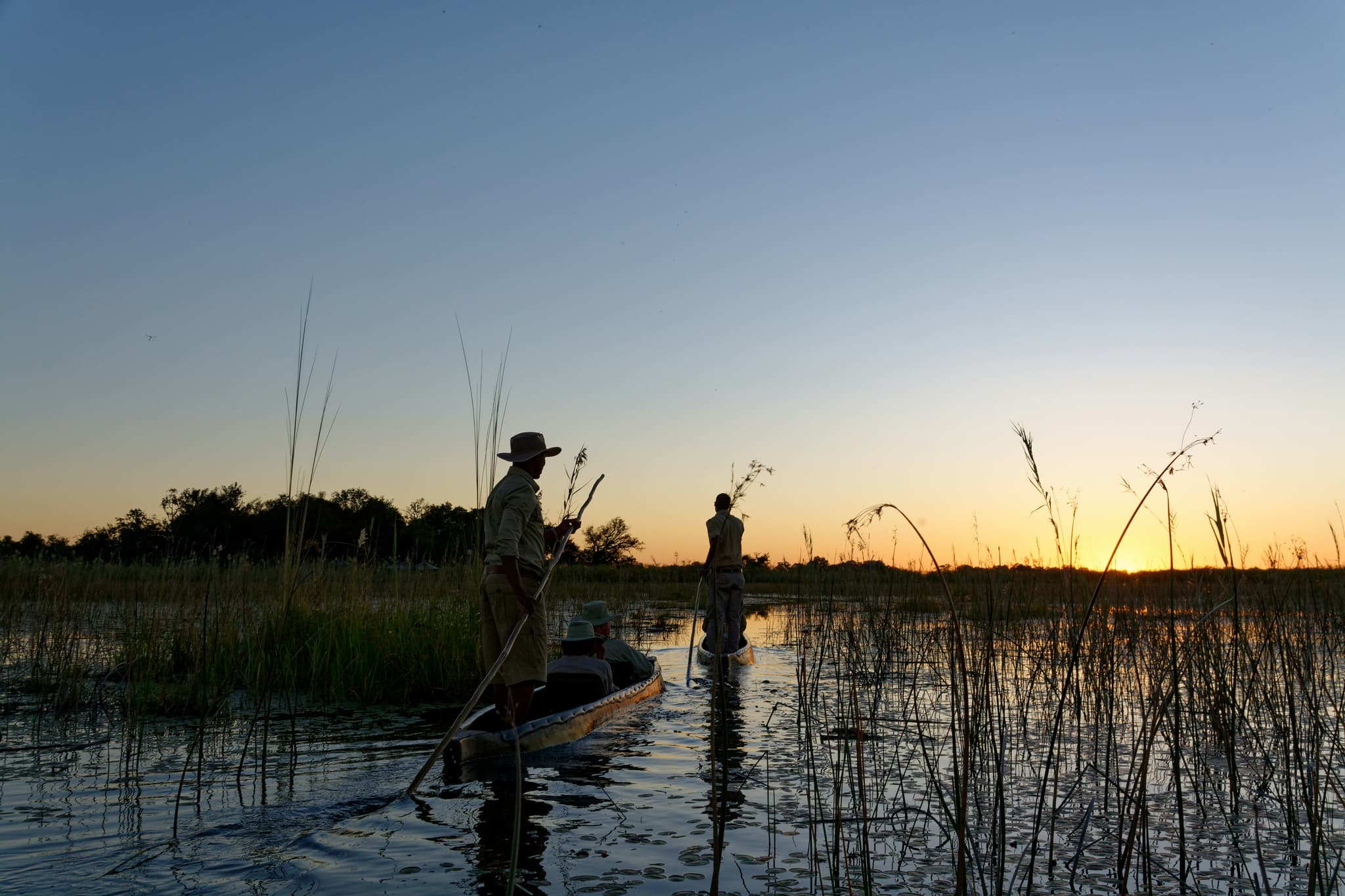
The world's largest inland delta — glide by mokoro through reed channels, drift past hippos and big game, and stay on private islands reached only by light aircraft.
Chobe National Park
Elephant capital
Home to one of Africa's largest elephant populations. Sunset river cruises on the Chobe deliver herds, hippos, crocs and superb birdlife at close range.
Moremi Game Reserve
Big cats & predators
The protected heart of the Delta and one of the richest reserves in Africa — lion, leopard, wild dog and cheetah amid floodplains and forest.
Makgadikgadi & Nxai Pans
Salt flats & migration
Vast, shimmering salt pans, habituated meerkats, ancient baobabs and the seasonal zebra migration — quad bikes and sleep-outs under huge skies.
Central Kalahari
Desert wilderness
One of the world's largest game reserves — black-maned lions, oryx and the green-season explosion of plains game across endless desert horizons.
Linyanti & Savute
Remote & wild
Far-flung concessions famous for big predators, large elephant herds and some of the lowest visitor numbers in the safari world.
Tsodilo Hills
UNESCO rock art
A sacred sandstone outcrop in the northwest with thousands of ancient San rock paintings — the 'Louvre of the Desert'.
Kasane & Victoria Falls
Add-on
Kasane (gateway to Chobe) sits near the four-corners border — Victoria Falls, on the Zambia/Zimbabwe side, is an easy add-on to a Botswana safari.
Getting around
Most safaris start with a flight into Maun (gateway to the Okavango Delta) or Kasane (gateway to Chobe); Gaborone is the capital and business hub. From Australia, you'll typically connect via Johannesburg in South Africa (Airlink and Air Botswana serve Maun, Kasane and Gaborone).
- Light-aircraft transfers are how you reach almost every Delta camp (e.g., Mack Air, Moremi Air). Frameless soft bags (no wheels or rigid bases) — no hard cases — with a strict limit of around 15 -20 kg per person including hand luggage (inclusive of camera gear), and a small maximum bag size (roughly 25 × 30 × 62 cm) set by the Cessna luggage pod. Confirm your camp's exact limit before you pack.
- Self-drive 4x4 is rewarding in the drier reserves (Central Kalahari, the pans, parts of Chobe) for the well-prepared, but the Delta's water camps are fly-in only.
- Driving is on the left, as in Australia; distances are long and roads outside towns can be rough, with livestock and wildlife on them — avoid driving at night.
- Within camps, all game drives, boat cruises and mokoro trips are run by your lodge and its guides.
Money & payments
The currency is the Botswana Pula (BWP, written P), divided into 100 thebe.
- US dollars are widely accepted at safari camps and for tipping, and are useful to carry; bring clean, newer notes.
- Cards — Visa and Mastercard — are accepted at most lodges, hotels and larger shops in towns; some remote camps settle extras and tips by card on departure.
- ATMs are reliable in Maun, Kasane, Gaborone and Francistown but scarce or absent in the wilderness — draw cash before you head into the bush.
- Carry some cash (Pula and/or USD) for tips, curios, park fees and small purchases.
- Tell your bank you'll be travelling so your cards aren't blocked, and notify them of both South Africa and Botswana if you transit Johannesburg.
Health before you go
See your GP or a travel clinic about 6–8 weeks before you leave.
- Malaria — present in the northern safari areas (Okavango, Moremi, Chobe, Linyanti, the Makgadikgadi region and Ngamiland), with highest risk November to May/June. Gaborone, Francistown and the southern/central Kalahari are essentially malaria-free. Take anti-malarial medication if your itinerary includes a risk area and prevent bites with repellent and long sleeves at dusk.
- Yellow fever — does not occur in Botswana, but you must show a vaccination certificate if you arrive from, or have transited for more than 12 hours through an endemic country, a yellow-fever-risk country, (parts of Africa and South America) — relevant on multi-country trips.
- Other vaccines — make sure routine vaccinations are current; many travellers also add hepatitis A and typhoid. Ask your doctor.
- Water — bottled or filtered water is the safe choice in remote areas; camps supply drinking water.
Insurance: medical facilities are limited outside the main towns and remote camps rely on air evacuation, so comprehensive travel insurance that covers medical evacuation is essential.
Staying safe
Botswana is one of Africa's safest and most stable countries, and Smartraveller advises normal safety precautions. Most visits are completely trouble-free.
- In towns — petty theft can occur in Gaborone, Maun and Francistown; keep valuables out of sight and don't walk alone after dark.
- Safari areas — camps and reserves are very safe, but you are in genuine wilderness: always follow your guide's instructions, never walk in camp at night without an escort, and keep a respectful distance from wildlife.
- On the road — avoid driving at night (wildlife and livestock), carry water and fuel on remote routes, and stick to tracks.
Emergencies: 999 (police), 997 (ambulance), 998 (fire). Save your lodge's number and the Australian contacts below.
Language, people & customs
English is the official language and is used for business, government and tourism, so you'll be understood everywhere. Setswana is the national language and most widely spoken day to day; a friendly "Dumela" (hello) is always welcome.
Batswana are known for being warm, polite and reserved — greetings matter, so take a moment before getting down to business. Dress is generally casual; pack neutral colours for safari and modest cover for towns and villages. Tipping is part of the safari experience (see above). Always ask before photographing people, and note that photographing government buildings, military or police sites is best avoided.
Staying connected
- Mobile coverage (4G) is good in and around the towns — Maun, Kasane, Gaborone, Francistown — from operators such as Mascom, Orange and BTC.
- In the wilderness, expect little or no signal; remote camps are deliberately off-grid (a welcome chance to switch off).
- Wi-Fi — many lodges offer it in common areas, though it can be slow or satellite-based; don't count on it for work.
- SIMs & eSIMs — inexpensive prepaid local SIMs are available in town (bring your passport to register), and travel eSIMs covering Botswana are a convenient alternative.
- Power — camps often run on solar with limited charging hours, so a power bank is invaluable.
Starter packing list
Safari
- Neutral, layerable clothing: khaki, olive, beige — avoid bright colours and black/dark blue
- Warm fleece, beanie & gloves: winter dawn drives (May–Aug) are freezing
- Wide-brim hat & sunglasses
- Binoculars
- High-SPF sunscreen & insect repellent: DEET-based for malaria areas
- Soft-sided duffel: required for light-aircraft transfers — ~20 kg incl. hand luggage
Health & documents
- Passport: valid 6+ months beyond arrival, with blank pages
- Travel insurance details: must cover medical evacuation
- Anti-malarials & personal medication
- Yellow-fever certificate: only if arriving via a risk country
- Copies of key documents
Practical
- Universal travel adapter
- Power bank: limited charging in bush camps
- Cash — US dollars and/or Pula: for tips and remote areas
- Reusable water bottle
- Headlamp or torch
Emergency & embassy contacts
Australian High Commission, Pretoria
+27 12 423 6000
Accredited to Botswana from South Africa. 292 Orient Street, Arcadia, Pretoria 0083. consular.pretoria@dfat.gov.au
Australian Honorary Consul, Gaborone
+267 776 00002
Plot 16C1, Mmokolodi, Gaborone — limited consular assistance for Australians in Botswana.
Consular emergencies (after hours)
+61 2 6261 3305
DFAT's 24-hour Consular Emergency Centre in Canberra, for Australians needing urgent help overseas.
Police / Ambulance / Fire
999 / 997 / 998
Local emergency numbers in Botswana. Save your lodge's number too — many camps coordinate their own medical evacuation.
Frequently asked
Do Australians need a visa for Botswana?
No — Australian passport holders can visit for tourism for up to 90 days without a visa. Your passport must be valid for at least six months beyond your arrival date (strictly enforced) with blank pages. Confirm the current rules on Smartraveller before you fly.
When is the best time to go on safari?
The dry season (roughly May–October) is prime: cool, clear days, thinning bush and wildlife gathering at water — with the Okavango flood at its highest around July–September. The green season (November–March) is lush, great for birding and newborns, and better value, but hotter and wetter.
Do I need malaria tablets?
Likely yes, if you're visiting the northern safari areas (Okavango, Chobe, Moremi, Linyanti, the Makgadikgadi region), where malaria is present, highest from November to May/June. Gaborone and the southern Kalahari are essentially malaria-free. See your doctor 6–8 weeks before for advice.
Should I bring US dollars or Pula?
Both are useful. Safari camps widely accept US dollars (and Visa/Mastercard), while Pula is handy in towns. Carry some cash for tips and remote areas, and draw money in Maun, Kasane or Gaborone before heading into the bush.
What are the luggage limits for the Delta?
Strict. Light aircraft to Okavango camps allow only soft-sided bags — no hard cases — usually around 20 kg per person including hand luggage, in a small bag (roughly 25 × 30 × 62 cm). Check your specific camp's limit before packing.
Is Botswana safe for tourists?
Yes — it's one of Africa's safest and most stable countries, and Smartraveller advises normal safety precautions. Take the usual care against petty theft in towns, and always follow your guide's instructions in the wild.
How far behind Sydney is Botswana?
Botswana runs on Central Africa Time (UTC+2) with no daylight saving, so it's 8–9 hours behind Sydney depending on the time of year (8 hours during Australian winter, 9 during daylight-saving summer).
Sources & last verified
Last verified: 29 June 2026. This guide is researched from official and authoritative sources and reviewed by Explore Africa. Visa, health and safety rules can change — always confirm the current advice before you travel.
Key sources:
- Smartraveller (Australian Government): smartraveller.gov.au/destinations/africa/botswana
- Botswana Tourism Organisation: botswanatourism.co.bw
- Australian High Commission, Pretoria (accredited to Botswana): southafrica.embassy.gov.au
- US CDC Travelers' Health: wwwnc.cdc.gov/travel/destinations/traveler/none/Botswana
- NaTHNaC / TravelHealthPro: travelhealthpro.org.uk/country/33/botswana