country· 10 min read· Explore Africa editorial · Published June 2026 · Updated 18 Sept 2026
Madagascar: lemurs, baobabs & the eighth continent
Everything an Australian traveller needs for Madagascar — visas, money, malaria, safety, the climate month by month, tipping and the experiences not to miss. Researched, cited and reviewed.
Madagascar is like nowhere else on Earth — a continent-sized island that split away tens of millions of years ago and evolved in isolation, so roughly nine in ten of its plants and animals live here and nowhere else. This is the land of lemurs, of spiny forests and rainforests, of baobab avenues and the limestone pinnacles of the tsingy, fringed by some of the Indian Ocean's finest beaches. It rewards the curious, patient traveller: distances are long, roads are slow and infrastructure is modest, but the wildlife and landscapes are extraordinary. This guide covers the practical things for Australian travellers — visas, money, health, safety, when to go and how to get around.
At a glance
- Capital
- Antananarivo ("Tana")
- Currency
- Malagasy Ariary (MGA)
- Languages
- Malagasy & French · limited English
- Time zone
- EAT (UTC+3) · 7–8 hrs behind Sydney
- Dialling code
- +261
- Electricity
- 127V / 220V / 50Hz · plugs Type C & E (Madagascar also officially utilises Type D, J, and K power)
- Driving
- On the right
- Visa (Australians)
- Required — visa on arrival / e-visa
Madagascar month by month
🌡 Hot & humid · 26–30°C
💧 Wet · cyclone risk (east)
Peak wet season; heavy rain and cyclone risk on the east coast. Many parks hard to reach, but lush and good for reptiles and frogs.
🌡 Hot & humid · 26–30°C
💧 Wet · cyclone risk
Wettest, stormiest month — travel can be disrupted. Baby lemurs appear in some species.
🌡 Warm · 25–29°C
💧 Easing
Rains tapering; roads still difficult in places but the landscape is at its greenest.
🌡 Mild–warm · 23–28°C
💧 Low
A lovely time as the dry season begins — green scenery, fewer visitors, improving roads.
🌡 Mild · 20–27°C
💧 Dry
Excellent all-round travel: dry, comfortable, active wildlife. One of the best months.
🌡 Cool · 15–25°C
💧 Dry
Cool, dry and clear; cold in the highlands. Great hiking and lemur viewing.
🌡 Cool · 14–24°C
💧 Dry
👥 AUS school holidays
Peak season — dry and cool. Humpback whales arrive off Île Sainte-Marie.
🌡 Cool–mild · 15–26°C
💧 Dry
Prime wildlife and whale-watching; busy. Pack warm layers for highland mornings.
🌡 Mild · 17–28°C
💧 Dry
Arguably the best month — warm days, active lemurs, jacarandas in bloom and whales still offshore.
🌡 Warm · 19–30°C
💧 Very low
Warm and dry with superb wildlife before the rains; great for reptiles and chameleons.
🌡 Hot · 21–31°C
💧 First rains
Hot, with the first rains; baby lemur season for many species. Good value, building humidity.
🌡 Hot & humid · 24–31°C
💧 Rising · storms
Hot and increasingly wet; festive-season demand on the islands.
Top experiences
Andasibe-Mantadia
Rainforest & the indri
The easiest rainforest from Tana — home to the indri, the largest lemur, whose haunting call carries through the canopy. Superb night walks for chameleons and mouse lemurs.
Avenue of the Baobabs
Morondava · sunset
The iconic stand of centuries-old Grandidier's baobabs glowing at sunset — one of Africa's great photographs.
Tsingy de Bemaraha
UNESCO limestone
A surreal forest of razor-sharp limestone pinnacles crossed by walkways and via ferrata — remote, dry-season-only and unforgettable.
Isalo National Park
Canyons & pools
Sandstone massifs, natural swimming pools and palm-lined canyons — Madagascar's best hiking, in the dry south.
Nosy Be & islands
Beaches & diving
The island's beach capital — turquoise water, diving, snorkelling and seasonal whale sharks off the northwest.
Île Sainte-Marie
Whales · Jul–Sep
A laid-back island off the east coast and one of the world's great spots to watch humpback whales breed and calve.
Ranomafana
Cloud forest
Misty montane rainforest rich in lemurs (including the golden bamboo lemur), frogs and birds — a biodiversity hotspot.
Berenty & the spiny forest
Dancing sifakas
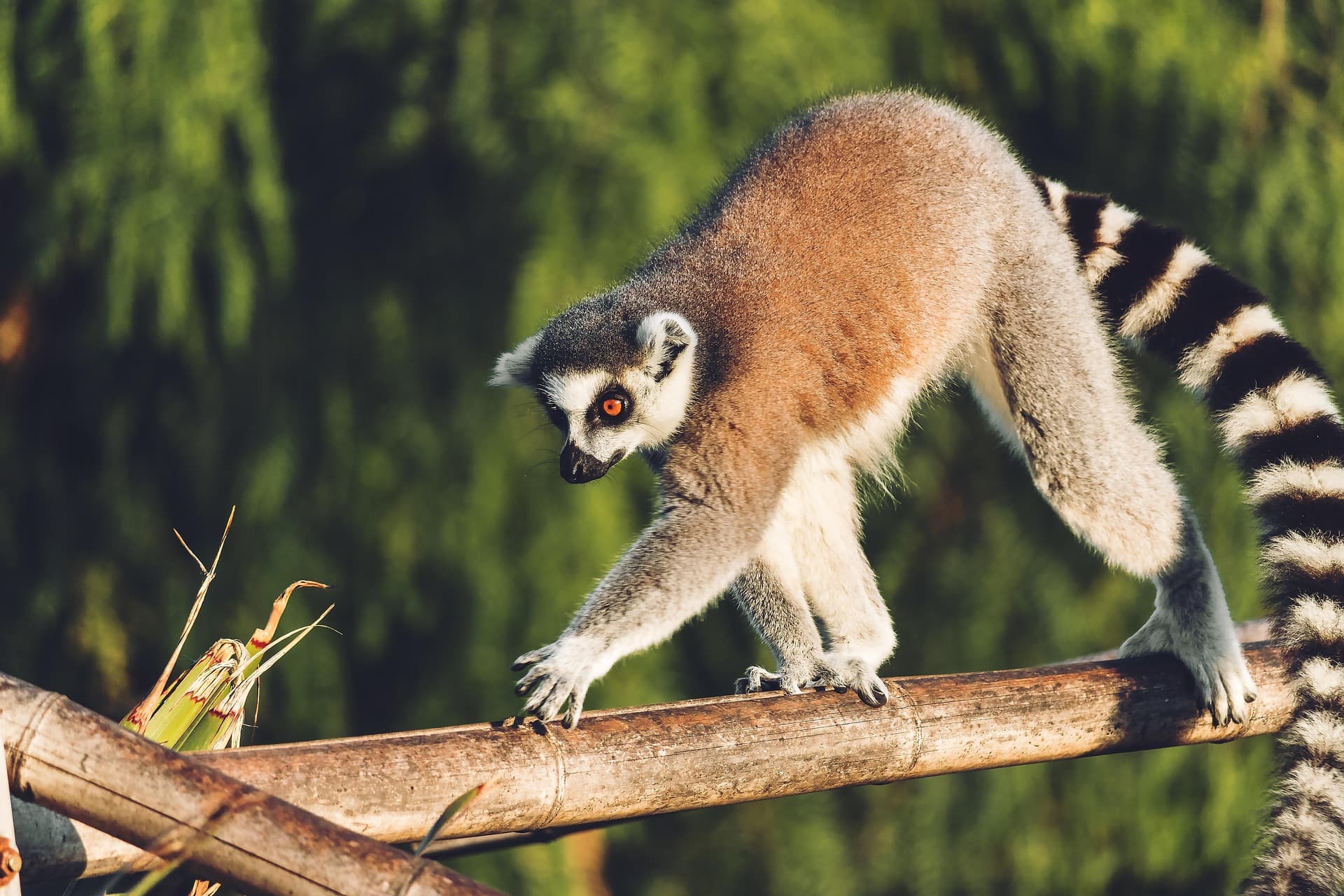
Famous for ring-tailed lemurs and 'dancing' Verreaux's sifakas in the extraordinary spiny forest of the deep south.
Antananarivo
Highland capital
A hilly, characterful capital of cobbled lanes and the Rova palace — most trips begin and end here.
Getting around
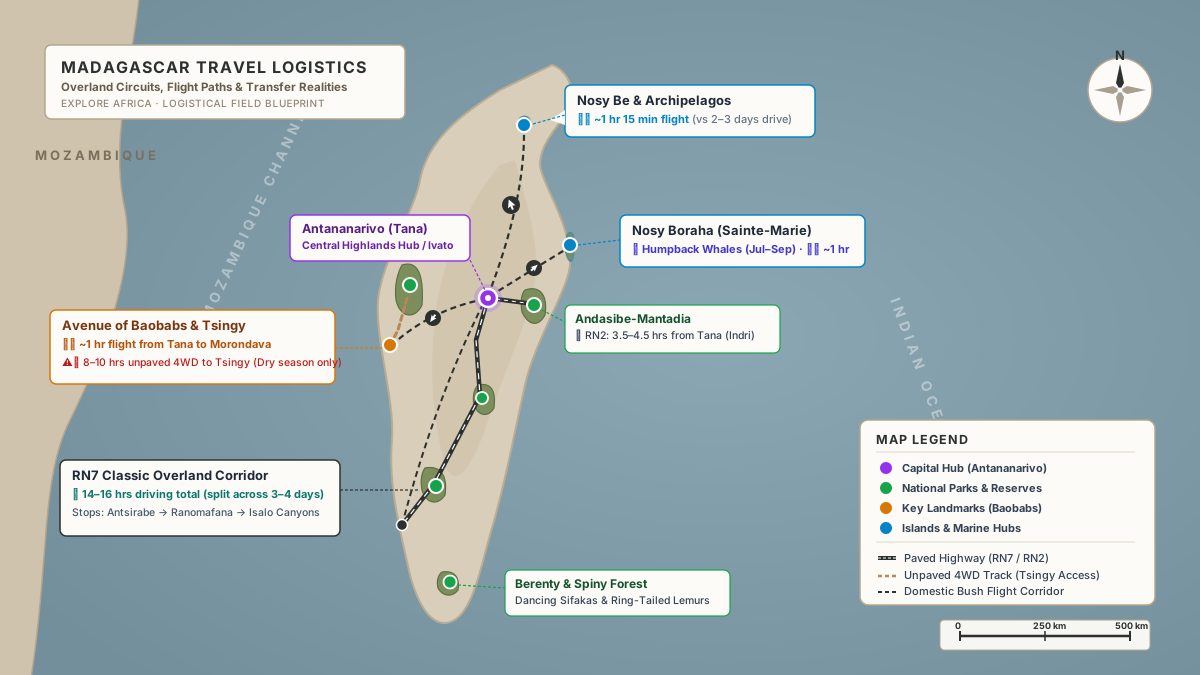
Madagascar is large and travel is slow — distances that look short on a map can take a full day by road.
- Domestic flights (Madagascar Airlines - note that Madagascar Airlines is executing a transition back to its historic identity, Air Madagascar, which will be finalised by 31 October 2026) link Tana with Nosy Be, Diego Suarez, Toliara, Morondava and other hubs, and save days over driving — but schedules change, so build in buffer time and reconfirm.
- Private driver-guide is the usual way to explore overland; self-drive is not recommended given road conditions and signage.
- Roads range from sealed national routes to rough tracks; the wet season (Nov–Mar) makes many parks and the west/Tsingy effectively inaccessible.
- National parks are explored on foot with a compulsory local guide — this supports conservation and local communities, and the guides' eyes are extraordinary.
Money & payments
The currency is the Malagasy Ariary (MGA); it is a closed currency, so bring euros or US dollars to change on arrival.
- Cash is king — carry ariary for guides, tips, park fees, markets and rural areas. Cards are accepted only at larger hotels and some city restaurants.
- ATMs exist in cities and larger towns but can be unreliable and have low withdrawal limits; don't depend on them outside Tana.
- Bring enough cash for the days between towns, in good-condition notes.
- The legal limit you can take out of the country is exactly 400,000 MGA per person. Travellers should travellers visit an airport exchange booth before clear outbound security screening.
Staying safe
Australia's Smartraveller currently advises travellers to exercise a high degree of caution in Madagascar because of civil unrest, crime and natural disasters. Conditions can change, so check the current advice before departure and while travelling.
- Avoid demonstrations and large gatherings, keep valuables out of sight and do not walk alone after dark, especially in Antananarivo.
- Use a reputable driver or lodge transfer, keep doors locked and avoid road travel at night.
- Cyclone season is generally November to April and can disrupt roads, flights and coastal travel.
- In parks and reserves, follow your guide: wildlife, steep terrain and remote conditions need practical care.
- Operators answering emergency lines may not speak English, so keep your lodge, driver and insurer's assistance numbers saved offline.
- Taking pictures of military personnel, police checkpoints, radio towers, government buildings, and airport security infrastructure is illegal and can result in immediate camera confiscation, fines, or detention.
Language, people & customs
Malagasy is the main language and French is widely used in administration, business and tourism; English is less common outside larger hotels and established tourism operators. A few Malagasy greetings are warmly received.
Customs vary between communities. Respect local fady (taboos) and follow a local guide's advice around sacred places, tombs and villages. Ask before photographing people, dress modestly at spiritual sites and avoid loud or confrontational behaviour. Madagascar's tourism board also asks visitors not to buy products made from protected plants or animals.
Staying connected
Madagascar's international dialling code is +261. Mobile data and Wi-Fi are generally available in Antananarivo, larger towns and many hotels, but coverage becomes patchy on remote roads, islands and in national parks.
- Ask your accommodation whether Wi-Fi reaches rooms or only reception and common areas.
- Download maps, tickets, insurance details and key contacts before long overland sections.
- Carry a charged power bank; outages and long driving days are common.
- If buying a local SIM, use an authorised outlet and bring your passport for registration. Check roaming or eSIM coverage before relying on it outside the main centres.
Emergency & embassy contacts
Police in cities
17 or 117 (mobile)
From a landline: 020 22 220 17. Response and English-language support may be limited.
Gendarmerie outside cities
19 or 119 (mobile)
From a landline: 020 22 223 02.
Fire / medical emergency
18 or 118 / 124
For medical help, a direct hospital or your insurer may be faster. Save your lodge and driver contacts too.
Australian High Commission
+230 202 0160
Madagascar is covered by the Australian High Commission in Port Louis, Mauritius. Email consular.portlouis@dfat.gov.au. For a 24-hour consular emergency call +61 2 6261 3305 (or 1300 555 135 within Australia).
Starter packing list
Documents & money
- Passport and current visa confirmation: plus paper and offline copies
- Comprehensive travel insurance: including medical evacuation and disruption
- Ariary and backup cash: cards and ATMs are unreliable away from cities
Health
- Prescribed antimalarials and personal medicines
- Insect repellent and long evening layers
- High-SPF sunscreen and a refillable bottle: drink bottled or treated water
Climate & parks
- Lightweight rain layer: essential in the wet season and rainforest
- Warm layer for the highlands: mornings and winter nights can be cold
- Sturdy closed walking shoes
- Binoculars, head torch and dry bag
- Soft-sided luggage: confirm limits for domestic flights
Frequently asked
Do Australian travellers need a visa for Madagascar?
Yes. Tourist visa options include visa on arrival and the official e-visa system. Validity, fees and supporting-document rules change, so confirm the current requirements on Smartraveller and Madagascar's official immigration site before paying or flying.
When is the best time to visit?
April to October is generally the easiest period for overland travel and wildlife, with cooler, drier conditions. The official cyclone season runs from November to April, and some western routes or parks become difficult or inaccessible. The east, highlands, west and islands have different microclimates, so check the exact route.
Is Madagascar safe to visit?
Many organised trips run smoothly, but Smartraveller advises a high degree of caution. Use reputable transfers, avoid demonstrations and walking after dark, keep valuables discreet and monitor cyclone or unrest updates.
Do I need malaria tablets?
Malaria is a risk. Speak with a travel doctor well before departure about antimalarials, vaccinations and mosquito-bite prevention for your route and health history.
Can I drink the tap water?
No. Madagascar's tourism board advises against drinking tap water. Use sealed bottled or properly treated water and take care with ice and raw foods.
Why does travelling between places take so long?
Road conditions, weather, ferries and changing domestic schedules make journey times unpredictable. Use a local driver-guide, avoid tight same-day connections and keep at least one buffer night before an international flight.
Sources & last verified
Last verified: 27 August 2026. Visa, health, safety and weather information changes — confirm current advice before travelling.
Primary sources:
- Australian Government Smartraveller — smartraveller.gov.au
- Australian High Commission, Mauritius — mauritius.highcommission.gov.au
- Madagascar National Tourism Board: practical advice — madagascar-tourisme.com
- Madagascar National Tourism Board: good to know — madagascar-tourisme.com
- Madagascar National Tourism Board: before you go — madagascar-tourisme.com