country· 14 min read· Explore Africa editorial · Published June 2026 · Updated 30 Oct 2026
Namibia: dunes, deserts & wide-open silence
Everything Australian travellers need for Namibia — the 2025 visa change, money, malaria areas, when to go, self-drive on the left and the desert highlights from Sossusvlei to Etosha.
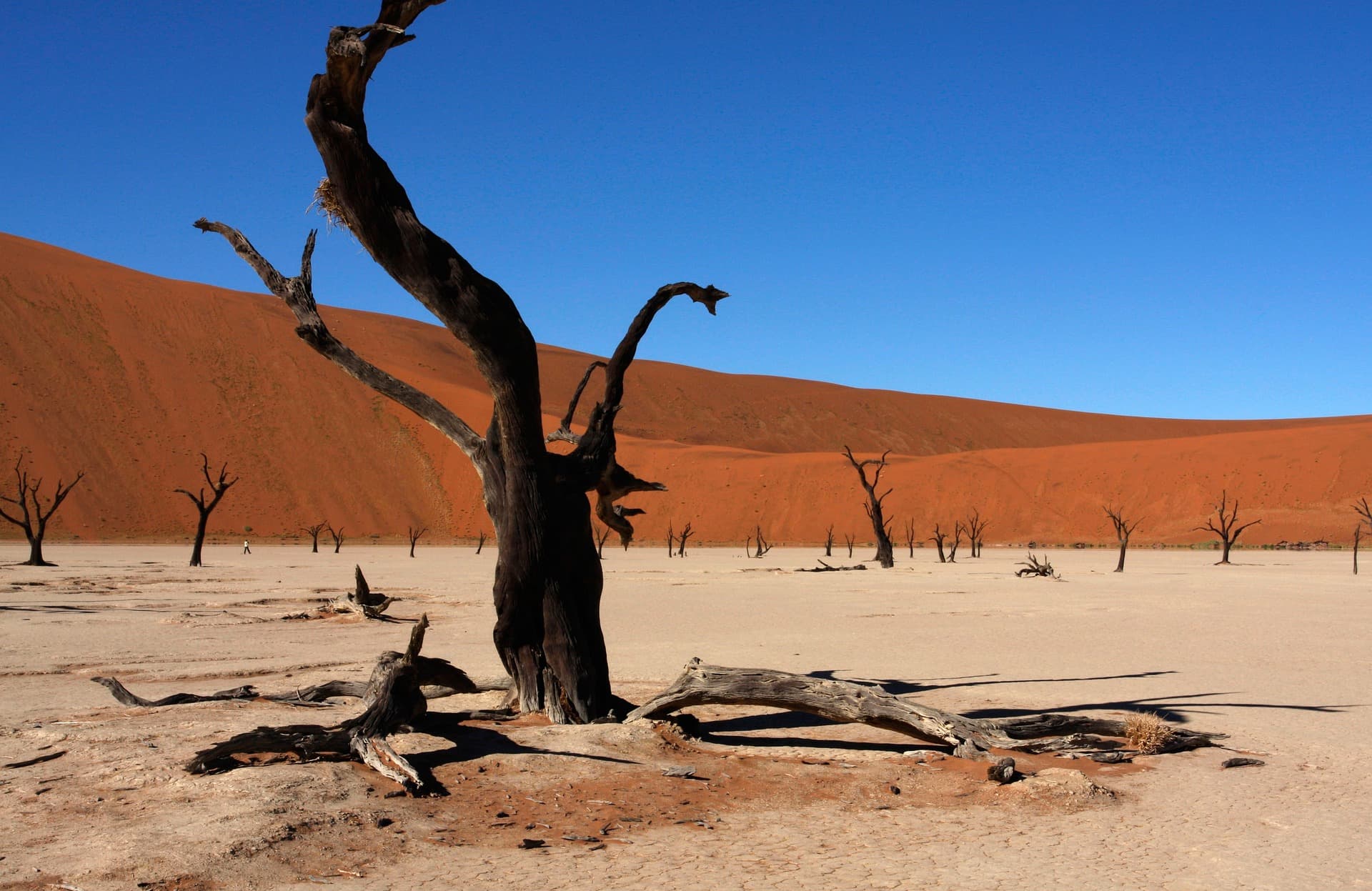
Namibia is Africa at its most cinematic — vast, empty and astonishingly beautiful. This is the land of the world's oldest desert, where apricot dunes at Sossusvlei meet a foggy, shipwreck-strewn coast, where elephants and rhino gather at Etosha's floodlit waterholes, and where the night sky is among the darkest on earth. It is also one of the easiest and safest places in Africa to explore under your own steam: roads are quiet, English is the official language and the infrastructure is excellent. The one big change to know about is the visa — since April 2025 Australians need one to enter. This guide covers the practical things — visas, money, health, safety, when to go and how to get around — so you can focus on the landscapes.
At a glance
- Capital
- Windhoek
- Currency
- Namibian Dollar (NAD / N$) · SA Rand also accepted
- Languages
- English (official) · Afrikaans & German widely spoken
- Time zone
- CAT (UTC+2) · 8–9 hrs behind Sydney
- Dialling code
- +264
- Electricity
- 220V / 50Hz · plug Type D & M
- Driving
- On the left
- Visa (Australians)
- Required since 1 Apr 2025 — visa on arrival / e-visa
Namibia month by month
🌡 Hot · 30–35°C
💧 Afternoon storms inland
Peak summer heat, with short, dramatic afternoon showers in the interior. Lush, dust-free skies and newborn plains game; the coast (Swakopmund) stays cool and breezy.
🌡 Hot · 30–35°C
💧 Wettest month inland
The greenest, wettest time inland — superb birding and dramatic light, though some gravel roads can wash out. Desert days are very hot.
🌡 Warm · 28–33°C
💧 Easing
Rains tapering off; landscapes still green and photogenic. A quiet, good-value time to travel.
🌡 Mild–warm · 25–30°C
💧 Low
A lovely all-rounder — warm days, cooler nights, thinning crowds and the start of the dry season. Excellent for photography.
🌡 Mild days, cool nights · 23–28°C
💧 Dry
Clear skies, comfortable days and cold desert nights. Game begins to concentrate at Etosha's waterholes.
🌡 Cool · 20–25°C day, near 0°C night
💧 Dry
Crisp winter. Desert mornings can drop to freezing — pack warm layers for dawn game drives and balloon flights.
🌡 Cool · 20–24°C day, cold nights
💧 Dry
👥 AUS school holidays
Prime safari weather, dry and clear. Cold nights; busy with international visitors, so book ahead.
🌡 Cool–mild · 22–27°C
💧 Dry · windy
Excellent game viewing as water dwindles. Often windy, especially on the coast and in the dune fields.
🌡 Warming · 25–30°C
💧 Dry
Arguably the sweet spot — warm days, comfortable nights and outstanding wildlife at Etosha's waterholes.
🌡 Hot · 30–35°C
💧 Dry, building heat
Peak game viewing before the rains — animals crowd the waterholes — but increasingly hot, especially in the north and the desert.
🌡 Hot · 30–34°C
💧 First rains possible
Building heat with the first scattered showers. Newborn animals appear and migratory birds arrive; fewer crowds.
🌡 Hot · 30–35°C
💧 Summer storms inland
Hot, green and atmospheric with afternoon thunderstorms inland. Festive-season demand at coastal towns and popular lodges.
Top experiences
Sossusvlei & Deadvlei
Namib-Naukluft
The iconic apricot dunes of the Namib — some of the tallest on earth — and the ghostly camel-thorn skeletons of Deadvlei. Climb Big Daddy at sunrise; it's Namibia's signature image.
Etosha National Park
Big game safari
Elephant, lion, rhino, giraffe and springbok gather at floodlit waterholes around a vast white salt pan — superb, reliable game viewing, ideal for self-drive.
Swakopmund
Coastal town
A quirky German-colonial seaside town between dune and ocean — the adventure capital for quad-biking, sandboarding, scenic flights and fresh seafood.
Damaraland
Desert wilderness
Dramatic red rock, ancient Twyfelfontein rock engravings (a World Heritage site) and the chance to track desert-adapted elephant and black rhino.
Fish River Canyon
Far south
One of the largest canyons in the world — a colossal 160 km gorge, with epic viewpoints and a famous multi-day hiking trail (winter only).
Skeleton Coast
Wild Atlantic shore
Fog-bound, shipwreck-littered desert coast where dunes meet a cold, churning sea — remote, haunting and best reached by fly-in safari.
Cape Cross Seal Reserve
Wildlife
One of the largest Cape fur seal colonies on the planet — tens of thousands of seals on a wild stretch of coast north of Swakopmund.
Kolmanskop ghost town
Near Lüderitz
A former diamond-rush town slowly being reclaimed by the desert — sand-filled rooms make for unforgettable photography (permit required).
Sesriem & balloon flights
Sunrise over the dunes
Drift over the Namib at dawn in a hot-air balloon, or explore the narrow Sesriem Canyon — gateway to the great dunes.
NamibRand & dark skies
Stargazing
A private reserve and International Dark Sky Reserve where the Milky Way blazes overhead — among the clearest night skies anywhere.
Getting around
International flights arrive at Hosea Kutako International Airport (Windhoek), usually via Johannesburg, Cape Town or Doha. There's also an airport at Walvis Bay on the coast.
- Self-drive is the classic way to see Namibia and hugely popular — quiet roads, big skies and total freedom. Driving is on the left. A 4x4 is recommended for many routes.
- Gravel roads make up most of the network. Keep speeds down (around 80 km/h or less), slow right down for corrugations and soft sand, and watch for animals.
-Tyre Deflation on Gravel: Clarify that for gravel roads (which make up ~80% of routes), drivers must deflate tyres down to 1.8–2.0 bar (26–29 psi). Driving on high highway pressure on corrugated gravel causes loss of traction, extreme vibration, vehicle rollovers, and sharp rock punctures. Dual Spare Tyres: Recommend carrying two spare tyres (or a tyre plug/repair kit and 12V air compressor) when venturing into remote regions like Damaraland, Kaokoveld, or the Skeleton Coast.
- Distances are vast and services sparse — fuel up at every town, carry plenty of water and a spare tyre, and plan realistic daily drives.
- Never drive at night in rural areas — wildlife, livestock and pedestrians make it genuinely dangerous after dark.
- Fly-in safaris with light aircraft link the remote lodges (Skeleton Coast, NamibRand, Damaraland) and save days of driving — expect strict soft-bag luggage limits (around 15–20 kg).
- Guided tours and transfers are a relaxed alternative if you'd rather not drive the long gravel stretches yourself.
Money & payments
The currency is the Namibian Dollar (NAD, written N$).
- It's pegged 1:1 to the South African Rand, and Rand is accepted everywhere in Namibia — handy if you're combining the two countries. Note the reverse isn't true: Namibian Dollars aren't accepted in South Africa, so spend or change any N$ before you leave.
- Cards (Visa and Mastercard) are widely accepted in towns, lodges, restaurants and supermarkets.
- ATMs are reliable in Windhoek, Swakopmund and larger towns, but scarce in remote areas — withdraw cash before heading into the desert or the far north.
- Carry cash for tips, craft markets, park entry, small towns and fuel — many fuel stations are cash only, which catches self-drivers out.
- Tell your bank you'll be travelling so your cards aren't blocked, and keep some Rand or N$ on hand at all times.
Health before you go
See your GP or a travel clinic about 6–8 weeks before you leave.
- Malaria — present in the northern regions: highest risk year-round in the Zambezi (Caprivi), Kavango East and Kavango West regions, and seasonally (roughly November–April/June) in the north including Etosha, Kunene, Omusati, Oshana, Ohangwena, Oshikoto and Otjozondjupa. Central and southern Namibia — Windhoek, Sossusvlei, Swakopmund, the desert and the south — are essentially malaria-free. Ask your doctor about anti-malarials for the relevant areas and prevent bites with repellent, long sleeves and covered ankles at dusk.
- Yellow fever — there is no risk in Namibia, but you must show a vaccination certificate if you arrive from, or have transited (over 12 hours), a country with yellow-fever risk — relevant on multi-country African trips.
- Routine & other vaccines — make sure routine vaccinations are current; many travellers also add hepatitis A and typhoid. Ask your doctor.
- Water — tap water is generally safe in cities and towns; in remote areas use bottled or filtered water.
Insurance: medical facilities are limited outside Windhoek and distances are huge, so comprehensive travel insurance that covers medical evacuation is essential.
Staying safe
Namibia is one of Africa's safer destinations, and Smartraveller advises travellers to exercise normal safety precautions. Most visits are trouble-free.
- In Windhoek and other towns, petty crime (bag-snatching, theft from cars) happens — keep valuables out of sight, don't walk alone after dark and use taxis or lifts arranged by your hotel at night.
- The biggest real risk is the road. Gravel roads, long distances and wildlife mean accidents are the leading hazard — drive slowly, never at night, take regular breaks and don't over-plan your daily distances.
- Desert self-reliance — carry extra water, fuel and a spare tyre, tell someone your route, and don't rely on phone coverage in remote areas.
- Wildlife — keep your distance and stay in your vehicle in national parks.
Emergencies: dial 112 from a mobile, or police 10111. Save your lodge's and car-hire company's numbers, and the Australian contacts below.
Language, people & customs
English is the official language and is used for signage, business and tourism, so you'll get by easily. Afrikaans and German are widely spoken (a legacy of Namibia's history), along with indigenous languages such as Oshiwambo, Otjiherero, Damara/Nama and others.
Namibians are warm, polite and fairly reserved; an unhurried, friendly greeting is appreciated. Dress is casual and practical — neutral colours on safari, modest cover at rural or religious sites, and warm layers for cold desert nights. Always ask before photographing people, particularly in traditional communities such as the Himba, where a respectful arrangement (often through your guide) is the norm.
Staying connected
- Mobile coverage (4G) is good in Windhoek, Swakopmund and the main towns, but drops away across the desert and remote routes — expect long stretches with no signal.
- Wi-Fi is available at most lodges and hotels, though it can be slow or satellite-based in remote areas (a fine excuse to switch off).
- SIMs & eSIMs — a prepaid local SIM (MTC is the main network) is inexpensive and useful for self-drivers; bring your passport to register it. Travel eSIMs are a convenient alternative.
- Download offline maps and your route before you set out — don't rely on live navigation once you leave the towns.
Emergency & embassy contacts
Australian High Commission, Pretoria
+27 12 423 6000
Australia's diplomatic representation for Namibia is via the High Commission in Pretoria, South Africa, assisted by an Honorary Consul in Windhoek.
Australian Consulate (Honorary), Windhoek
+264 61 300 194 / +264 81 283 4629
Honorary Consul in Windhoek — limited consular assistance; full services are provided by the High Commission in Pretoria.
Address: 56 Chalcedoon Street, Windhoek
Email:
australian.consulate.namibia@gmail.com
Consular emergencies (after hours)
+61 2 6261 3305
DFAT's 24-hour Consular Emergency Centre in Canberra, for Australians needing urgent help overseas.
Local emergencies
112 (mobile) / 10111 (police)
Dial 112 from any mobile, or police 10111. Save your lodge and car-hire numbers too.
Starter packing list
Safari & desert
- Neutral, layerable clothing: khaki, olive, beige for game viewing
- Warm fleece, beanie & gloves: desert nights can hit freezing in winter
- Wide-brim hat & sunglasses
- High-SPF sunscreen & lip balm: intense desert sun and dry air
- Insect repellent: DEET-based for the malaria north
- Binoculars & a good camera
- Lightweight scarf or buff: for dust on gravel roads
Self-drive
- International Driving Permit: carry with your licence
- Offline maps downloaded
- Reusable water bottles: carry more water than you think
- Snacks & cash for fuel: many stations are cash only
Health & documents
- Passport: valid 6+ months, 3 blank pages
- Visa (e-visa printout or funds for visa on arrival)
- Travel insurance details: must cover medical evacuation
- Anti-malarials & personal medication: if visiting the north
- Yellow-fever certificate: only if arriving via a risk country
- Copies of key documents
Practical
- Universal / Type D & M adapter
- Power bank & charging cables
- Some cash in N$ or Rand: for tips, fuel and markets
- Head torch: for camps and stargazing
Frequently asked
Do Australians need a visa for Namibia?
Yes — this changed in 2025. Since 1 April 2025 Australian passport holders need a visa. You can apply online beforehand via Namibia's e-services portal (eservices.mhaiss.gov.na) or get a visa on arrival at major entry points like Windhoek airport, for a fee of around N$1,600 (about US$90). Applying online saves time. Always confirm the current rules on Smartraveller before you fly.
When is the best time to visit Namibia?
The dry winter (roughly May–October) is prime for wildlife — animals gather at Etosha's waterholes and skies are clear, though nights are cold. April and November are pleasant shoulder months. The green summer (December–March) brings dramatic light, newborn animals and birdlife, with hot days and occasional afternoon storms inland.
Do I need malaria tablets?
Only for the northern areas — the Zambezi (Caprivi) and Kavango regions year-round, and Etosha and the north during the wet season (roughly November–April). Central and southern Namibia, including Sossusvlei, Swakopmund and Windhoek, are essentially malaria-free. See your doctor 6–8 weeks before for advice.
Is Namibia safe?
Yes — it's one of Africa's safer countries, and Smartraveller advises normal safety precautions. Take care with petty theft in Windhoek and don't walk alone after dark. The biggest real risk is the road: drive slowly on gravel, never at night, and plan realistic distances.
Can I self-drive in Namibia?
Absolutely — it's the classic way to travel and very popular. Driving is on the left, a 4x4 is recommended, and most roads are gravel. Keep speeds down, carry water and a spare tyre, fuel up at every town (often cash only) and never drive after dark. Fly-in safaris are a good alternative for the most remote lodges.
What money should I bring?
The Namibian Dollar (N$), which is pegged 1:1 to the South African Rand — and Rand is accepted everywhere in Namibia. Cards work in towns and lodges, but carry cash for tips, markets and fuel, and withdraw before heading into remote areas where ATMs are scarce.
Can I drink the tap water?
Tap water is generally safe in cities and towns. In remote areas, stick to bottled or filtered water — your lodge will advise.
Sources & last verified
Last verified: 29 June 2026. This guide is researched from official and authoritative sources and reviewed by Explore Africa. Visa, health and safety rules can change — always confirm the current advice before you travel.
Key sources:
- Smartraveller (Australian Government): smartraveller.gov.au/destinations/africa/namibia
- Australian Government DFAT — Namibia country brief: dfat.gov.au/geo/namibia
- Australian High Commission, Pretoria: southafrica.embassy.gov.au
- Embassy of the Republic of Namibia — new visa requirements (1 April 2025): namibiaembassyusa.org
- Visit Namibia (official tourism): visitnamibia.com.na
- US CDC Travelers' Health / Yellow Book — Namibia: wwwnc.cdc.gov/travel
- Bank of Namibia: bon.com.na