country· 14 min read· Explore Africa editorial · Published June 2026 · Updated 30 Oct 2026
Tanzania: the Serengeti, Kilimanjaro & Zanzibar
Everything Australians need to plan a Tanzania safari and Zanzibar escape — visas, the Great Migration calendar, malaria and health, money, tipping and safety, verified against official sources.
Tanzania is East Africa at its most cinematic — and for many Australians it is the safari of a lifetime. This is the home of the Serengeti and the Great Migration, the wildlife-packed caldera of the Ngorongoro Crater, the baobab country of Tarangire, and snow-capped Mount Kilimanjaro, the highest peak in Africa. When the dust settles, the spice island of Zanzibar waits offshore with white sand and turquoise water. English is widely spoken alongside Swahili, the wildlife is staggering, and a well-planned trip is smooth and rewarding. Australians do need a visa (an easy online e-visa), and there are a few entry and health rules to get right. This guide covers the practical things — visas, money, health, when to go and how to get around — so the only hard choice left is plains or palms.
At a glance
- Capital
- Dodoma (Dar es Salaam is the largest city)
- Currency
- Tanzanian Shilling (TZS / TSh) · USD widely used in tourism
- Languages
- Swahili (Kiswahili) · English widely spoken
- Time zone
- EAT (UTC+3) · 7–8 hrs behind Sydney
- Dialling code
- +255
- Electricity
- 230V / 50Hz · plug Type G (also Type D)
- Driving
- On the left
- Visa (Australians)
- Required — e-visa ~US$50 (single entry, 90 days)
Tanzania month by month
🌡 Hot · 28–31°C
💧 Dry spell (north)
👥 Festive peak
A short dry window between the rains. The Migration herds are calving on the southern Serengeti and Ndutu plains — lush, green and full of newborns and predators.
🌡 Hot · 28–31°C
💧 Mostly dry (north)
Peak calving in the south — around half a million wildebeest calves are born in a few weeks. Superb predator action; warm, green plains.
🌡 Hot · 28–31°C
💧 Long rains begin (late)
The long rains usually arrive late in the month — humid, with afternoon storms. Greener, quieter and lower-priced, though some bush camps begin to close.
🌡 Warm · 26–29°C
💧 Long rains (wettest)
The wettest month. Heavy showers most days (rarely all day), lush scenery and few visitors. Many remote camps close; roads can be tricky.
🌡 Warm · 25–28°C
💧 Long rains easing
Rains taper through the month. Green, dramatic and good value as the dry season approaches.
🌡 Mild–warm · 24–27°C
💧 Dry
The dry season opens — clear skies, thinning bush, excellent game viewing. The Migration is grouping in the western Serengeti for the Grumeti River crossings.
🌡 Mild–warm · 24–27°C
💧 Dry
👥 AUS school holidays
Prime safari weather. The first Mara River crossings can begin in the north. Cool mornings on game drives — pack layers.
🌡 Mild–warm · 25–28°C
💧 Dry
👥 Peak season
Peak dry season and peak Migration drama — dramatic Mara River crossings in the northern Serengeti. Book well ahead.
🌡 Warm · 26–29°C
💧 Dry
👥 Peak season
Arguably the best all-round month — superb wildlife, big herds in the north and reliable river crossings. Warm, dry and clear.
🌡 Hot · 28–31°C
💧 Dry, building late
Excellent late-dry-season viewing before the rains; the herds begin drifting back south. Hot and dusty; humidity builds.
🌡 Hot · 28–31°C
💧 Short rains
The short rains green the plains — brief afternoon showers, great birding and newborns, fewer crowds. The herds return to the southern Serengeti.
🌡 Hot · 28–31°C
💧 Short rains easing
👥 Festive peak
Light, sporadic rain; warm and green. The Migration settles back on the southern short-grass plains. Festive-season demand on the coast and Zanzibar.
Top experiences
Serengeti & the Great Migration
Iconic safari
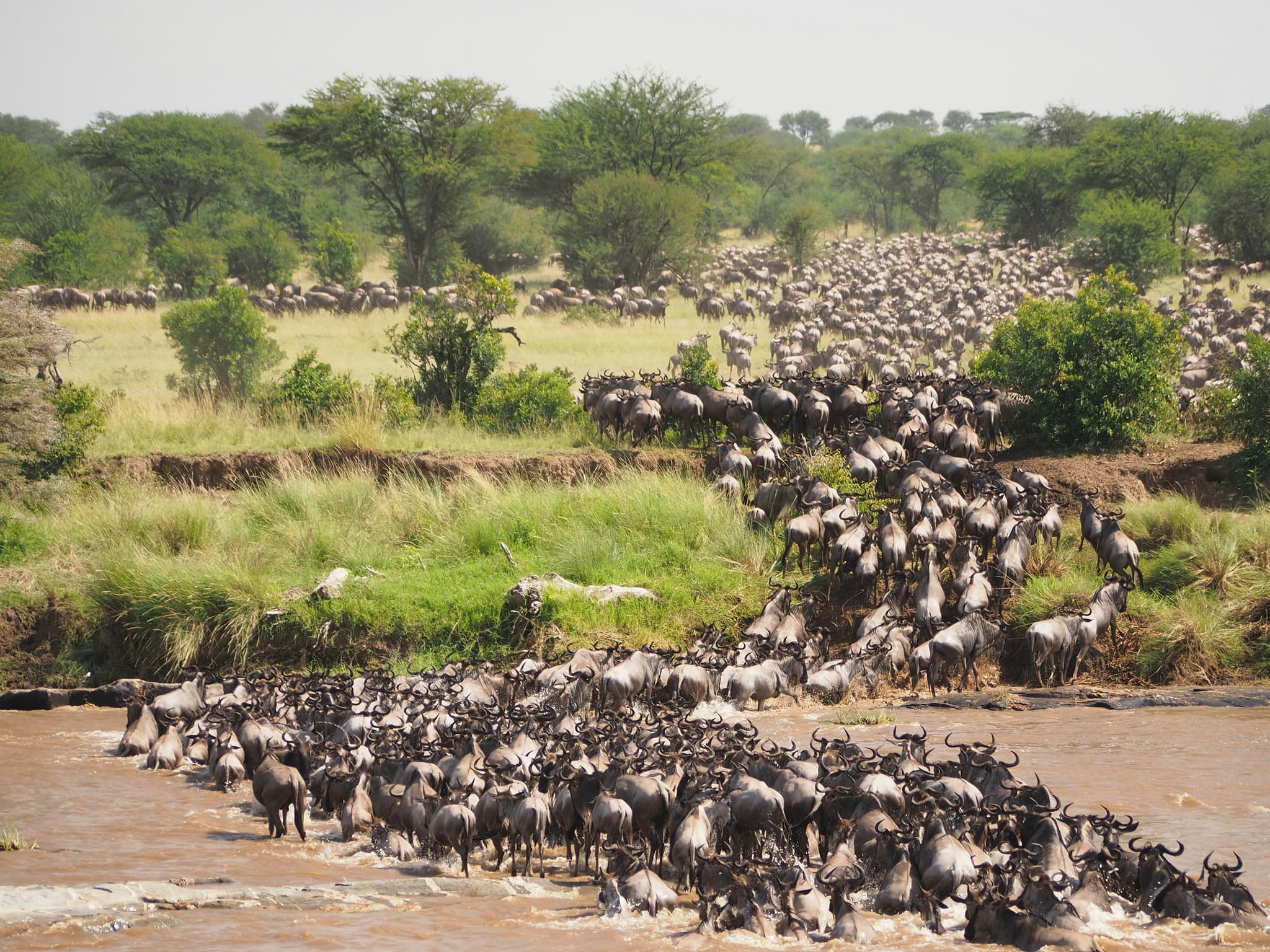
Endless plains and the world's greatest wildlife spectacle — over a million wildebeest and zebra on the move, calving in the south (Jan–Feb) and crossing the Mara River in the north (roughly Jul–Oct).
Ngorongoro Crater
Wildlife amphitheatre
A vast, intact volcanic caldera and UNESCO site teeming with game — among the best places in Africa to see black rhino, plus lion, elephant and flamingos on the crater floor.
Tarangire National Park
Elephants & baobabs
Huge elephant herds and ancient baobab trees along the Tarangire River — at its best in the dry season (Jun–Oct) when wildlife concentrates on the water.
Lake Manyara
Birds & tree-climbing lions
A compact, scenic park beneath the Rift Valley escarpment — flamingo-fringed lake, forest, and famous tree-climbing lions. An easy add to the northern circuit.
Mount Kilimanjaro
Africa's highest peak
At about 5,895m, the continent's rooftop — a multi-day trek (Marangu, Machame and other routes) that needs proper acclimatisation, no technical climbing required.
Zanzibar
Spice island & beaches
Historic Stone Town (a UNESCO site), spice farms and dhow sails, plus powder-white beaches and reefs — the classic beach finish to a mainland safari.
Nyerere National Park (Selous)
Wild & remote south
One of Africa's largest protected areas, on the Rufiji River — boat safaris, walking safaris and big game far from the northern crowds.
Ruaha National Park
Untamed wilderness
Tanzania's largest national park — vast, remote and superb for lion, leopard, wild dog and elephant, with a true off-the-beaten-track feel.
Getting around
Most Australians fly via a Middle East or Asian hub, arriving at Kilimanjaro International (JRO) for the northern safari circuit, Julius Nyerere International (DAR) in Dar es Salaam for the south and coast, or Abeid Amani Karume International (ZNZ) on Zanzibar.
- Light-aircraft flights (Coastal Aviation, Auric Air, Precision Air, Regional Air and others) link the parks, Dar es Salaam and Zanzibar — they save long drives over big distances. A strict 15 kg luggage limit for bush flights (Coastal Aviation, Auric Air, Precision Air, Safari Air Link) must be in 100% soft-sided, structureless duffel bags (no hard bottoms, frames, or wheels) to fit into Cessna Caravan fuselage belly pods. Total Weight Inclusion: Explicitly state that the 15 kg limit includes all hand luggage, camera bodies, and long lenses combined. — check with your operator before you pack.
- Pro-Tip for Photographers: If your safari camera gear pushes you over the 15 kg limit, you do not have to leave it behind. Both Coastal Aviation and Auric Air allow you to pre-book a "Freight/XL Seat" or "Premium Class" ticket. This effectively purchases a portion of the aircraft's weight allocation, upgrading your personal limit to 30 kg
- Safari by 4WD with a driver-guide is the norm on the northern circuit (Arusha is the gateway town); roads between parks can be long and rough, so a good vehicle and guide matter.
- Zanzibar is reached by a short flight or by ferry from Dar es Salaam; on the island, use hotel transfers or arranged taxis.
- Self-drive is uncommon for visitors — most trips use guided vehicles and transfers. Driving is on the left.
Money & payments
The currency is the Tanzanian Shilling (TZS, written TSh).
- US dollars are widely used across the tourism industry — park fees, many lodges and tips are often quoted in USD. Bring clean, newer notes (series dated 2009 or later); older or worn US bills are frequently refused.
- Cards are accepted at upmarket hotels, lodges and larger restaurants, though a surcharge is common. Don't rely on cards in smaller towns or rural areas.
- ATMs are found in cities and larger towns (Arusha, Dar es Salaam, Stone Town) and dispense shillings; they can be scarce or unreliable near the parks, so carry enough cash.
- Carry cash in both shillings and small USD notes for tips, markets, curios and incidentals.
- Tell your bank you'll be travelling so your cards aren't blocked.
Health before you go
See your GP or a travel clinic about 6–8 weeks before you leave.
- Malaria — there is a risk in all areas below about 1,800m, including Zanzibar; the higher altitudes (such as the upper slopes of Kilimanjaro) are lower risk. Take anti-malarial medication as prescribed and prevent bites with repellent, long sleeves at dusk and a treated net. Discuss the right tablets with your doctor.
- Yellow fever — Tanzania is not generally considered a yellow-fever-risk country, but you must show a valid vaccination certificate if you are arriving from, or transiting, a yellow-fever-risk country — common on multi-country African trips, so carry your certificate. A vaccination certificate is required only if arriving from—or transiting for more than 12 hours through—an airport in a yellow-fever-risk country (such as a long layover in Addis Ababa or Nairobi). Direct flights from non-endemic hubs (e.g. Doha, Dubai) do not trigger this requirement.
- Other vaccines — make sure routine vaccinations are current; travellers commonly add hepatitis A and typhoid, and your doctor may suggest others. Ask for tailored advice.
- Arrival screening — health screening such as temperature checks may apply on arrival; follow any current requirements.
- Water — drink bottled or filtered water; avoid ice and unpeeled raw produce away from quality lodges.
Insurance: comprehensive travel insurance that covers medical evacuation is essential — and for Zanzibar the ZIC inbound insurance is a separate mandatory requirement (see the visa note above).
Staying safe
Most visits to Tanzania are trouble-free, and the safari areas and lodges are very safe. Take normal city precautions and follow your guide's advice.
- In cities and towns (Dar es Salaam, Arusha, Stone Town) — keep valuables out of sight, avoid walking alone after dark, use arranged taxis or hotel transfers, and be alert around busy markets and bus stations where bag-snatching and pickpocketing occur.
- Plastic Bag & Single-Use Bans (Staying Safe / Customs): Nationwide Plastic Carrier Bag Ban: Tanzania strictly prohibits the importation, export, and use of single-use plastic carrier bags. Airport customs will confiscate plastic shopping and garbage bags from luggage upon arrival. Reusable fabric packing cubes or transparent zip-lock bags for toiletries (expected to leave the country with the traveller) are permitted. Single-Use Plastics in National Parks: Disposable plastic beverage bottles and plastic straws are banned inside all TANAPA national parks and conservation areas; travellers must carry a refillable water bottle.
- On the coast and Zanzibar — dress modestly away from the beach and resorts (Zanzibar is predominantly Muslim), and respect local customs, especially during Ramadan.
- Wildlife — always follow your guide and ranger; never approach animals on foot outside designated areas.
- Documents — carry a copy of your passport and visa, and keep the originals secure.
Emergencies: dial 112 (general/ambulance) or 999 (police); these can be unreliable outside major cities, so save your lodge's and operator's numbers, and the consular contacts below.
Language, people & customs
Tanzania's national language is Swahili (Kiswahili), and English is widely used in business, tourism and signage, so you'll get by easily on a guided trip. A few Swahili words go a long way — jambo (hello), asante (thank you) and karibu (welcome) are met with warm smiles.
Tanzanians are friendly and courteous, and greetings matter — take a moment to say hello before getting to the point. Dress modestly in towns and especially on Zanzibar and the coast (cover shoulders and knees away from the beach). Always ask before photographing people, and never photograph government or military sites. On safari, wear neutral colours and follow your guide's lead.
Staying connected
- Mobile coverage (4G) is good in cities, towns and around many parks, though it drops out in remote wilderness areas — part of the appeal.
- Wi-Fi is available at most lodges and hotels, but can be slow or limited to common areas.
- SIMs & eSIMs — affordable prepaid local SIMs (Vodacom, Airtel, Halotel) are sold widely; registration requires your passport. Travel eSIMs are a convenient alternative you can set up before you fly.
- Power — supply is generally reliable in cities; remote camps often run on generators or solar, so charge devices when you can and bring a power bank.
Emergency & embassy contacts
Australian High Commission, Nairobi (accredited to Tanzania)
+254 20 427 7100
Limuru Road, Rosslyn, Nairobi, Kenya. Australia has no high commission in Tanzania; Nairobi provides consular help. Consular email: consular.nairobi@dfat.gov.au.
Australian Consulate, Dar es Salaam
+255 744 384 730
Level 3, Address Building, Bains Singh Avenue, Msasani Peninsula, Dar es Salaam — limited consular services.
Consular emergencies (after hours)
+61 2 6261 3305
DFAT's 24-hour Consular Emergency Centre in Canberra, for Australians needing urgent help overseas.
Local emergencies
112 / 999
112 (general/ambulance) or 999 (police). Service can be unreliable outside major cities — also save your lodge and operator numbers.
Starter packing list
Safari
- Neutral, layerable clothing: khaki, olive, beige — avoid bright colours; black and dark blue attract tsetse flies
- Warm fleece & beanie: dawn game drives and the highlands are cold
- Wide-brim hat & sunglasses
- Binoculars
- High-SPF sunscreen & insect repellent: DEET-based for malaria areas
- Soft-sided duffel: required for light-aircraft transfers (~15 kg limit)
Beach & town
- Swimwear & beach gear: for Zanzibar and the coast
- Modest cover-up: shoulders and knees in Stone Town and villages
- Comfortable walking shoes & sandals
- Light rain jacket: if travelling in the rains, Mar–May or Nov
Health & documents
- Passport: valid at least 6 months
- e-visa confirmation (printed)
- Zanzibar ZIC insurance QR code: if visiting the islands
- Travel insurance details: must cover medical evacuation
- Anti-malarials & personal medication
- Yellow-fever certificate: only if arriving via a risk country
Practical
- Universal / Type-G adapter
- Power bank
- Clean, newer US dollar notes: series 2009+ for fees and tips
- Phone with offline maps & a torch/headlamp
Frequently asked
Do Australians need a visa for Tanzania?
Yes. The easiest option is the online e-visa (visa.immigration.go.tz) — a single-entry tourist visa is about US$50, valid for up to 90 days; apply at least 10 business days ahead. A visa on arrival is also possible at major entry points for the same fee. Always confirm the current rules on Smartraveller before you fly.
Do I need a yellow fever certificate?
Only if you are arriving from, or transiting (usually over 12 hours in), a yellow-fever-risk country — common on multi-country African trips. Tanzania itself is not generally a risk country, but carry your certificate if your route requires it.
What's the deal with Zanzibar insurance?
All visitors to Zanzibar must hold mandatory inbound travel insurance from the Zanzibar Insurance Corporation (ZIC) — about US$44 per adult for up to 92 days. Buy it in advance at inbound.visitzanzibar.go.tz and keep the QR code; this is separate from your own travel insurance, which you should still have.
Do I need malaria tablets?
For most of Tanzania, yes — there is malaria risk in the safari parks and on Zanzibar. See your GP or a travel clinic 6–8 weeks before for the right anti-malarials, and prevent bites with repellent and covering up at dusk.
When is the best time to go?
The dry season (June–October) is prime for general game viewing and the dramatic Mara River crossings in the northern Serengeti. For the Migration calving and newborns, visit the southern plains in January–February. Zanzibar is best in the drier months; avoid the heaviest long rains (April).
Should I pay in shillings or US dollars?
Both have a place. US dollars (clean notes dated 2009 or later) are widely used for park fees, lodges and tips; carry shillings for markets, small purchases and incidentals. Cards work at upmarket places but often carry a surcharge.
Is Tanzania safe for tourists?
Generally yes, with common sense. Safari areas and lodges are very safe. Take normal precautions in cities and towns — keep valuables hidden, use arranged transport at night, and dress modestly on Zanzibar and the coast.
Sources & last verified
Last verified: 29 June 2026. This guide is researched from official and authoritative sources and reviewed by Explore Africa. Visa, health and safety rules can change — always confirm the current advice before you travel.
Key sources:
- Smartraveller (Australian Government): smartraveller.gov.au/destinations/africa/tanzania
- Tanzania Immigration (e-visa): visa.immigration.go.tz
- Visit Zanzibar — mandatory inbound insurance (ZIC): inbound.visitzanzibar.go.tz
- US CDC Travelers' Health — Tanzania: wwwnc.cdc.gov/travel/destinations/traveler/none/tanzania
- Australian High Commission, Kenya (accredited to Tanzania): kenya.highcommission.gov.au