country· 13 min read· Explore Africa editorial · Published June 2026 · Updated 30 Oct 2026
Zambia: walking safaris, the Falls & wild rivers
Everything Australians need to plan a Zambia trip — the home of the walking safari. Visa-free entry, money, health, the best time to go, and the unmissable: Victoria Falls, South Luangwa, the Lower Zambezi and Kafue.
Zambia is the safari purist's Africa — wild, uncrowded and proudly old-school. This is the country that invented the walking safari, in the legendary South Luangwa Valley, and where you can stand on the lip of Victoria Falls or peer down it from Devil's Pool. Add the elephant-rich Lower Zambezi, the vast wilderness of Kafue and some of the most respected guiding on the continent, and you have a destination for travellers who want the bush at its most authentic. It's friendly, English-speaking and now visa-free for Australian tourists. This guide covers the practical things — money, health, safety, when to go and how to get around — so all that's left to plan is the adventure.
At a glance
- Capital
- Lusaka
- Currency
- Zambian Kwacha (ZMW / K) · USD widely used in tourism
- Languages
- English (official) · 70+ local languages
- Time zone
- CAT (UTC+2) · 8–9 hrs behind Sydney
- Dialling code
- +260
- Electricity
- 230V / 50Hz · plug types C, D & G
- Driving
- On the left
- Visa (Australians)
- Visa-free for tourism (since 2025)
Zambia month by month
🌡 Warm · 26–31°C
💧 Heavy rains
Peak of the Emerald Season — lush, dramatic skies and superb birding. Many bush camps are closed and some dirt roads are impassable, but a handful of all-weather lodges run wonderful low-season trips.
🌡 Warm · 26–31°C
💧 Heavy rains
Verdant landscapes, newborn animals and migrant birds. Hot and humid; access is by 4x4 or boat at the lodges that stay open.
🌡 Warm · 26–31°C
💧 Easing rains
Rains tapering off and the Zambezi running high — Victoria Falls builds towards its thundering peak.
🌡 Mild–warm · 25–30°C
💧 Showers easing
The land is green and the rivers are full. Camps begin to reopen as roads dry out — a quiet, beautiful time to visit.
🌡 Mild · 14–28°C
💧 Dry
Start of the dry season and one of the most scenic months — Victoria Falls is at near-full flow while the bush is still green and game viewing is opening up.
🌡 Cool · 10–26°C
💧 Dry
Walking safaris hit their stride as the bush camps open. Crisp, cloudless days; cold mornings on game drives — pack warm layers.
🌡 Cool · 9–26°C
💧 Dry
👥 AUS school holidays
Peak season. Excellent wildlife as animals concentrate near water; cold dawns and warm afternoons. South Luangwa and the Lower Zambezi are at their best.
🌡 Mild · 11–29°C
💧 Dry
Prime safari weather, warming up. Devil's Pool at Victoria Falls usually opens as the Zambezi drops. Canoeing on the Lower Zambezi is excellent.
🌡 Warm · 15–33°C
💧 Dry
Outstanding game viewing as water sources shrink and animals gather. Warm days, mild nights — a superb all-round month.
🌡 Hot · 19–37°C
💧 Dry · first storms late
The 'suicide month' — very hot, especially in the low-lying valleys, but the wildlife viewing is spectacular around the last waterholes. Victoria Falls is at its lowest on the Zambian side.
🌡 Hot · 19–34°C
💧 First rains
The first storms break the heat and the bush greens up fast. Great birding and dramatic skies as the Emerald Season begins; some camps start to close.
🌡 Warm · 26–31°C
💧 Rains building
Full green season — lush, atmospheric and quiet. Migrant birds arrive and predators hunt newborns; rain is frequent but rarely all day.
Top experiences
South Luangwa National Park
Home of the walking safari
Zambia's flagship park, where the guided walking safari was born in the 1960s. Big cats, huge elephant and buffalo herds and famously expert guides — at its best in the dry season, June to October.
Victoria Falls & Livingstone
One of the seven natural wonders
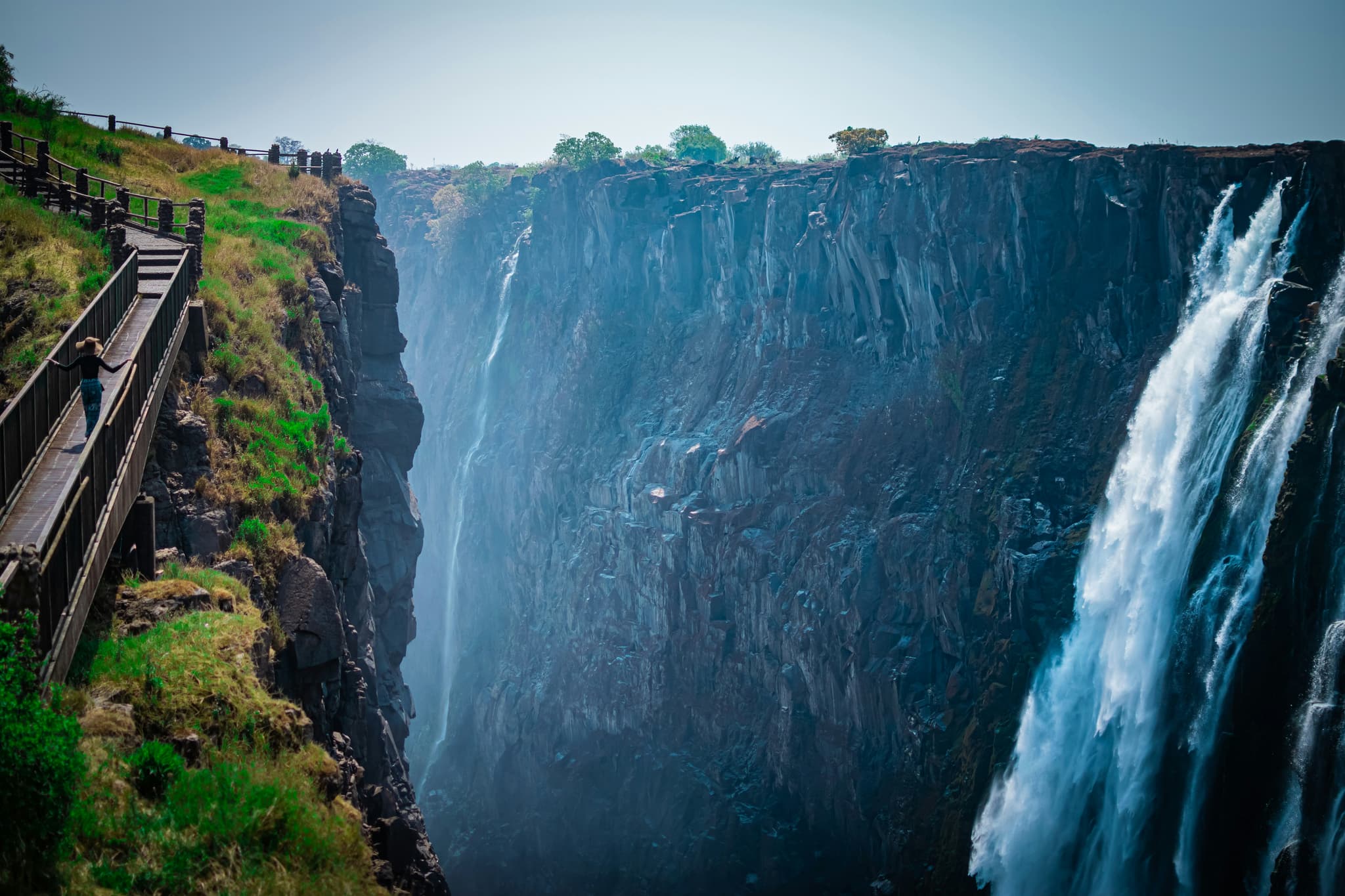
The local name is Mosi-oa-Tunya, 'the smoke that thunders'. The Zambian side offers Knife-Edge Bridge views, Livingstone Island and a buzzing adventure town.
Devil's Pool
Aug–Dec (low water)
Swim to the very edge of Victoria Falls in a natural rock pool — only safe and accessible when the Zambezi is low, roughly August to December. A bucket-list thrill reached via Livingstone Island.
Lower Zambezi National Park
Canoe & river safari
Game drives, walking, fishing and canoeing beneath the escarpment along the Zambezi River — superb elephant, hippo and birdlife. May to October is prime.
Kafue National Park
Vast & uncrowded
One of Africa's largest parks — the Busanga Plains, big cats and very few other vehicles. Hot-air ballooning runs over the plains from around June to October.
Walking safaris
On foot with an armed guide
Zambia's signature experience — tracking wildlife on foot with a professional guide and scout, reading the bush as the old explorers did. The dry season (June–October) is ideal.
Emerald (green) season
Nov–Apr
Lush landscapes, newborn animals, dramatic skies and exceptional birding, with fewer visitors and lower prices at the all-weather lodges that stay open.
Lake Kariba & the Zambezi
Water & sunsets
Houseboats, fishing and golden sundowners on one of the world's largest man-made lakes, on the Zimbabwe border.
Getting around
International flights arrive at Kenneth Kaunda International (Lusaka) and Harry Mwanga Nkumbula International (Livingstone) for Victoria Falls. There are no direct flights from Australia — most travellers connect via Johannesburg, Nairobi, Addis Ababa or the Gulf hubs.
- Light-aircraft transfers are the standard way to reach the parks — Proflight Zambia and charter operators link Lusaka, Livingstone, Mfuwe (South Luangwa), the Lower Zambezi and Kafue. Soft-sided bags only. Charter flights between bush airstrips (Proflight / charter Cessna aircraft) require 100% frameless soft-sided duffel bags with no rigid bottom plates or wheels to fit in aircraft luggage pods, with a strict limit of around 15–20 kg total per person. This restriction explicitly includes all checked luggage, carry-ons, and heavy camera equipment — confirm with your lodge.
- Road transfers serve some routes (for example Mfuwe to the South Luangwa camps), but distances are long and many park roads are rough or seasonal.
- Self-drive is for the experienced and well-prepared only — a 4x4 is essential, fuel and services are sparse, and the wet season closes many roads. Most visitors travel on a fully guided, lodge-arranged basis.
- In towns, use lodge transfers or a trusted taxi or ride-hailing app rather than hailing on the street.
Money & payments
The currency is the Zambian Kwacha (ZMW, written K). By law, payments inside Zambia should be made in Kwacha, but US dollars are widely used in tourism — many lodges, parks and operators quote and accept USD, and park fees and the KAZA Univisa are priced in dollars.
- Bring clean, recent US dollar notes (series 2013 or newer; small denominations like US$5 and US$10 are handy for tips). Worn or pre-2013 notes are often refused.
- Cards (Visa and Mastercard) are accepted at hotels, larger lodges and some restaurants in the cities, but acceptance is patchy in the bush — never rely on cards alone.
- ATMs are found in Lusaka, Livingstone and larger towns and generally dispense Kwacha; use ones at banks or malls and shield your PIN.
- Carry cash for tips, curios, park areas and remote camps. Change US dollars for Kwacha at banks or bureaux de change, not on the street.
- Tell your bank you'll be travelling so your cards aren't blocked.
Health before you go
See your GP or a travel clinic 6–8 weeks before you leave.
- Malaria — present throughout Zambia, all year, including the safari parks and Victoria Falls. Take anti-malarial medication (your doctor will advise on options) and prevent bites with repellent, long sleeves and trousers at dusk, and the bed nets provided at camps.
- Yellow fever — Zambia is low-risk and the vaccine is not routinely required for travel direct from Australia, but you must show a vaccination certificate if you arrive from, or have transited more than 12 hours through, a yellow-fever-risk country (parts of Africa and South America) — relevant on multi-country trips. Carry your certificate.
- Other vaccines — make sure routine vaccinations are up to date; many travellers also add hepatitis A and typhoid, and your doctor may discuss others. Ask before you go.
- Water — drink bottled or filtered water; lodges provide safe drinking water.
Insurance: medical facilities are limited, especially in the bush, so comprehensive travel insurance that covers medical evacuation is essential.
- NOTE: Over-the-counter medications containing diphenhydramine (such as standard Benadryl) are illegal in Zambia and subject to strict enforcement/confiscation.
Staying safe
Zambia is one of Africa's more stable and welcoming countries, and the great majority of safari trips are trouble-free.
- In Lusaka and towns — petty theft and bag-snatching occur, so keep valuables out of sight, don't walk alone after dark, and use trusted transfers or a ride-hailing app at night.
- Safari areas — lodges, camps and national parks are very safe; always follow your guide's instructions, especially on walking safaris and around water (hippos and crocodiles are dangerous).
- Borders — take care near the remote border with the Democratic Republic of the Congo, where boundaries can be unmarked; stick to recognised crossings and tourist routes.
- Adventure activities — Victoria Falls offers white-water rafting, bungee and microlights; use reputable, well-equipped operators.
Emergencies: dial 999 or 112 (police), 991 (ambulance) and 993 (fire) — though response can be slow; your lodge and travel operator are your first call in the bush.
Language, people & customs
English is Zambia's official language — used in government, business, signage and tourism — so you'll communicate easily everywhere. Alongside it, more than 70 local languages are spoken, with Bemba, Nyanja, Tonga and Lozi among the most common; a greeting in the local tongue is always welcomed.
Zambians are famously friendly, courteous and relaxed. Greetings matter — take a moment to say hello before getting to business. Dress is modest and casual; neutral colours for safari, and respectful cover at villages and places of worship. Always ask before photographing people, and avoid photographing government buildings, airports and military sites. Same-sex relationships are criminalised under Zambian law, so LGBTQIA+ travellers should be aware and discreet — see Smartraveller for current advice.
Staying connected
- Mobile coverage (3G/4G) is good in Lusaka, Livingstone and the larger towns, but patchy to non-existent in the remote parks — part of the appeal.
- Wi-Fi — most lodges have it in common areas, though it can be slow or limited; many bush camps are deliberately offline.
- SIMs & eSIMs — local prepaid SIMs (Airtel, MTN, Zamtel) are cheap; registration requires your passport. Travel eSIMs are a convenient alternative — set one up before you fly.
- Power — the grid can suffer load-shedding (scheduled outages); good lodges run on solar or generators, and many remote camps are solar-powered with limited charging hours.
Emergency & embassy contacts
Australian Embassy, Harare (Zimbabwe)
+263 861 200 2100
Accredited to Zambia. 1 Green Close, Borrowdale, Harare. Open Mon–Thu 08:00–17:00, Fri 08:00–14:00.
Australian Honorary Consulate in Lusaka (conducts passport interviews and provides local initial consular support, while full mission services are managed by the Embassy in Harare).
Consular emergencies (after hours)
+61 2 6261 3305
DFAT's 24-hour Consular Emergency Centre in Canberra, for Australians needing urgent help overseas.
Local emergencies
999 or 112 (police)
Ambulance 991 · Fire 993. Response can be slow — in the bush, contact your lodge or operator first. Save your camp's number.
Starter packing list
Safari
- Neutral, layerable clothing: khaki, olive, beige — avoid bright colours, black and dark blue (tsetse flies)
- Warm fleece, beanie & gloves: winter mornings are cold on open game drives
- Wide-brim hat & sunglasses
- Binoculars
- High-SPF sunscreen & DEET-based insect repellent
- Closed walking shoes: essential for walking safaris
- Soft-sided duffel: required for light-aircraft transfers (15–20 kg limit)
Victoria Falls & water
- Swimwear: for Devil's Pool and the pool
- Quick-dry clothes & a light rain jacket: the Falls' spray soaks you
- Dry bag or waterproof phone case
- Water shoes or sandals
Health & documents
- Passport: valid 6+ months, 3 blank pages
- Travel insurance details: must cover medical evacuation
- Anti-malarials & personal medication
- Yellow-fever certificate: only if arriving via a risk country
- Copies of key documents
Practical
- Universal adapter (covers C/D/G)
- Power bank
- Clean US dollars in small notes: series 2013 or newer, for tips and fees
- Headtorch: useful in solar-powered camps
- Phone with offline maps & a travel eSIM
Frequently asked
Do Australians need a visa for Zambia?
No — since January 2025 Australian passport holders can enter visa-free for tourism, receiving a stamp on arrival for up to 30 days (extendable in-country to a maximum of 90 days a year). Have a passport valid for six months with three blank pages, plus a return ticket. Confirm the current rules on Smartraveller before you fly.
Do I need malaria tablets?
Yes — malaria is present throughout Zambia all year, including the safari parks and Victoria Falls. See your GP or a travel clinic 6–8 weeks before departure about anti-malarials, and prevent bites with repellent, covered clothing at dusk and bed nets.
Do I need a yellow fever vaccination?
Not for travel direct from Australia — Zambia is low-risk. But you must show a yellow-fever certificate if you arrive from, or transit more than 12 hours through, a risk country (parts of Africa and South America). Carry your certificate on multi-country trips.
When is the best time to go?
For classic safari and walking safaris, the dry season (May–October) is prime — wildlife gathers at water and the bush thins out. July–October is peak. For Victoria Falls at full thunder, visit March–June; for Devil's Pool, come at low water, roughly August–December. The green 'Emerald Season' (November–April) is lush, quiet and great for birding.
Should I bring US dollars or Kwacha?
Both. The local currency is the Kwacha, but tourism runs largely on US dollars — bring clean notes dated 2013 or later, in small denominations for tips and fees. Cards work in cities and bigger lodges but not reliably in the bush, so carry cash.
Is Zambia safe for tourists?
Yes — it's one of Africa's more stable, welcoming countries and safari areas are very safe. Use normal city precautions in Lusaka, follow your guide's instructions in the bush (especially around water and on walks), and take care near the remote DRC border. Check Smartraveller for current advice.
What makes Zambia different from other safari destinations?
Zambia is where the walking safari was born — it's wilder, quieter and more focused on expert guiding and on-foot, small-camp experiences than the busier parks elsewhere. Add Victoria Falls and Devil's Pool, and it's a favourite of repeat safari-goers.
Sources & last verified
Last verified: 29 June 2026. This guide is researched from official and authoritative sources and reviewed by Explore Africa. Visa, health and safety rules can change — always confirm the current advice before you travel.
Key sources:
- Smartraveller (Australian Government): smartraveller.gov.au/destinations/africa/zambia
- Zambia Department of Immigration: zambiaimmigration.gov.zm
- Australian Embassy, Harare (accredited to Zambia): zimbabwe.embassy.gov.au
- US CDC Travelers' Health: wwwnc.cdc.gov/travel/destinations/traveler/none/zambia
- Zambia Tourism Agency: zambiatourism.com