country· 13 min read· Explore Africa editorial · Published June 2026 · Updated 30 Oct 2026
Zimbabwe: Victoria Falls, Hwange & wild Mana Pools
Everything Australians need to plan a Zimbabwe safari — visas and the KAZA Univisa, USD cash, malaria and yellow-fever rules, when to go for Victoria Falls and Hwange, safety, tipping and embassy contacts.
Zimbabwe is one of Africa's great safari secrets — wild, uncrowded and guided by some of the best-trained rangers on the continent. This is where you stand at the thundering edge of Victoria Falls, track lion and wild dog on foot in Mana Pools, watch vast elephant herds gather at Hwange's waterholes and walk among the granite kopjes and ancient rock art of the Matobo Hills. Australians do need a visa, but it's straightforward — issued on arrival or online. It's also largely a cash economy that runs on US dollars, so a little preparation goes a long way. This guide covers the practical things — money, health, safety, when to go and how to get around — so you can focus on the adventure.
At a glance
- Capital
- Harare
- Currency
- US dollar (USD) widely used · local ZiG
- Languages
- 16 official · English widely spoken
- Time zone
- CAT (UTC+2) · 8–9 hrs behind Sydney
- Dialling code
- +263
- Electricity
- 220–240V / 50Hz · plug Type D & G
- Driving
- On the left
- Visa (Australians)
- Visa on arrival / e-visa · from US$30
Zimbabwe month by month
🌡 Hot · 25–30°C
💧 Frequent storms
Peak of the rains — lush, green and superb for birding and newborn animals. Some bush camps close; roads can be tricky in remote parks.
🌡 Hot · 25–30°C
💧 Frequent storms
Still wet and green. Victoria Falls is building towards its high-water peak — spectacular and very misty.
🌡 Warm · 24–29°C
💧 Easing
Rains tapering, the bush still green. The Falls run hard from the late-summer catchment.
🌡 Mild · 22–28°C
💧 Low
A lovely transition — drying tracks, green scenery and the Falls near peak flow. Game viewing improves as the bush thins.
🌡 Mild · 12–26°C
💧 Dry
Start of prime safari: cooler, drier days and thinning vegetation. The Falls are full and dramatic.
🌡 Cool · 7–24°C
💧 Dry
Excellent game viewing; cold, crisp mornings on game drives — pack warm layers. Falls still strong.
🌡 Cool · 7–24°C
💧 Dry
👥 AUS school holidays
Peak dry-season wildlife as animals concentrate at water. Cold dawns, warm afternoons. A busy, popular month.
🌡 Mild · 9–28°C
💧 Dry
Top game viewing in Hwange and Mana Pools; dry, dusty and easy to spot wildlife. Falls flow easing on the Zimbabwe side.
🌡 Warming · 13–32°C
💧 Dry
Outstanding wildlife as waterholes shrink and animals gather. Warming days; walking-safari conditions at their best.
🌡 Hot · 18–35°C
💧 Very low
The hottest month — exceptional game viewing before the rains, but intense heat. Victoria Falls is at its lowest (best for white-water rafting and the Zambia-side Devil's Pool).
🌡 Hot · 18–33°C
💧 First rains
First storms green the bush and break the heat — wonderful birding, newborns and far fewer crowds.
🌡 Hot · 18–30°C
💧 Building storms
Warm, green and lush with afternoon storms. Photogenic skies and good value before the festive peak.
Top experiences
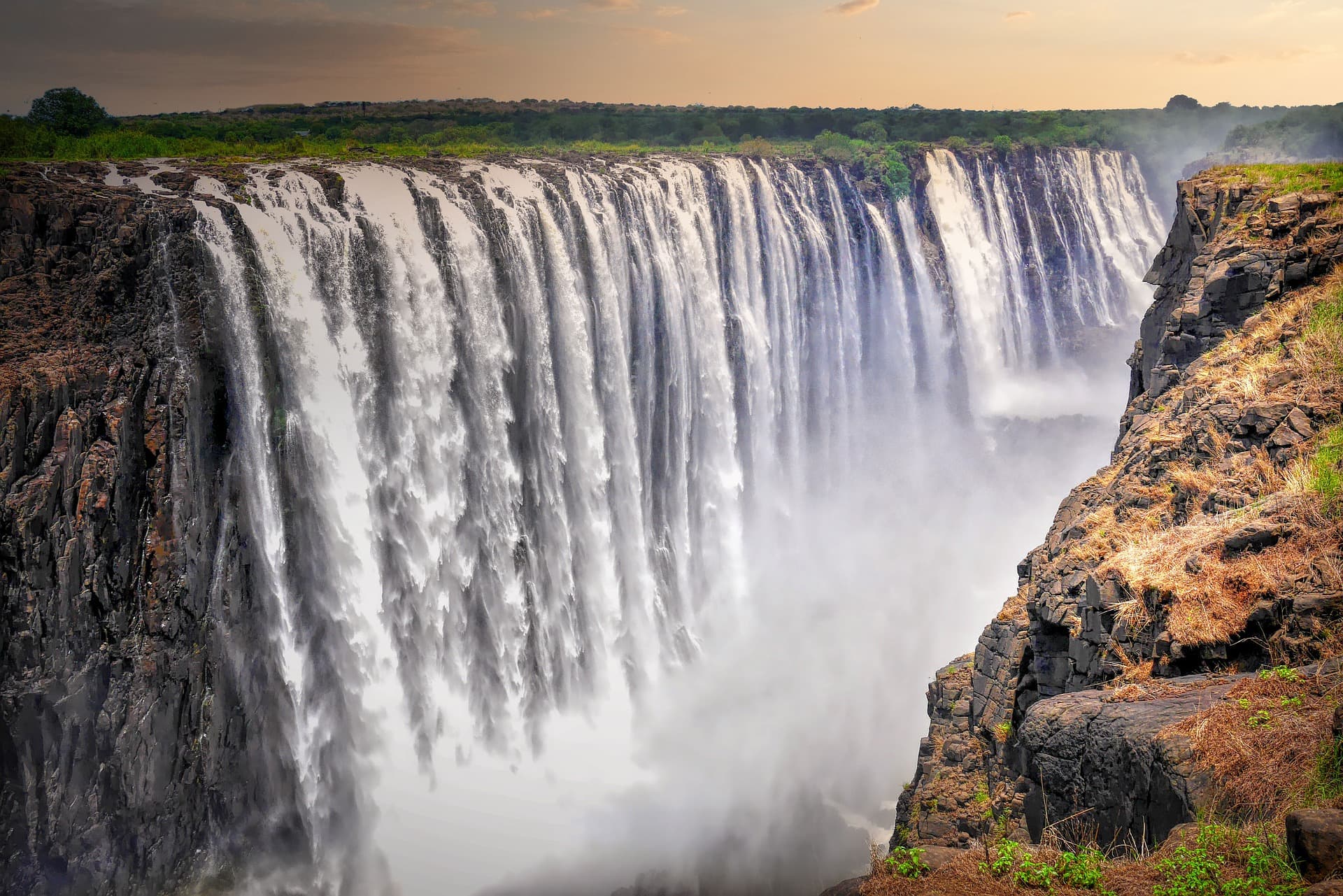
Victoria Falls
'The Smoke That Thunders'
One of the world's great natural wonders — Mosi-oa-Tunya. Walk the rainforest viewpoints, take a sunset Zambezi cruise, or add a helicopter flight or white-water rafting.
Hwange National Park
Elephant country
Zimbabwe's largest park and one of Africa's finest for big elephant herds, lion and painted dogs — superb waterhole game viewing in the dry season.
Mana Pools National Park
Walking safari
A UNESCO World Heritage wilderness on the Zambezi, famed for guided walking safaris, canoeing and remarkably close encounters with elephant and wild dog.
Matobo Hills
Granite & rock art
Otherworldly balancing boulders, ancient San rock paintings, Cecil Rhodes' grave and some of the best rhino tracking on foot in Africa.
Lake Kariba
Houseboat & sundowners
A vast inland sea — drift on a houseboat past elephants and fish eagles, with legendary fiery sunsets over drowned forests around Matusadona.
Great Zimbabwe
Ancient stone city
The largest ancient stone structures south of the Sahara — a UNESCO World Heritage Site that gave the nation its name.
Gonarezhou National Park
Off the beaten track
Remote, rugged and red-cliffed in the south-east — part of the Great Limpopo Transfrontier wilderness, for travellers who want true solitude.
Canoeing the Zambezi
On the water
Multi-day canoe safaris along the lower Zambezi — paddle past hippo and elephant, camping on the riverbank under huge skies.
Getting around
Most trips arrive at Victoria Falls Airport (the safari gateway) or Harare International; Bulawayo is the gateway to Matobo and the south.
- Regional flights connect Johannesburg and other African hubs to Victoria Falls and Harare — there's no direct service from Australia, so you'll connect via Johannesburg, the Gulf, or Nairobi.
- Light-aircraft transfers link the safari areas (Hwange, Mana Pools, Kariba) — inter-park charter and light-aircraft flights (e.g., Wilderness Air, Mack Air, Safari Logistics into Mana Pools and Hwange) strictly mandate 100% soft-sided, frameless duffel bags (no rigid bottom plates, pull-out handles, or wheels) within the 15–20 kg total limit (inclusive of hand luggage and camera gear) to fit into Cessna Caravan fuselage pods. Check with your lodge before you pack.
- Road transfers are common between Victoria Falls, Hwange and Kariba; distances are long and some roads are rough, so build in time.
- Self-drive is for the experienced and well-prepared only — fuel can be scarce, signage is limited and you'll need to carry cash. Most visitors travel on guided, lodge-arranged transfers instead.
- Driving is on the left.
Money & payments
Zimbabwe is largely a cash economy that runs on US dollars. The local currency is the ZiG (Zimbabwe Gold), introduced in 2024, but in practice tourists pay for almost everything in USD.
- Bring US dollars cash — enough for your whole trip, in a mix of small denominations. Notes should be clean, undamaged and ideally series 2013 or newer; worn or torn bills are often refused.
- Cards are accepted at many lodges, hotels and Victoria Falls operators, but acceptance is patchy and connections fail — never rely on them.
- ATMs are scarce and unreliable and may not dispense USD. Don't count on withdrawing cash once you arrive.
- Change is often short — carrying small bills (US$1, US$5, US$10) makes tipping and small purchases far easier.
- Currency rules: Under Reserve Bank of Zimbabwe regulations, the maximum non-declaration physical cash allowance upon departure is US$2,000 equivalent total across all currencies (or up to any higher amount explicitly declared upon arrival on Form 47 / CD1).
- Tell your bank you'll be travelling so any card you do bring isn't blocked.
- Note that Zimbabwe National Parks (Zimparks) conservation and entry fees for foreign tourists (e.g., Victoria Falls rainforest entry ~US$58, Hwange/Mana Pools daily conservation fees) must be paid in USD cash or with international Visa/Mastercard. Warning: Satellite and network connectivity can be highly unstable in remote areas like Hwange and Mana Pools. Never rely entirely on card machines at park gates; you should always carry enough physical USD cash to cover your expected fees.
Health before you go
See your GP or a travel clinic about 6–8 weeks before you leave.
- Malaria — present across much of Zimbabwe. Risk is highest from November to June in areas below 1,200 m, and year-round in the Zambezi valley — that covers Victoria Falls, Hwange, Mana Pools and Lake Kariba. Risk in Harare and Bulawayo (on the high plateau) is slight. Take anti-malarial medication and prevent bites with repellent, long sleeves and trousers at dusk.
- Yellow fever — yellow fever does not occur in Zimbabwe, but you must show a vaccination certificate if you arrive from (or transit through) a country with yellow-fever risk — relevant on multi-country African trips. It is not required for travellers coming directly from Australia. Yellow Fever vaccination certificate is strictly required only if arriving from—or transiting for more than 12 hours through—an airport in a yellow-fever-endemic country (e.g., layovers in Addis Ababa or Nairobi). Direct transit through South Africa (Johannesburg) does not require one.
- Other vaccines — make sure routine vaccinations (including measles/MMR) are current; many travellers also add hepatitis A and typhoid. Ask your doctor.
- Water — drink bottled or filtered water; avoid tap water and ice from unknown sources.
Insurance: medical facilities are limited and you must pay for all care up front, so comprehensive travel insurance that covers medical evacuation is essential.
Staying safe
Zimbabweans are famously warm and welcoming, and the great majority of safari visits are trouble-free with sensible precautions.
- Petty crime (bag-snatching, pickpocketing) occurs in city centres and at crowded spots — keep valuables out of sight, especially in central Harare and around bus and railway stations.
- Safari areas and lodges are very safe; you'll be in the hands of professional guides.
- Avoid political gatherings, protests and demonstrations — they can turn confrontational, and photographing them, government buildings, the president or military/police is prohibited.
- On the road — avoid driving at night (poor lighting, livestock, potholes), and have small USD notes ready for occasional police checkpoints.
- Wildlife — never walk in unfenced camps at night without an escort, and always follow your guide's instructions.
- Warning that wearing camouflage patterns or military-style clothing is strictly illegal for civilians in Zimbabwe and can lead to questioning, fines, or confiscation by police.
- Note that photographing State House, military installations, police checkpoints, government buildings, and presidential motorcades is strictly prohibited under Zimbabwean law.
Emergencies: Call 999 for police, ambulance or fire. Services can be limited, so also save your lodge's number and your insurer's medical-assistance contact.
Language, people & customs
Zimbabwe has 16 official languages. The most widely spoken are Shona and Ndebele, while English is the language of business, government, signage and tourism — so you'll get by easily everywhere.
Zimbabweans are courteous and friendly, and a warm greeting and a little patience go a long way. Dress is generally conservative — neutral, modest clothing is appreciated in towns and rural areas, and neutral colours (khaki, olive, beige) work best on safari. Always ask before photographing people, and never photograph soldiers, police, government buildings or the president. Same-sex relationships are criminalised and not socially accepted — LGBTQIA+ travellers should be discreet.
Staying connected
- Mobile coverage (3G/4G) is reasonable in towns and tourist hubs like Victoria Falls, but patchy or absent in remote parks.
- Wi-Fi — most lodges and hotels offer it, though it can be slow or limited to common areas (a good excuse to switch off).
- SIMs & eSIMs — local prepaid SIMs (Econet, NetOne) and eSIMs are available; bring your passport to register a physical SIM. Many travellers find an eSIM bought before departure the easiest option.
- Power cuts (load-shedding) are common; good lodges and hotels run on generators or solar, so charge devices and power banks whenever you can.
Emergency & embassy contacts
Australian Embassy, Harare
+263 861 200 2100
1 Green Close, Borrowdale, Harare. The accredited Australian mission for Zimbabwe (it does not process visas).
Consular emergencies (after hours)
+61 2 6261 3305
DFAT's 24-hour Consular Emergency Centre in Canberra (1300 555 135 from within Australia), for Australians needing urgent help.
Police / Ambulance / Fire
999
Smartraveller lists 999 for police, medical emergencies, and fire. Save your lodge and insurer contacts as well.
Starter packing list
Safari
- Neutral, layerable clothing: khaki, olive, beige — avoid bright colours, black and dark blue
- Warm fleece, beanie & gloves: winter dawns (May–Aug) are cold on open game drives
- Wide-brim hat & sunglasses
- Binoculars
- High-SPF sunscreen & insect repellent: DEET-based for malaria areas
- Soft-sided duffel: required for light-aircraft transfers
Health & documents
- Passport: valid 6+ months, 2 blank pages
- Travel insurance details: must cover medical evacuation
- Anti-malarials & personal medication
- Yellow-fever certificate: only if arriving via a risk country
- Copies of key documents & e-visa confirmation
Money & practical
- US dollars cash: clean notes, small denominations, for the whole trip
- Universal / Type D & G adapter
- Power bank: for frequent power cuts
- Phone with offline maps
- Reusable water bottle: with filter if possible
Frequently asked
Do Australians need a visa for Zimbabwe?
Yes. Australians need a visa. Smartraveller currently says a 30-day tourist visa is available on arrival and may be extended in Zimbabwe up to a maximum stay of 90 days. Payment at entry may be made in US-dollar cash or by international credit or debit card. You can also use the official eVisa platform. Confirm the rules immediately before travel.
What is the KAZA Univisa — do I need it?
The KAZA Univisa (US$50) covers Zimbabwe and Zambia with multiple entries for up to 30 days, and allows day trips to Botswana (such as Chobe) provided you return the same day. It's worth it if you'll cross between Zimbabwe and Zambia more than once — for example, seeing both sides of Victoria Falls.
Should I bring cash or rely on cards?
Bring US dollars cash for the whole trip, in clean, small-denomination notes. Zimbabwe is largely a cash economy; cards are accepted in some lodges and hotels but acceptance is unreliable and ATMs are scarce. The local ZiG currency exists but tourists mostly pay in USD.
Do I need malaria tablets?
For the main safari areas — Victoria Falls, Hwange, Mana Pools and Lake Kariba — yes. The Zambezi valley has year-round risk; elsewhere below 1,200 m the risk peaks November–June. Harare and Bulawayo are low-risk. See your doctor 6–8 weeks before for advice.
Is a yellow-fever vaccination required?
Not if you travel directly from Australia. A certificate is only required if you arrive from, or transit more than 12 hours through, a country with yellow-fever risk — which can apply on multi-country African trips. Check your full itinerary with your doctor.
When is the best time to go?
For wildlife, the dry winter months (roughly July–October) are prime, as animals gather at water and the bush thins — October is hottest with superb game viewing. Victoria Falls is most powerful from February to May. Many trips combine both.
Is Zimbabwe safe for tourists?
Yes, with common sense. Most safari visits are trouble-free and locals are very welcoming. Watch for petty theft in city centres, avoid political gatherings, don't photograph officials or government sites, and follow your guide in wildlife areas.
Sources & last verified
Last verified: 16 July 2026. Entry, health and safety rules can change — confirm them before travel.
Key sources:
- Smartraveller — smartraveller.gov.au
- Zimbabwe eVisa Platform — evisa.gov.zw
- Australian Embassy, Harare — zimbabwe.embassy.gov.au