practicalities· 15 min read· Explore Africa editorial · Published September 2026 · Updated 1 Nov 2026
Crossing the Border Between Tanzania and Kenya on a Migration Safari: The Complete Logistics Guide
There is no direct crossing between the Serengeti and the Maasai Mara. This guide explains exactly how the border works, which crossing to use, what documents you need as an Australian traveller, and whether it is worth driving at all.
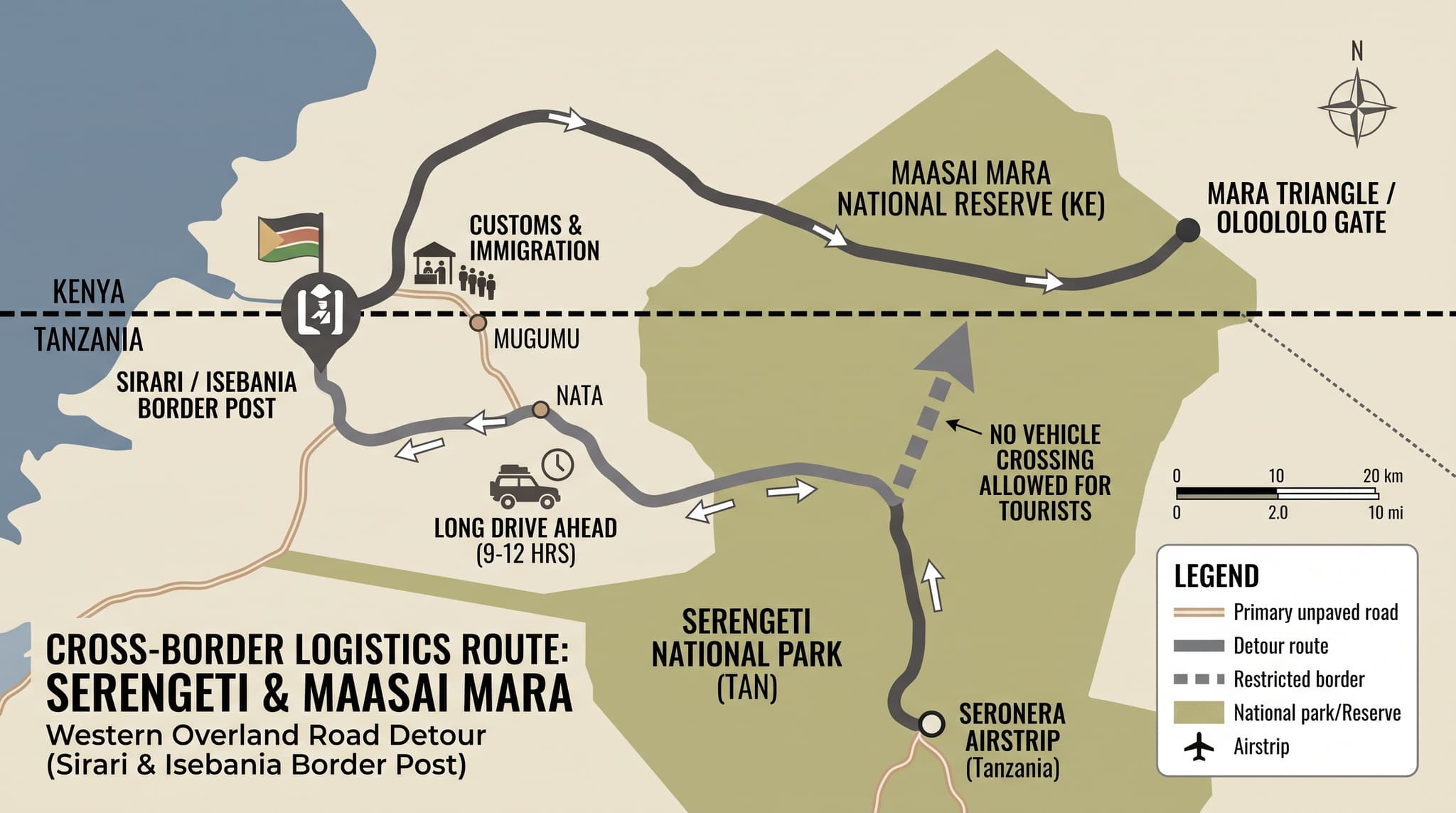
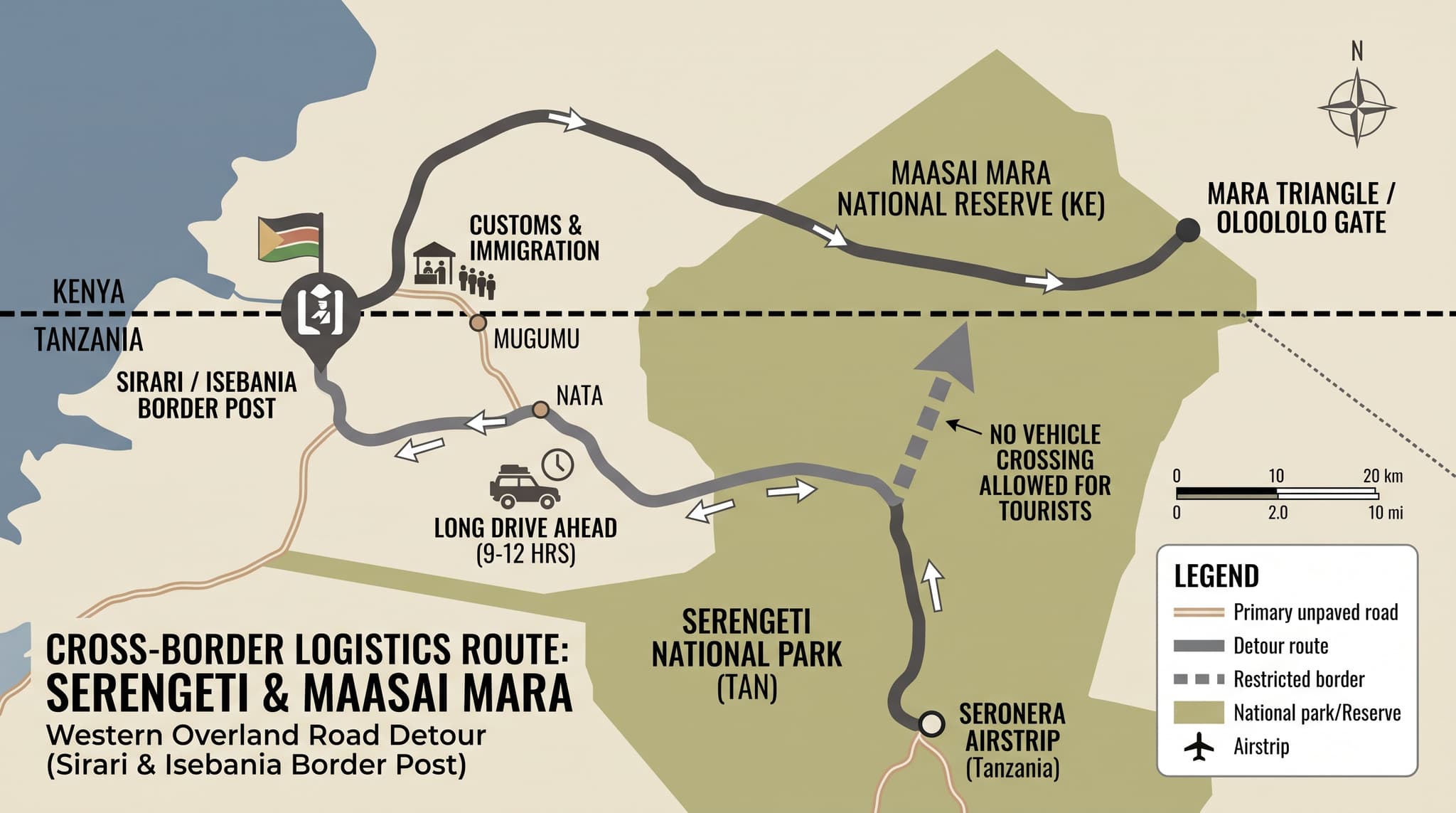
The wildebeest migration is one of the great spectacles on earth, and following it properly means crossing between Tanzania and Kenya. That sounds straightforward until you try to plan it. The border does not sit conveniently between the Serengeti and the Maasai Mara. There is no crossing point there at all. The only practical international land crossing for a migration circuit is at Sirari on the Tanzanian side and Isebania on the Kenyan side — a point well west of both parks. Getting there from the Northern Serengeti takes five to six hours minimum. From the Mara, it is another three to four hours after that. Add one to three hours at the border itself, and you are looking at a full travel day with almost no wildlife viewing. There is also a mandatory vehicle swap at the border, since Kenyan safari vehicles cannot legally operate in Tanzania and vice versa. None of this is insurmountable, but it needs to be understood and planned for. This guide covers every moving part: which border to use, what documentation Australians need, how the crossing procedure works on the ground, what the vehicle restrictions mean for your itinerary, and when flying between countries is the smarter call.
At a glance
- Migration circuit crossing
- Sirari (TZ) / Isebania (KE) — the only practical option
- Total overland travel day
- 10–12 hours including border formalities — a full day lost to transit
- Tanzania entry
- e-Visa required in advance — visa on arrival abolished January 2025
- Kenya entry
- Electronic Travel Authorisation (eTA) required — apply at etakenya.go.ke
- Vehicle swap
- Mandatory — your safari vehicle changes at the border
- Book ahead
- Peak migration camps (July–September) fill 12–18 months in advance
The Three Land Crossings — and Which One You Actually Need
There are three official land border crossings between Tanzania and Kenya. Understanding which one serves which corridor will save you from a costly detour.
1. Namanga (Nairobi ↔ Arusha corridor)
Namanga is the busiest and best-equipped crossing for tourists. It sits about 160 km southeast of Nairobi and 100 km north of Arusha, making it the logical choice for anyone combining Nairobi with Arusha, Kilimanjaro, or Ngorongoro. It operates as a One Stop Border Post (OSBP), where officers from both countries work within a shared complex to reduce processing time. Shuttle buses run regularly, facilities are reasonable, and the crossing is generally efficient if you arrive early — queues during peak safari season (June–October) can be long. Namanga is not, however, relevant to the migration circuit. It serves the eastern tourist corridor, not the western Serengeti–Mara route.
2. Isebania (KE) / Sirari (TZ) — the migration crossing
This is the crossing you need if you are linking the Serengeti with the Maasai Mara. It sits in the far west, and it is the only practical land option for the migration circuit. It operates 24 hours a day as an official OSBP, but services thin out considerably after dark. Cross during daylight whenever possible. Drive times from key locations are as follows:
- From Northern Serengeti (Kogatende area, the prime July–September crossing zone): approximately 5–6 hours to Isebania/Sirari
- From Central Serengeti (Seronera): approximately 4–5 hours
- From Southern Serengeti (Ndutu): 6 or more hours
- From most Maasai Mara camps to the border: approximately 3–4 hours
- Border processing: 1–3 hours depending on the queue
- From the border into the Mara (to Oloololo gate): approximately 2 hours via the town of Migori
Total realistic travel time for a Mara-to-Serengeti or Serengeti-to-Mara crossing: 10–12 hours. You will see very little wildlife during this day. This is a logistics day, not a safari day, and your itinerary should be built accordingly.
3. Loitoktok (Kilimanjaro ↔ Amboseli corridor)
Loitoktok is the least commonly used of the three crossings for migration-circuit travellers. It is most relevant for those combining Moshi or Kilimanjaro with Amboseli in Kenya. If your itinerary runs through southern Kenya rather than the Mara, this crossing is worth knowing about, but it plays no role in a Serengeti–Mara circuit.
The crossing that does not exist
It bears repeating clearly: there is no border crossing between the Serengeti and the Maasai Mara. The parks share an ecosystem but not an immigration facility. Travellers who assume they can cross through the northern Serengeti directly into the Mara Triangle will find no such option exists.
What Actually Happens at the Border — Procedure, Vehicle Swaps and Fixer Warnings
The crossing procedure at Isebania/Sirari
Both crossings (Namanga and Isebania/Sirari) operate as One Stop Border Posts. In practice, the process works like this:
- Your driver stops and advises you to leave the vehicle with all passports and important documents.
- You complete exit formalities for the country you are leaving — stamps, document checks, any departure cards.
- You move through to the other side and complete entry formalities for the country you are entering — immigration, visa or eTA verification, possible customs inspection.
- Luggage or vehicle documentation may be inspected. Cooperate fully and stay with your guide.
- Once cleared, you rejoin your vehicle — or more accurately, you rejoin your new vehicle, because your safari vehicle does not cross with you.
The mandatory vehicle swap
This is the detail that catches most travellers off guard. Kenyan-registered commercial safari vehicles cannot legally operate in Tanzania. Tanzanian vehicles face reciprocal restrictions in Kenya. As of November 2025, enforcement of Kenyan vehicles entering Tanzanian national parks has tightened further — Kenyan-commercial safari vehicles registered in Kenya have long been prohibited by law from operating inside Tanzanian national parks under the bilateral 1985 Tourism Agreement; this is an established statutory restriction, not discretionary ranger leniency.
In practice, a reputable operator will arrange a coordinated handover. Your Tanzanian vehicle and guide bring you to the border. You clear immigration. A Kenyan vehicle and guide meet you on the other side. Your luggage transfers between vehicles. The two guides who know you best — the one finishing and the one starting — should ideally spend five minutes together to brief on preferences, dietary needs, and anything notable from the game drives. Ask your operator to confirm this handover arrangement before you depart Australia.
Fixers
At Isebania/Sirari, as at most active African border crossings, unofficial fixers will approach you offering to expedite your stamp or smooth the process in exchange for payment. Ignore them completely. Their involvement can complicate rather than accelerate your processing and occasionally results in documents being withheld. Your registered guide handles the border procedure. Follow their instructions only.
Timing your crossing
Aim to reach the border no later than mid-morning if you are crossing on the same day you leave camp. Queues are longest in the mid-afternoon, particularly during peak migration season. An early camp departure — by 6:00–6:30 am from Northern Serengeti — gives you the best chance of clearing the border by midday and reaching your Mara camp before dark. Crossing in the opposite direction (Mara to Serengeti), the same principle applies. Do not underestimate how long the drive takes once you factor in unpaved road conditions in both parks.
Currency
Carry some local currency — Tanzanian Shillings on the Tanzanian side, Kenyan Shillings on the Kenyan side. USD is widely accepted at the border and in most tourist-facing contexts, but small expenses (water, a phone charge, a snack at the border town) are easier to handle in local currency. Currency exchange at Isebania/Sirari is available during daylight hours only.
Entry Requirements for Australians — Visas, eTAs and Health Documents
Tanzania — e-Visa (mandatory since January 2025)
Visa on arrival for Tanzania was abolished on 30 January 2025. All travellers, including Australians, must now obtain an e-Visa before crossing any Tanzanian border — land, air, or sea. Australia is among the 158 nationalities eligible for the online e-Visa. Apply through the official Tanzania immigration portal at visa.immigration.go.tz (verify the current live URL at time of booking, as government portals do occasionally migrate).
- Single entry tourist visa: USD 50
- Multiple entry visa: USD 100
- Apply well in advance — do not leave this until the week before departure. Tanzania Immigration recommends applying at least 10 days prior to departure, although safari operators, travel agencies, and global entry experts recommend applying 2 to 3 weeks priot to departure as processing times can slow down substantially during peak migration months (July–October).
- If you are crossing the Tanzania–Kenya border in both directions (Serengeti first, then Mara, then back into Tanzania), you will need a multiple entry visa or a fresh single entry visa for the return crossing.
- The East African Community (EAC) re-entry exemption rule. If an Australian enters Kenya on a single-entry eTA, departs directly into an EAC partner state (Tanzania, Uganda, or Rwanda), and re-enters Kenya directly, the single-entry eTA remains valid for re-entry without purchasing a second eTA, provided the trip is within the original validity window. (Note: Tanzania does not share this concession, so returning to Tanzania does require either a multi-entry visa or a new single-entry visa).Confirm this with your operator.
Kenya — Electronic Travel Authorisation (eTA)
As of 1 January 2024, Kenya replaced its eVisa system with the Electronic Travel Authorisation. All international arrivals, including Australians, must apply before travel. The eTA costs USD 30, though bank processing fees may bring this slightly higher.
- Apply exclusively at: etakenya.go.ke
- Do not use any third-party site — scam portals mimicking the official site are active
- The old evisa.go.ke portal is no longer active
- Apply at least 3 days before travel; applications can be submitted up to 3 months in advance
- Every traveller requires their own eTA, including infants and children
- The eTA allows a single entry and a stay of up to 90 days
- The authorisation is tied to the specific dates and flights entered in your application — if your travel dates change, update your application accordingly
Yellow Fever certificate
Carry your Yellow Fever vaccination certificate. Kenya is classified as a Yellow Fever endemic country. If you are crossing from Kenya into Tanzania, Tanzanian immigration will require proof of vaccination. Without it, you may be vaccinated at the border at your own cost or denied entry. If you have not been vaccinated, attend a travel health clinic in Australia before departure — allow at least 10 days for the vaccine to take effect, and keep the physical certificate (the yellow card) with your passport throughout the trip. The exception is transiting through international airports (such as Nairobi JKIA or Addis Ababa) only mandates a Yellow Fever certificate if the airport transit exceeds 12 hours.
Passport validity
Your passport must be valid for at least six months from your arrival date in the first country you enter. Check this well before travel — many Australians carry passports with less validity than they realise.
Flying Between Countries — When the Border Drive Stops Making Sense
For most travellers who can afford to combine both the Serengeti and the Maasai Mara, flying between the two is the right call. The overland crossing via Isebania/Sirari is a 10–12 hour day with minimal wildlife viewing. A flight, by contrast, is typically 1.5–3 hours in the air, gets you to your next camp before lunch, and preserves an afternoon game drive.
The standard flying route
Most operators route travellers as follows:
- Depart a Maasai Mara airstrip (Kichwa Tembo, Musiara, Keekorok, Serena or similar) to Nairobi's Wilson Airport (WIL)
- Connect at Wilson to a domestic Tanzanian flight to Kilimanjaro International Airport, Arusha Airport, or directly into a Serengeti airstrip (Seronera, Grumeti, Kogatende depending on where the migration is)
The reverse routing works in the same way. Wilson Airport handles a large volume of light aircraft traffic and is a well-functioning hub for East African safari connections, though schedules are subject to weather and demand — build in buffer time and avoid booking flights that require arriving at Wilson with less than two hours before an onward connection.
A common western safari air-link alternative: bush flights flying from the Maasai Mara to Migori Airstrip (Kenya), taking an operator-assisted 45-minute ground transfer through the Isebania/Sirari border post, and boarding an onward domestic flight from Tarime Airstrip (Tanzania) directly into the Serengeti (Kogatende or Seronera). This completely avoids the long detour via Nairobi while bypassing the 10–12 hour overland drive.
The mobile camp alternative
For travellers who want to follow the migration without dealing with the border at all, mobile camps are worth serious consideration. A small number of operators — Olakira Migration Camp is the most cited example — physically relocate their camps multiple times a year to track the herds. In June and July they may be in the Western Corridor near the Grumeti River. By August they have moved north to the Mara River region of the northern Serengeti. You stay within Tanzania throughout, your operator handles all positioning, and you are always within reach of the action. You pay a premium for this model, but it removes the logistical complexity of the border crossing entirely while keeping you in the ecosystem.
When the overland crossing does make sense
The drive via Isebania/Sirari is appropriate for budget-focused travellers, those on overland truck itineraries, or those who genuinely want the experience of a land crossing through East Africa. It is also worth considering if your itinerary includes towns along the western corridor — Lake Victoria, Kisumu — where the drive connects meaningfully to the landscape rather than simply passing through it. In any other migration-focused context, fly.
Border Crossing Preparation Checklist for Australians
Documents — obtain before leaving Australia
- Tanzania e-Visa: Apply at visa.immigration.go.tz. Single entry USD 50, multiple entry USD 100. Mandatory since January 2025 — no visa on arrival.
- Kenya eTA: Apply at etakenya.go.ke only. Costs USD 30. Apply at least 3 days before travel; up to 3 months ahead is fine.
- Passport validity check: Must be valid for at least 6 months from your entry date into the first country.
- Yellow Fever certificate: Physical yellow card required if crossing from Kenya into Tanzania. Vaccinate at a travel health clinic at least 10 days before departure.
- Travel insurance documentation: Carry policy number and emergency contact. Ensure cover includes medical evacuation — standard in East Africa safari planning.
- Children's eTAs: Every traveller including infants needs their own Kenya eTA.
Confirm with your operator before travel
- Which border crossing is being used: For migration circuit: confirm Isebania/Sirari. For Nairobi–Arusha: Namanga.
- Vehicle handover arrangements: Confirm the Kenyan and Tanzanian vehicles and guides are coordinated for the border swap.
- Visa type for return crossing: If re-entering Tanzania after Kenya, confirm whether your e-Visa covers multiple entries.
- Departure time from camp: For Northern Serengeti to Mara crossing, target 6:00–6:30 am departure to reach the border by mid-morning.
- Flying alternative considered: Ask your operator to compare overland vs. fly-in costs and time. For most travellers, flying is worth it.
Pack for the crossing day
- USD cash: Clean, undamaged notes. Useful for any unexpected fees; widely accepted at border towns.
- Local currency: Some Kenyan Shillings and Tanzanian Shillings for small expenses. Exchange available at border during daylight only.
- Snacks and water: The crossing day is long. Assume you will be in transit for 10–12 hours.
- Entertainment and charging cables: Long road sections between the border and parks have limited to no mobile reception.
- Printed document copies: Carry printed copies of your e-Visa approval, eTA approval, Yellow Fever certificate and passport photo page.
- Prohibited items:: Both Kenya and Tanzania strictly prohibit single-use plastic carrier/duty-free bags, disposable plastic beverage bottles/straws are banned within both Maasai Mara and Serengeti National Park
Frequently Asked Questions — Tanzania–Kenya Border Crossing
Can I cross directly between the Serengeti and the Maasai Mara?
No. There is no border crossing between the two parks. The only practical land crossing for the migration circuit is at Isebania (Kenya) and Sirari (Tanzania), located well to the west. Getting there from the Northern Serengeti alone takes 5–6 hours.
Do Australians need a visa for Tanzania and Kenya?
Yes to both, though the systems differ. For Tanzania, apply for an e-Visa before travel at visa.immigration.go.tz — visa on arrival was abolished in January 2025. For Kenya, apply for an Electronic Travel Authorisation (eTA) at etakenya.go.ke. The eTA replaced the old eVisa system in January 2024 and costs USD 30.
How long does the border crossing take?
The crossing itself takes 1–3 hours depending on the queue. Combined with drive times from your camp on either side, you should budget a full 10–12 hour day for any Mara-to-Serengeti or Serengeti-to-Mara land transfer.
Why do I have to change vehicles at the border?
Kenyan and Tanzanian commercial safari vehicles are not legally permitted to operate in the other country. Your operator should arrange coordinated vehicle handovers at the border as a standard part of any cross-border itinerary.
Someone at the border offered to get my stamp faster for a fee. Should I pay them?
No. These are unofficial fixers. Their involvement can slow rather than speed the process, and it occasionally results in documents being temporarily withheld. Follow your registered guide's instructions only.
Is it better to fly between the Serengeti and the Maasai Mara?
For most travellers, yes. Flying preserves a full day of safari time and avoids the logistical complexity of the border crossing. The standard route is from a Mara airstrip to Nairobi's Wilson Airport, then onward to a Serengeti airstrip or Kilimanjaro/Arusha. The overland crossing makes sense for budget travellers or those on overland truck itineraries.
Do I need a Yellow Fever certificate?
Yes, if you are crossing from Kenya into Tanzania. Kenya is classified as a Yellow Fever endemic country, and Tanzania requires proof of vaccination at entry if you are arriving from an endemic country with the exception of transiting through international airports (such as Nairobi JKIA or Addis Ababa) only mandates a Yellow Fever certificate if the airport transit exceeds 12 hours. Carry your physical yellow vaccination card with your passport throughout the trip.
How far in advance should I book for the peak migration season?
For July, August and September — when the Mara River crossings are at their peak — the best camps in the Mara Triangle and private conservancies book out 12 to 18 months in advance. If you are planning a migration circuit for any of these months, start enquiring immediately.
What is the Namanga crossing, and should I use it?
Namanga is the main tourist crossing between Nairobi and Arusha. It is well-equipped and suited to the eastern corridor — Kilimanjaro, Ngorongoro, northern Tanzania. It is not relevant to the migration circuit, which requires the Isebania/Sirari crossing further west.