practicalities· 19 min read· Explore Africa editorial · Published August 2026 · Updated 9 Sept 2026
Flying to Africa from Australia
Choosing between Qantas direct and a Middle East connection shapes your entire safari itinerary — get the routing wrong and you could miss your bush flight before you've even unpacked.
Getting to an African safari from Australia involves more moving parts than most long-haul trips, and the routing decision you make in Sydney or Perth will ripple all the way to a remote bush airstrip in Botswana or the Kruger. There are now two broad paths: fly Qantas direct into Johannesburg from Sydney or Perth, or connect through a Middle East or Singapore hub to reach Johannesburg, Nairobi, Dar es Salaam, or Cape Town. Each approach has genuine advantages — and one very specific trap that catches Australian travellers more often than it should. The 'same-day bush connection' problem is real: arrive into OR Tambo on an afternoon flight from Sydney, and the clock is immediately working against you. Understanding the terminal layout at JNB, the role of Airlink as the primary regional connector, and which transit hotels are actually walkable from arrivals will determine whether your safari starts on day one or day two. This guide covers every route option currently operating, flags the Qatar Airways and Etihad service disruptions that affected early 2026 and the subsequent partial restoration of both carriers, and gives you a practical overnight-transit checklist so nothing is left to chance. Verify current schedules at qantasnewsroom.com.au and flyairlink.com before booking, and check johannesburg-airport.co.za/terminals.html for the latest terminal information.
At a glance
- Qantas Sydney–JNB flight time
- ~14 hrs 50 min (QF63/QF64 — nonstop, A380, ~4× weekly from March 2026; verify current days on qantas.com)
- Qantas Perth–JNB flight time
- ~11 hrs 15 min (QF65/QF66 — nonstop, A330, 3× weekly: Tue/Fri/Sun; verify on qantas.com)
- Middle East hub options
- Dubai (Emirates), Doha (Qatar — restored and expanding from mid-2026), Abu Dhabi (Etihad — partially restored from June 2026), Singapore (Singapore Airlines)
- East African safari gateways
- Nairobi (NBO) and Dar es Salaam (DAR) via Dubai, Doha, or Abu Dhabi
- Regional bush connector
- Airlink (4Z) — hub at JNB operating domestic bush routes (Hoedspruit/Skukuza via Terminal B) and cross-border safari routes (Maun/Kasane/Vic Falls via Terminal A).
- Recommended JNB connection strategy
- Overnight transit hotel — do not attempt same-day bush connection after afternoon arrival from Australia
Qantas Direct: Sydney and Perth to Johannesburg
Qantas is the only airline flying nonstop from Australia to South Africa on both coasts. The Sydney–Johannesburg service (QF63/QF64) has been the flagship of the route for years, recently upgraded to an Airbus A380 which nearly doubled capacity and reintroduced First Class — useful to know if you are planning to burn Qantas Points on a premium fare. Departures from Sydney typically leave between 09:30 and 10:35, arriving JNB at approximately 15:00–16:25. That arrival window is the central problem discussed in Section 4 below. Note that as of March 2026, the Sydney service was reduced from daily to approximately four times weekly; confirm current operating days on qantas.com before booking.
The Perth route has a layered history. Qantas first operated Perth–Johannesburg nonstop before suspending the service in March 2023. South African Airways then stepped in, restarting its own non-stop Perth–Johannesburg service in April 2024 after a four-year pandemic-era absence. Qantas relaunched the route on 7 December 2025 with flight QF65, operating three times weekly (Tuesday, Friday, Sunday — verify on qantas.com, as operating days shifted from the original announcement) on an A330 with 27 business class suites in a 1-2-1 configuration. The return (QF66) is notably faster at around 9 hours 55 minutes thanks to tailwinds.
For West Australian travellers especially, the direct Perth route removes the need for an east-coast positioning flight — a genuine convenience when you are already carrying soft safari bags and facing a strict 15–20 kg luggage limit on bush planes ahead.
Official route details and current schedules: qantasnewsroom.com.au
Middle East and Singapore Transit Routes
The major alternative to Qantas direct is routing through a Middle East hub or Singapore, which opens up a wider range of African entry points beyond Johannesburg.
Emirates via Dubai (DXB): The most consistent option in this group. Emirates connects from Australian cities to Nairobi, Dar es Salaam, Johannesburg, Cape Town, and other African gateways. For safari travellers targeting Kenya or Tanzania, a Dubai connection is often the most straightforward path — you avoid Johannesburg entirely and arrive directly into East Africa. Emirates curtailed services to South Africa in early March 2026 amid regional disruptions but had restored around 60% of its network by mid-March 2026; verify current status before booking.
Qatar Airways via Doha (DOH): Historically strong on east and southern Africa and well-regarded for in-flight product. Qatar Airways suspended or significantly curtailed flights to Johannesburg, Cape Town, and Durban in early March 2026, but had restored and expanded its African services by mid-2026 — including increasing Cape Town frequencies as part of its Summer 2026 African network expansion. Verify current schedules before booking.
Etihad via Abu Dhabi (AUH): Also reduced services to South Africa in the early 2026 disruption period, but resumed Johannesburg–Abu Dhabi flights from 15 June 2026, operating four times a week. Verify current schedules before committing.
Singapore Airlines via Singapore (SIN): A solid option for eastern Australian travellers. Singapore Airlines operates a nonstop Singapore–Johannesburg service (one of the longest routes departing from South Africa), meaning the Australia leg is SYD/MEL/PER → SIN, then a long-haul direct to JNB. Business and premium economy cabins are available. For travellers who prefer to break the journey across two long-haul sectors rather than one very long one, Singapore is a logical and comfortable middle stop.
East African gateway note: Nairobi's Jomo Kenyatta International Airport (NBO) and Julius Nyerere International in Dar es Salaam (DAR) are the two dominant East African safari gateways. Both are accessible via Dubai, Doha, or Abu Dhabi connections. If your safari is Kenya or Tanzania-based, routing through the Middle East directly to NBO or DAR and bypassing Johannesburg entirely simplifies your logistics considerably.
OR Tambo International: How the Terminal Works
Johannesburg's OR Tambo International (JNB) has two main terminals — Terminal A and Terminal B — housed within the same building complex and joined internally by short corridors. Walking between them takes about 5 to 10 minutes. Arriving international passengers exit landside after baggage reclaim/customs, take the central terminal escalators/lifts upstairs, and re-clear security at their respective departure terminal.
International Arrivals & Customs: All travellers arriving from Australia arrive into Terminal A/B arrivals hall. You must clear South African border control, collect all checked luggage from the carousel, and pass through customs into the public arrivals concourse.
Domestic Safari Flights (e.g., Hoedspruit / Skukuza for Kruger): Turn left after customs, head upstairs to Terminal B, re-check your bags at the domestic check-in counters (including Airlink), and clear domestic security.
Cross-Border Safari Flights (e.g., Maun / Kasane for Botswana, Victoria Falls): These are international flights. Head upstairs to Terminal A (International Departures), check in, clear South African outbound passport control, and proceed to the international departure gates.
Note on Airlink (4Z): Airlink is the primary safari connector across Southern Africa. SA Express no longer operates—disregard any legacy guides referencing it.
Full terminal guide: johannesburg-airport.co.za/terminals.html
Airlink routes and schedules: flyairlink.com
What to Pack: Safari Luggage Checklist for the Australia–Africa Journey
Clothing
- Neutral-toned safari shirts (3–4 lightweight, long-sleeve): Olive, khaki, sand, or grey — avoid white (dust) and dark blue or black (attracts tsetse flies in some regions)
- Safari trousers or zip-offs (2 pairs): Lightweight and quick-drying; zip-offs give you shorts without extra packing
- Shorts (1–2 pairs): For camp downtime; not appropriate on most game drives
- Warm mid-layer fleece or softshell jacket: Early morning game drives in Botswana or the Kruger can be genuinely cold, even in dry season
- Packable down jacket or gilet: Compresses small; doubles as a blanket on the long-haul flight
- Light waterproof rain shell: Essential during green season; useful in transit airports
- Smart-casual outfit for transit hotel and city stays (1 set): Useful for JNB transit hotel dinner and any pre- or post-safari city time
- Base-layer thermal top (1): Lightweight merino is ideal — works as a sleep layer on the plane too
- Underwear and socks (5–6 sets, merino preferred): Merino manages odour better across multi-day bush rotations where laundry may be infrequent
- Swimwear (1–2 pieces): Most permanent tented camps and lodges have a pool
- Buff or neck gaiter: Doubles as dust protection on open-vehicle game drives and sun protection
- Wide-brim hat with chin strap: Chin strap critical on open game-drive vehicles at speed
- Light gloves (if travelling April–August dry/cool season): Particularly relevant for Botswana and the Kruger highlands at dawn
Footwear
- Neutral-coloured walking shoes or light hiking boots: Closed-toe essential; brown or olive — avoid bright colours on walking safaris
- Comfortable slip-on sandals or Crocs: For camp, pool, and airport; sandals are the easiest shoes to remove at security
- Warm socks (2–3 pairs, wool or merino): For cold-morning game drives and as flight compression socks on long-hauls
Gear & Carry-On Essentials
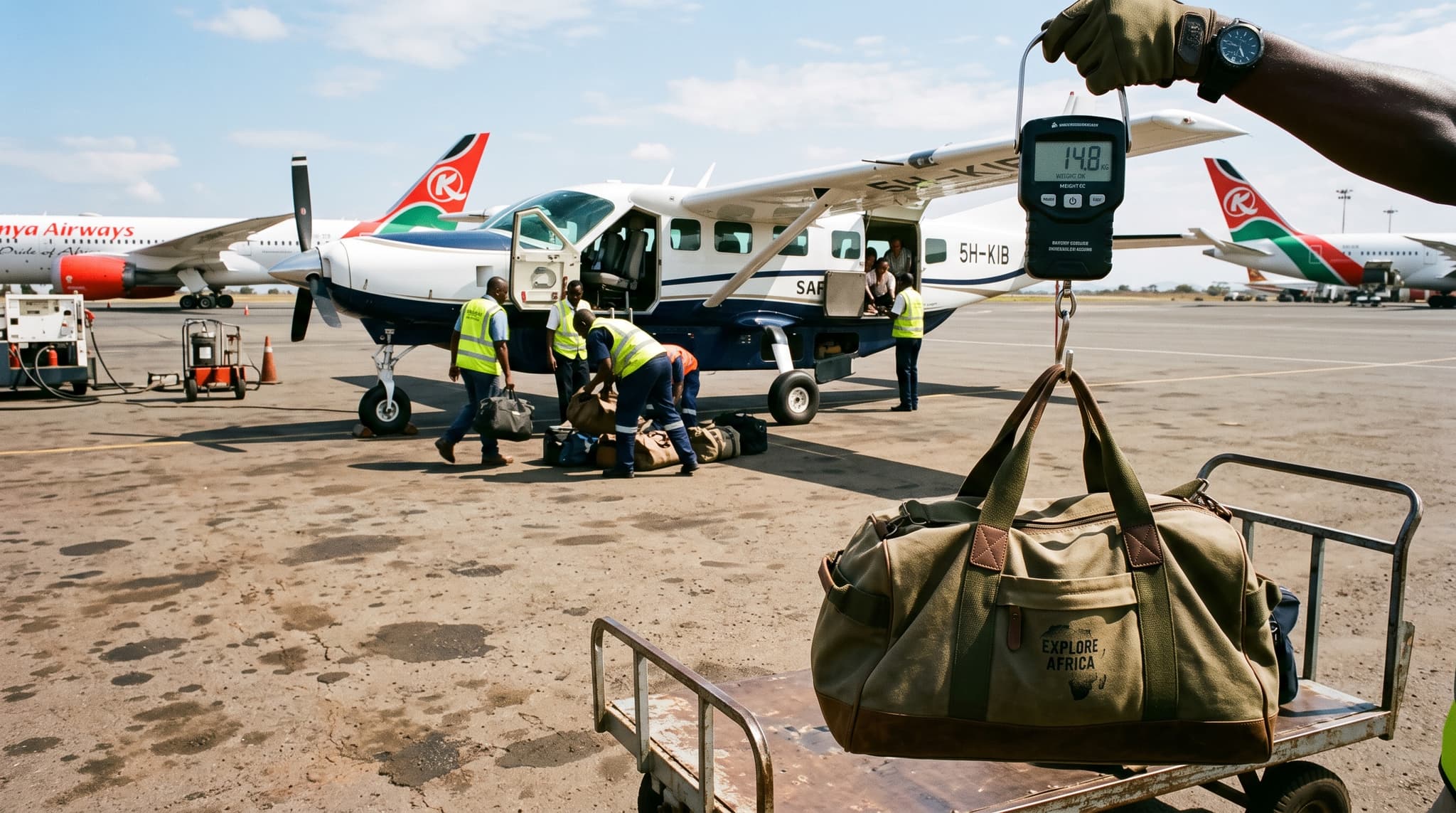
- Soft-sided duffel bag (main checked luggage, max 15–20 kg): Hard-shell suitcases are typically not permitted on light safari aircraft — soft bags only
- Day pack or small carry-on backpack: For the long-haul flight, overnight transit hotel, and camp day use
- Binoculars (8×42 recommended): Non-negotiable for serious game viewing; pack in carry-on, not in checked luggage
- Camera with zoom lens and spare batteries: Battery charging may only be available at certain hours in remote camps — carry extras
- Universal travel adaptor (South Africa uses Type M/N plugs): Type M is the large 3-pin round; carry a universal to cover all African destinations
- Portable battery/power bank (20,000 mAh recommended): Keep in carry-on only — most airlines prohibit large power banks in checked luggage
- Packing cubes: Critical for soft-bag organisation; allows fast repacking between overnight transit and bush camp
- Small padlock for duffel bag zip: Useful at transit hotels and where bags are stored at camp during activities
- Reusable water bottle: Most camps provide filtered water; reduces plastic waste at remote destinations
- Headlamp or small torch: Camps are often unlit between tents at night; headlamp is more practical than a phone torch
- Sleep kit for long-haul (eye mask, ear plugs, inflatable neck pillow): The Sydney–JNB leg is ~15 hours; arriving rested materially affects your same-day transit decision-making
Documents & Finance
- Passport (valid for 6+ months beyond return date, with multiple blank pages): South Africa specifically requires at least two blank pages for entry stamps
- All flight booking confirmations printed and on phone: Include your Airlink bush-flight booking separately — it will not appear on your Qantas itinerary
- Safari camp booking vouchers: Camps often require a voucher or confirmation number on arrival
- Transit hotel confirmation for JNB overnight: Book and confirm before you leave Australia — airport hotels fill quickly around peak flight arrivals
- Travel insurance policy (print and digital copy): Ensure your policy covers emergency medical evacuation — essential for remote bush destinations
- Yellow Fever vaccination certificate (if required for your itinerary): Required for entry into Kenya, Tanzania, and some other East African and West African countries; check current requirements with your destination country's embassy
- Small amount of local currency (South African Rand and/or USD): USD is widely accepted as gratuity currency across sub-Saharan Africa; Rand for South African transit costs
- Credit card with no foreign transaction fees: Notify your bank before travel; some remote lodge regions have patchy card terminals — carry cash backup
Health & Medical
- Malaria prophylaxis (prescribed by your GP or travel medicine clinic): Start course before departure; most Botswana and Kruger safari regions are malaria zones — confirm with your doctor
- Insect repellent (DEET 30–40% or Picaridin-based): Essential at dusk and dawn in malaria zones; pack in checked luggage for the flight
- High-SPF sunscreen (factor 50+): African sun is intense; open game-drive vehicles offer no shade
- Lip balm with SPF: Often overlooked; dry safari air and sun exposure combine quickly
- Personal prescription medications (full supply plus 5-day buffer): Carry in original packaging with a doctor's letter; split between carry-on and checked bag in case of lost luggage
- Basic first-aid kit (blister pads, antiseptic wipes, bandages, antihistamine): Remote camps have first-aid capability but not a pharmacy
- Imodium and rehydration salts: Dietary changes and travel fatigue can cause stomach issues; better to have and not need
- Hand sanitiser (100 ml or less for carry-on): Game-drive vehicles may not have handwashing facilities between stops
- Compression socks for long-haul flights: The Sydney–JNB leg alone is nearly 15 hours; compression socks meaningfully reduce DVT risk
Transit Hotels at OR Tambo: Your Overnight Options
If you take one piece of advice from this guide, let it be this: book your JNB transit hotel before you leave Australia. Airport hotels near OR Tambo fill up quickly around the peak afternoon arrival window, and you do not want to be problem-solving accommodation at midnight after a 15-hour flight.
Four well-documented options, ranked by proximity to the international arrivals hall:
InterContinental OR Tambo — directly connected to Terminal A via an enclosed walkway, approximately 70 metres from the international arrivals hall. The most convenient option if you want to be in bed within minutes of clearing customs. Priced accordingly.
City Lodge OR Tambo — connected via pedestrian walkways, approximately 0.2 miles (a short walk with luggage). Consistently recommended by experienced JNB transitters as the best balance of convenience and value. A 10–15 minute indoor walk from arrivals.
Southern Sun OR Tambo — approximately 500 metres from the terminal. A free 24-hour shuttle runs roughly every 15 minutes; pickup is at the shuttle terminal behind the InterContinental. Comfortable and well-regarded.
Premier Hotel OR Tambo — requires a free shuttle bus of approximately 10 minutes. Noted by Australian Frequent Flyer community members as roughly half the price of the InterContinental, with solid reviews. A good choice if you are cost-conscious and do not mind the short transfer.
All four options are standard international-grade hotels with restaurants — useful if you are arriving hungry after a long flight and want a proper meal before an early morning Airlink departure.
Frequently Asked Questions: Flying Australia to Africa for Safari
Is Qantas direct to Johannesburg better than flying via Dubai or Singapore?
It depends on your departure city and final African destination. The Qantas direct from Sydney (approximately 4× weekly from March 2026) or Perth (Tue/Fri/Sun — verify on qantas.com) is genuinely convenient — no transit stress, no missed connections in a Middle East hub. However, if your safari is in Kenya or Tanzania, routing via Dubai on Emirates to Nairobi or Dar es Salaam directly often makes more sense than going to Johannesburg first. For South Africa and Botswana safaris, Qantas direct wins on simplicity.
Can I fly from Johannesburg to my safari destination on the same day I arrive from Australia?
Technically possible, but strongly discouraged for afternoon arrivals. The Qantas Sydney service arrives JNB at approximately 15:00–16:25. After clearing international immigration, collecting bags, and transferring to the domestic side of the terminal for an Airlink bush flight, you are working with very little margin. Immigration queues at OR Tambo can be lengthy, and a missed connection typically means a lost safari night. Book an airport transit hotel and take the morning departure.
Which terminal do Airlink bush flights depart from at Johannesburg?
OR Tambo has two main terminals — Terminal A (international departures) and Terminal B (domestic operations and international arrivals), joined internally with no need to re-clear security airside. Airlink (airline code 4Z) operates from the domestic side of the complex, which is Terminal B. After clearing international arrivals, follow the transfer signs through the internal corridor to reach domestic check-in. Always confirm your specific gate with Airlink and check your boarding pass on the day, as OR Tambo is currently undergoing upgrades and signage may shift. Airlink's routes and schedules are listed at flyairlink.com, and the airport's terminal guide is at johannesburg-airport.co.za/terminals.html.
Are Qatar Airways and Etihad still operating to South Africa?
Both carriers significantly curtailed their South Africa services in early March 2026 amid regional disruptions, but the situation has since improved considerably. Qatar Airways had restored and was actively expanding its African network by mid-2026, including increased Cape Town frequencies. Etihad resumed Johannesburg–Abu Dhabi flights from 15 June 2026, operating four times a week. Verify current schedules directly with both airlines before booking — the situation was fluid and may continue to evolve.
What type of bag do I need for a bush safari flight?
A soft-sided, collapsible duffel bag is required for virtually all light aircraft bush transfers. Hard-shell suitcases cannot be loaded into the cargo holds of small bush planes like the Cessna Caravan and will be left behind. The weight limit is typically 15–20 kg total per person. Pack your soft duffel as your primary bag from the moment you leave Australia — do not plan to repack in Johannesburg.
What is the easiest transit hotel option at OR Tambo if I arrive late and exhausted?
The InterContinental OR Tambo is the fastest option — directly connected to Terminal A via an enclosed walkway, approximately 70 metres from the international arrivals hall. The City Lodge is a short indoor walk and offers good value. If price is a priority, the Premier Hotel runs a free shuttle that takes around 10 minutes and is reportedly around half the price of the InterContinental. Book all options before you leave Australia.
Do I need a Yellow Fever certificate to travel to Africa from Australia?
It depends on your specific itinerary. Kenya, Tanzania, and several other East African and West African countries require proof of Yellow Fever vaccination for entry. South Africa does not require it for direct arrivals from Australia, but does require it if you are arriving from a Yellow Fever endemic country. Check current requirements with your destination country's embassy and visit a travel medicine clinic in Australia at least 4–6 weeks before departure to allow time for vaccination and any other prophylaxis.
What happens if my luggage misses a bush connection at Johannesburg?
If your checked bag misses the Airlink connection and is recovered the following day, the airline will attempt to forward it to your destination — but in practice, a remote safari camp may not receive it until the day after that, once the airline has worked out the logistics of getting it to an airstrip. This is a strong argument for carrying essential safari items (binoculars, camera, medication, one change of clothes) in your carry-on rather than in checked luggage.