practicalities· 14 min read· Explore Africa editorial · Published October 2026 · Updated 30 Oct 2026
Visas for Australian travellers
A country-by-country guide to entry rules for Australian passport holders across the 12 African destinations Explore Africa knows best — what's visa-free, what needs an eVisa or eTA, what you can still get on arrival, plus yellow fever, regional passes and the rules that changed in 2025–26.
Africa is one of the easiest long-haul regions for Australians to travel — but the visa rules are a patchwork that changes more often than almost anywhere else. Some of our destinations wave you straight through with no visa at all; some now want an electronic authorisation arranged online before you board; and a couple have introduced brand-new visa requirements in the past year. The good news: with a little planning it's all very manageable, and several countries can be combined on a single regional visa. This guide walks through the entry rules for Australian passport holders across the 12 countries Explore Africa specialises in, flags what changed in 2025–26, and covers the cross-cutting essentials — passport validity, yellow fever certificates and dual nationality. One rule applies everywhere: requirements can change at short notice, so always confirm the current advice on Smartraveller (smartraveller.gov.au) before you book and again before you fly.
At a glance
- Passport validity
- 6 months beyond travel is the safe rule (South Africa needs only 30 days past departure)
- Blank pages
- Keep at least 2–3 blank pages free
- No visa needed
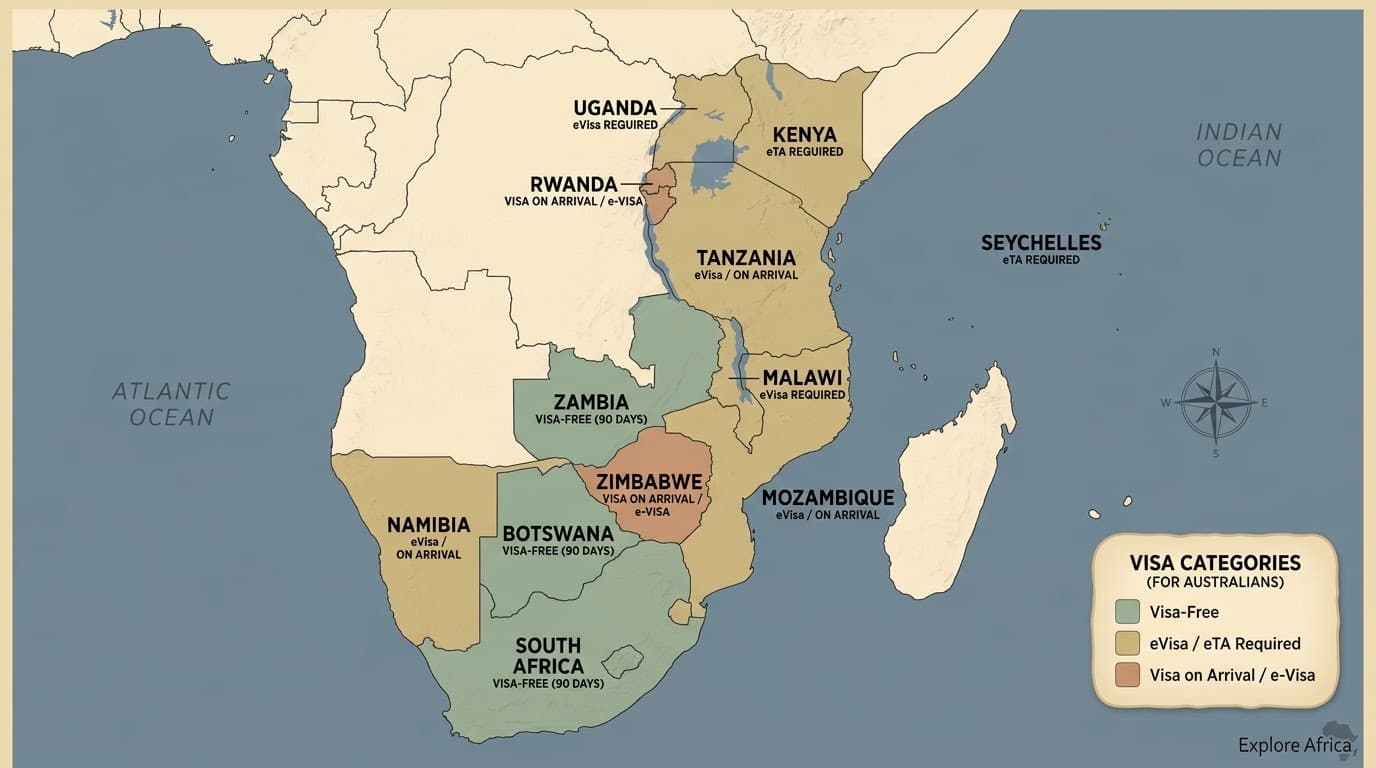
- South Africa · Botswana · Zambia
- Arrange online first
- Kenya · Tanzania · Uganda · Mozambique · Malawi · Namibia · Seychelles
- On arrival
- Zimbabwe (USD cash or international card) · Namibia · Rwanda (free for Australians)
- Yellow fever
- Mandatory for Uganda; elsewhere only if you arrive from a risk country
- Regional passes
- KAZA Univisa (Zimbabwe + Zambia) · EATV via Rwanda or Uganda; Kenya-first product still marked coming soon
- Golden rule
- Rules change often — confirm on Smartraveller before booking
Visa at a glance by country
South Africa
Visa-free · up to 90 days
No visa for tourism. Passport valid at least 30 days beyond departure with 2 blank pages; you may be asked for a return or onward ticket and proof of funds.
Botswana
Visa-free · up to 90 days
No visa for tourism. Passport valid 6 months. A yellow-fever certificate is required if you arrive from, or have transited, a yellow-fever risk country.
Namibia
Visa required (new since 1 Apr 2025)
Visa on arrival for about N$1,600 (≈US$90), or apply online beforehand at eservices.mhaiss.gov.na to skip the queue. Valid 3 months. This is a 2025 change — Namibia was previously visa-free.
Zimbabwe
Visa on arrival or eVisa
Australian passport holders (Category B) can get a tourist visa on arrival (US$30 single entry · US$ 45 double entry) or apply beforehand at evisa.gov.zw. Valid for 30 days initially and extendable in-country to a maximum 90-day stay. Fees at the border can be paid in USD cash (printed 2013 or later) or by international card, though carrying cash backup is essential.
Zambia
Visa-free · up to 90 days
No visa required for tourism (up to 90 days within any 12-month period, in force since late 2022). Carry proof of onward travel and sufficient funds. The US$50 KAZA Univisa is an option on arrival if pairing with Zimbabwe.
Kenya
eTA required (online)
Obtain a standard eTA before travel exclusively at etakenya.go.ke (base fee US$32.50; **US$ 34.09 total with card surcharge). Apply at least 2 weeks ahead. Multi-country tip: A single-entry Kenya eTA remains valid for re-entry if you cross directly into Tanzania, Uganda, or Rwanda and return to Kenya within your original 90-day validity window. Kenya's official portal still marks the East African Tourist eTA as ‘coming soon’, so travellers entering Kenya first cannot apply for the regional pass through Kenya.
Tanzania (incl. Zanzibar)
eVisa required (online)
US$50 single-entry tourist eVisa (or US$100 multiple-entry) applied for in advance at visa.immigration.go.tz — visa on arrival is no longer available. One visa covers the mainland and Zanzibar, but Zanzibar requires separate compulsory inbound travel insurance (US$ 44 per adult, US$22 for ages 3–17, free under 3) booked at inbound.visitzanzibar.go.tz. Apply at least 2–3 weeks ahead.
Uganda
eVisa required (online)
Apply online at least 2–3 weeks before travel at visas.immigration.go.ug (US$50 single entry). You must upload your Yellow Fever certificate during the online application and carry a printed paper copy of your eVisa approval letter for inspection at Entebbe. Uganda also issues the US$100 East Africa Tourist Visa (valid 90 days) for trips starting in Uganda and continuing only within Uganda, Rwanda, and Kenya.
Mozambique
eVisa required (online)
From about US$95 for 30 days at evisa.gov.mz. Since the February 2026 portal relaunch, don't rely on visa on arrival — apply before you fly and at least 1–2 weeks ahead.
Rwanda
Visa on arrival — free for Australians
Australians receive a fee-waived 30-day visa on arrival. Rwanda also issues the US$100 East Africa Tourist Visa for a trip that starts in Rwanda and remains within Rwanda, Uganda and Kenya; Rwanda says first entry must be through the country that issued it.
Malawi
Visa required (new since Jan 2026)
Visa-free entry for Australians was withdrawn in late 2025/early 2026. Apply online 2–3 weeks before departure at evisa.gov.mw (US$50–$75 for a single-entry tourist eVisa, valid up to 90 days from the date of issue, not arrival). Carry a physical printout of your approval letter for border control.
Seychelles
Visa-free, but Travel Authorisation needed
No visa required, and a visitor's permit of up to 3 months is issued free on arrival. However, every traveller must obtain a Digital Travel Authorisation (from €10 standard fee) at seychelles.govtas.com or via the Seychelles E-Border app up to 30 days before flying, using confirmed flight, accommodation, and passport details.
Before you apply
A few habits make African entry painless.
- Check Smartraveller for every country on your route. Each destination's page lists the current visa position, passport-validity rule and any health requirements.
- Mind your passport. Most African countries want at least 6 months' validity beyond your travel dates (South Africa is the exception at 30 days past departure), plus 2–3 blank pages. If your passport is getting full or close to expiry, renew it well before you go.
- Apply online where you can, and only on official sites. Kenya, Tanzania, Uganda, Mozambique, Malawi, Namibia and Seychelles all expect you to arrange entry online in advance. Use the official government portal — many lookalike sites charge a hefty markup for the same document.
- Carry a payment fallback. Zimbabwe currently accepts US-dollar cash or international credit/debit cards for a visa on arrival. Carry suitable USD cash as backup because card systems can fail.
- Have your proof ready. Return or onward tickets, accommodation bookings and evidence of funds are commonly requested — keep them printed as well as on your phone.
- Allow time. Some eVisas (Tanzania, Uganda) can take 7–10 working days, so don't leave applications to the last minute.
Multi-country passes that save money
If your trip crosses borders, regional products can help — but the first-entry rule matters.
- KAZA Univisa (US$50, valid 30 days) — Covers unlimited cross-border travel between Zimbabwe and Zambia, plus day trips into Botswana (Chobe) through the Kazungula border. Available on arrival at Victoria Falls, Livingstone, Harare, Lusaka, and Kazungula entry points (or via Zimbabwe's eVisa portal). Confirm sticker stock and availability at arrival.
- East Africa Tourist Visa (EATV) — Rwanda and Uganda currently publish a US$100, 90-day, multiple-entry visa for travel within Rwanda, Uganda and Kenya. Apply through Rwanda only when Rwanda is your first entry, or through Uganda only when Uganda is your first entry. Kenya's official eTA eligibility page currently labels its East African Tourist eTA as ‘coming soon’. If Kenya is your first entry, obtain the standard Kenya eTA and ask the relevant immigration authorities what separate documents the rest of the itinerary requires.
For a single-country trip, use that country's ordinary visa or eTA.
Yellow fever & health documents
Yellow fever certificates are about where you've been, not just where you're going — which is why they matter most on multi-country safaris.
- Uganda requires a yellow-fever vaccination certificate (ICVP) from every visitor (aged 1 year and over), regardless of where you have travelled from, both uploaded for your eVisa and inspected on arrival.
- Most other countries here — South Africa, Botswana, Namibia, Zambia, Zimbabwe, Tanzania, Malawi, Mozambique, Rwanda, and Seychelles — only require a certificate if you are arriving from, or have transited for more than 12 hours through, an airport in a yellow-fever risk country (such as Kenya, Uganda, or Ethiopia). Direct flights from Australia via Johannesburg, Doha, or Dubai do not trigger this requirement, nor do airside airport layovers under 12 hours in Nairobi or Addis Ababa.
- Get vaccinated at least 10 days before travel — that's when the certificate becomes valid. Since a 2016 WHO rule change, the yellow-fever certificate is valid for life, so no more 10-year boosters.
- Malaria isn't a document, but much of safari Africa is malarial — see your GP or a travel clinic 6–8 weeks ahead about anti-malarials and routine vaccinations.
- Carry the original yellow booklet (and a copy). A photo on your phone may not be accepted at the border.
Dual nationals
If you hold a second passport as well as your Australian one, take extra care.
- Australian–South African dual nationals must enter and exit South Africa on their South African passport — this is South African law, not a preference.
- For any country, travel on the same passport you used to obtain the visa, eVisa or eTA. Mixing passports between application and arrival causes problems at the gate.
- Other dual nationalities can change the rules entirely — some passports are visa-free where the Australian one is not, or vice versa. Check both, and tell us which passports you hold so we can plan around them.
Travelling with children (under 18) in Southern Africa
Unabridged Birth Certificates (UBC): Botswana, Namibia, South Africa, Zimbabwe, and Mozambique strictly enforce child-trafficking border laws. Travellers under 18 must carry an original or certified Unabridged Birth Certificate showing both parents' names alongside their passport. If only one parent is travelling, a certified Parental Consent Affidavit from the non-travelling parent is mandatory.
South Africa's Mandatory Customs Declaration (New from 1 July 2026)
While Australians remain visa-free for South Africa, every traveller entering or exiting South Africa (except those remaining airside in the international transit zone) must now submit a free SARS Online Traveller Declaration at sars.gov.za/travellerdeclaration or via the SATMS app within 24 hours before their final flight bound for South Africa.
Document checklist before you fly
Visas & authorisations
- Visa, eVisa or eTA for each country: printed approval plus a copy on your phone
- Regional pass if applicable: KAZA Univisa or East Africa Tourist Visa
- USD cash for on-arrival borders: Carry clean, untorn US dollar notes printed in 2013 or later (older series or creased notes are routinely rejected across East and Southern Africa). While Zimbabwe accepts USD cash and international cards, card terminals frequently go offline at border posts.
Passport & health
- Passport valid 6+ months: 30 days past departure is enough for South Africa only
- 2–3 blank passport pages
- Yellow-fever certificate: mandatory for Uganda; otherwise if arriving from a risk country
- Anti-malarials & travel insurance: insurance should cover medical evacuation
Proof & backups
- Return or onward ticket
- Accommodation bookings
- Evidence of sufficient funds
- Copies of all documents: kept separately from the originals
Frequently asked
Which African countries can Australians visit without a visa?
For tourism, South Africa, Botswana and Zambia require no visa for stays up to 90 days. Seychelles needs no visa but requires a paid Digital Travel Authorisation before you fly, and Rwanda gives Australians a free visa on arrival. Everywhere else on our list needs a visa, eVisa or eTA — see the country cards above.
What changed recently?
Several major entry rules shifted between 2024 and 2026. Kenya replaced its visa with an online eTA in January 2024; Tanzania abolished its visa on arrival in January 2025 (making the online eVisa mandatory); Namibia introduced a visa requirement on 1 April 2025; Malawi reinstated visas for Australians from January 2026; and Mozambique relaunched its eVisa portal in February 2026. Always reconfirm before booking.
Do I need a yellow fever vaccination?
Uganda requires a yellow-fever certificate from all visitors. Other countries here require it only if you arrive from, or transit, a risk country — which commonly applies on multi-country safaris. Get the jab at least 10 days before travel; the certificate is now valid for life.
What is the KAZA Univisa?
A US$50 regional visa covering Zimbabwe and Zambia, with unlimited crossings between them for 30 days — ideal for visiting Victoria Falls from both sides. It's available on arrival at the main Victoria Falls and Livingstone entry points.
I'm visiting several East African countries — is there one visa?
Sometimes. Rwanda and Uganda currently issue an East Africa Tourist Visa for a trip that starts in the issuing country and remains within Rwanda, Uganda and Kenya. Kenya's official eTA portal currently marks its East African Tourist eTA as ‘coming soon’. If Kenya is first, obtain the standard Kenya eTA and confirm separate requirements for Uganda and Rwanda before travel.
How long does my passport need to be valid?
As a safe rule, at least six months beyond your travel dates with two to three blank pages. South Africa is more lenient (30 days beyond departure), but six months keeps you clear everywhere on a multi-country trip.
Can I pay visa fees by card?
Online eVisas and eTAs are normally paid during the application. Smartraveller currently says Zimbabwe's visa-on-arrival fee can be paid in US-dollar cash or by international credit or debit card. Carry suitable USD cash as a backup because payment systems can be unavailable.
What if I hold a second passport?
Australian–South African dual nationals must enter and exit South Africa on their South African passport. For every country, travel on the same passport you used to get the visa or eTA. Tell us which passports you hold and we'll plan around them.
Sources & last verified
Last verified: 16 July 2026. Visa and entry rules change frequently — confirm each country immediately before booking and travel.
Key sources for this correction:
- Smartraveller, Zimbabwe — smartraveller.gov.au
- Zimbabwe eVisa FAQ — evisa.gov.zw
- Kenya eTA eligibility — etakenya.go.ke
- Rwanda Immigration, special arrangements — migration.gov.rw
- Uganda Immigration, East African Tourist Visa — immigration.go.ug