practicalities· 10 min read· Explore Africa editorial · Published October 2026 · Updated 2 Nov 2026
Specialised Travel Gear to Pack for Africa
Expert guidance on what to pack for Specialised Travel Gear for Africa, for Australian travellers.
This guide covers the exact, field-tested equipment rated highest by experienced safari travellers — all readily available in Australia before you fly.
Top Traveller-Rated Safari Duffels
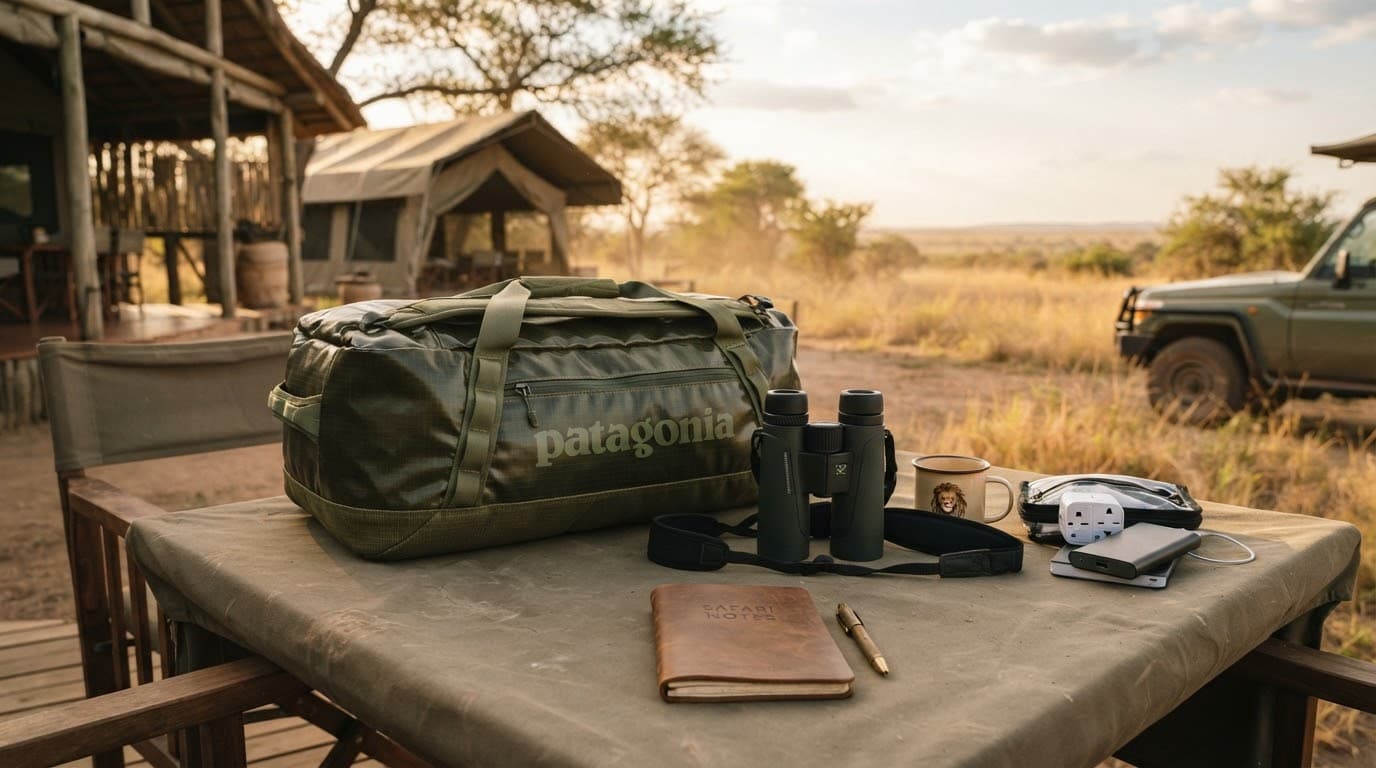
- Patagonia Black Hole Duffel (55L or 70L): The gold standard on bush airstrips. Built from 900-denier recycled TPU-laminated ripstop that seals out fine red bush dust and sudden downpours, with removable padded backpack straps for navigating OR Tambo or Nairobi airports hands-free. Completely frameless and malleable.
- Osprey Transporter Duffel (65L): A rugged, weather-resistant TPU-coated nylon alternative with stowaway harness straps and lockable U-zip access.
- Luggage Scale (Tarriss Jetsetter Digital Scale): Because bush charters weigh bags on the tarmac, pack a 50g digital luggage scale to check your weight before leaving Australia.
Optics, Photography & Off-Grid Power
On game drives, animals rarely pose five metres from the vehicle. Sharing a single pair of binoculars between two people guarantees one of you misses the leopard descending a sausage tree.
- Binoculars (Pack in Carry-On Only)
Aim for 8x42 magnification. An 8x magnification provides a wide, steady field of view from a moving 4x4, while the 42mm objective lens gathers maximum light during cold dawn drives and dusk predator sightings. Ensure they are nitrogen- or argon-purged so internal lenses never fog up or trap dust.
- Best Value All-Rounder — Vortex Diamondback HD 8x42: Consistently rated #1 for value by outdoor gear testers (4.8★). Exceptional low-light transmission, rugged rubber armour, and backed by an unconditional lifetime warranty.
- Best Premium Upgrade — Nikon Monarch M7 8x42: Features Extra-low Dispersion (ED) glass for razor-sharp edge-to-edge clarity, a locking dioptre ring, and generous eye relief for travellers who wear glasses or sunglasses (4.8★).
- Camera Care & Dust Protection
- Camera + Telephoto Zoom (100–400mm or 200–600mm) + 3 Spare Batteries: Remote bush camps run on solar battery banks that often limit charging to specific hours or central mess tents — never rely on a single battery.
- Giottos Rocket Air Blaster + LensPen: Never wipe a dusty lens directly with a cloth. Fine volcanic and Kalahari dust acts like sandpaper on optical coatings. Blow dust off first with a Rocket Air Blaster, then brush clean.
- Power & Adapters for Australians
Australia’s 230V / 50Hz voltage matches Southern and East Africa, so your appliances do not need a voltage converter — only the correct physical plug adapter.
- South Africa, Botswana, Namibia & Eswatini (Type M): These countries use the massive three-round-pin Type M (SANS 164-1) wall socket. Warning: Almost no "universal world adapter" sold at Australian airports fits a Type M socket. Buy a dedicated Type M adapter before you fly.
- Kenya, Tanzania, Uganda, Zambia & Zimbabwe (Type G): Uses the standard British 3-square-pin plug.
- 20,000mAh Carry-On Power Bank (INIU 45W or Anker Zolo 30W): At ~74Wh, a 20,000mAh bank sits safely below the strict 100Wh aviation limit for carry-on baggage while delivering 3–4 full phone or camera top-ups on full-day game drives.
Safari Clothing: The Science of Bush Colours
Most luxury and mid-range safari camps offer complimentary daily laundry (though underwear is typically excluded due to local cultural norms, so pack 5–6 pairs or wash your own with travel soap leaves). Because laundry is done daily, pack for 3 to 4 days maximum to stay well under your 15 kg luggage limit.
- What Colours to Pack (And What Is Illegal)
- Pack: Olive, khaki, sand, taupe, and muted grey.
- Avoid White & Bright Neon: White turns brown with dust within an hour and startles wildlife on walking safaris.
- Leave Dark Blue & Black at Home: Tsetse flies (common in the Serengeti, Tarangire, Zambezi Valley, and Okavango woodlands) are visually attracted to dark navy and black wavelengths and will bite right through thin shirts.
- Strictly No Camouflage: Wearing military or camouflage patterns is illegal for civilians in Zimbabwe, Zambia, Tanzania, and several neighbouring countries. Leave all camo gear at home.
- **The Essential Layering System*
- 2–3 Long-Sleeve UPF 50+ Safari Shirts: Lightweight, breathable merino or technical ripstop (e.g., Craghoppers Nosilife, Kathmandu, or Icebreaker merino).
- 2 Pairs of Lightweight Trousers or Zip-Offs: Quick-drying fabric for cool mornings that converts to shorts for 30°C afternoons.
- Warm Fleece + Packable Down Jacket: Dawn game drives in open-sided 4x4s in Botswana, the Kruger, and the Ngorongoro Crater rim drop to 0°C–6°C between May and August. Add a merino beanie and light gloves for winter departures.
- Wide-Brim Hat with Chin Strap: Open Land Cruisers move briskly; without a chin strap, your hat will blow off into a lion sighting.
- Microfibre Buff / Neck Gaiter: Pull it over your nose and mouth on dusty dry-season tracks, or wet it for evaporative cooling in October heat.
Bush Camp & Health Essentials
- Fabric Packing Cubes (No Plastic Bags!): Kenya, Tanzania, and Rwanda strictly prohibit single-use plastic bags (including Ziploc bags inside your luggage), with confiscation and fines at customs. Use ultralight fabric compression cubes (Peak Design or Eagle Creek) to organise your soft duffel legally.
- Headlamp with Red-Light Mode (Petzl Actik Core): Bush camps are unfenced and unlit at night. A headlamp keeps your hands free when zipping tents, and the red-light mode prevents blinding night vision or attracting swarms of bugs to your face.
- Bushman Plus 40% DEET DryGel (75g): Australian-made, sweat-resistant protection for dusk and dawn in malaria zones. The 75g gel tube passes airport carry-on liquid screening (under 100ml) and never leaks under cabin pressure.
- Insulated Reusable Water Bottle (Hydro Flask or Grayl GeoPress): Single-use plastic water bottles are banned inside all Tanzanian (TANAPA) and Kenyan national parks, including the Serengeti and Masai Mara. Lodges provide purified reverse-osmosis water stations to refill your bottle daily.
Documents, Visas & Financial Kit
- Passport (6+ Months Validity & Blank Pages): Must be valid for at least 6 months beyond your return date. Ensure you have at least 3 completely blank visa pages (South Africa and Namibia enforce this strictly at check-in in Sydney and Perth).
- Yellow Fever Certificate (ICVP): Carry the original yellow physical booklet if your itinerary includes Uganda, or if you transit for more than 12 hours through an endemic hub (such as Nairobi or Addis Ababa) en route to Southern Africa.
- Clean, Post-2013 US Dollar Bills (For East Africa, Zim & Zam): Across Tanzania, Kenya, Zimbabwe, and Zambia, US Dollars are the standard currency for tipping and visas on arrival — but banks and camps strictly reject USD notes printed before 2013 or bills with even minor tears or ink marks.
- Travel Insurance with Medical Evacuation: Remote concessions rely on light-aircraft medevac (e.g., AMREF Flying Doctors or Okavango Air Rescue). Ensure your policy explicitly covers remote emergency air evacuation.
The Official Explore Africa Gear & Packing Checklist
1. Luggage & Bags (Strictly Soft-Sided & Frameless)
- Main Checked Luggage:: 100% frameless, wheelless soft-sided duffel (55L to 70L). *Recommended: Patagonia Black Hole Duffel or Osprey Transporter Duffel.* (Must fit Cessna Caravan cargo pod: ~25×30×62 cm).
- Day Pack / Carry-On Backpack:: For long-haul flights, transit hotels, and daily game drives.
- Ultralight Fabric Packing Cubes:: Compression cubes to organise clothing legally (Kenya, Tanzania, and Rwanda strictly ban single-use plastic/Ziploc bags). *Recommended: Peak Design or Eagle Creek.*
- Digital Luggage Scale:: 50g portable scale to weigh bags before bush charter flights.
- Small TSA-Approved Padlock:: For duffel bag zippers during transit and camp storage.
2. Optics, Photography & Off-Grid Tech
- Binoculars (Carry-On Only):: 8x42 roof-prism, nitrogen/argon-purged binoculars for low-light predator tracking. *Recommended: Vortex Diamondback HD 8x42 or Nikon Monarch M7 8x42. (One pair per traveller).
- Camera System & Telephoto Zoom: : 100–400mm or 200–600mm lens, plus **3 spare batteries** (remote solar camps often limit charging windows).
- Camera Dust Protection:: Giottos Rocket Air Blaster and LensPen (never wipe abrasive volcanic/Kalahari dust directly with a cloth).
- Universal Plug Adapters: : Dedicated Type M (SANS 164-1)** 3-round-pin adapter for South Africa, Botswana, Namibia, and Eswatini. * **Type G** 3-square-pin adapter for Kenya, Tanzania, Zimbabwe, and Zambia.
- Off-Grid Power Bank:: 20,000mAh (under the strict 100Wh aviation limit for carry-on) with built-in USB-C cables. *Recommended: INIU 45W or Anker Zolo.*
- Headlamp with Red-Light Mode:: Essential for unlit bush camps. *Recommended: Petzl Actik Core.
3. Safari Clothing & Footwear (Neutral Layering System)
- Pack for 3–4 days maximum: Most camps offer daily laundry service.
- Long-Sleeve UPF 50+ Safari Shirts (2–3):: Lightweight merino or technical ripstop. *Colours:* Khaki, olive, sand, taupe, grey. **Avoid:** White (shows dust instantly) and dark blue/black (attracts painful tsetse flies in woodland/riverine areas).
- Strictly Prohibited:: Camouflage or military patterns (illegal for civilians in several African nations).
- Lightweight Safari Trousers / Zip-Offs (2 pairs):: Quick-drying technical fabric.
- Camp Shorts (1–2 pairs):: For downtime in camp; not permitted on most game drives.
- Warm Fleece or Softshell Jacket (1):: Essential for cold dawn drives (temperatures can drop to 0°C–6°C from May to August in Botswana and the Kruger).
- Packable Down Jacket / Gilet (1):: Compresses small; doubles as a plane blanket.
- Light Waterproof Rain Shell (1):** : Essential for green-season travel.
- Smart-Casual Outfit (1 set):: For transit hotel dinners in Johannesburg or Nairobi.
- Merino Base-Layer Thermal Top & Socks (2–3 pairs): : Multi-purpose sleep and flight compression wear.
- Underwear (5–6 sets):: Merino-blend recommended for multi-day bush rotations.
- Swimwear (1–2 pieces):: For lodge plunge pools.
- Wide-Brim Sun Hat with Chin Strap:: Critical on open vehicles moving at speed.
- Microfibre Buff / Neck Gaiter:: Dust and sun protection on dry tracks
- Closed-Toe Walking Shoes / Light Boots:: Neutral-coloured, worn on travel days to save bag weight.
- Slip-On Camp Sandals / Crocs:: Easy to remove at airport security and lodge walkways.
4. Documents, Finance & Health Kit
- Passport:: Valid for 6+ months beyond return date, with at least 3 completely blank visa pages side-by-side (strictly enforced by South Africa/Namibia check-in desks).
- Unabridged Birth Certificate (UBC):: Mandatory if travelling with anyone under 18 (Botswana/South Africa requirement).
- Yellow Fever Certificate (ICVP):: Physical yellow booklet if transiting >12 hours through an endemic hub or entering Uganda/Kenya.
- Clean, Post-2013 US Dollar Bills:: Uncreased, untorn USD notes for visas on arrival and tipping (older series notes are rejected across East Africa, Zimbabwe, and Zambia).
- Travel Insurance Policy:: Printed and digital copies explicitly covering **remote emergency medical evacuation** (e.g., AMREF or Okavango Air Rescue).
- Bushman Plus 40% DEET DryGel (75g):: Sweat-resistant malaria-zone insect repellent under the 100ml carry-on liquid limit.
- First-Aid & Personal Meds:: Full prescription supply plus a 5-day buffer, malaria prophylaxis, rehydration salts, and blister care.
- Insulated Reusable Water Bottle: To comply with single-use plastic water bottle bans inside national parks.
Frequently asked
Can I bring a soft duffel bag with wheels on a bush flight?
In most cases, no. Even if the exterior fabric is soft canvas, a wheeled duffel has a rigid internal frame and solid bottom plate that prevents the pilot from moulding the bag through the narrow door of a Cessna Caravan belly pod. If you are flying into the Okavango Delta, Serengeti, or Masai Mara, choose a 100% frameless, wheelless duffel.
What do I do with my extra "city luggage" if I'm visiting Cape Town or Nairobi too?
If you are combining a bush safari with a stay in Cape Town, the Winelands, or a beach break in Zanzibar, you do not need to haul your city clothes into the bush. You can store a hard suitcase securely at official Left Luggage facilities at OR Tambo International Airport (JNB, Terminal A basement), Cape Town International (CPT), or with your charter operator's base in Maun (MUB) or Arusha (ARK) while you take a 15 kg soft duffel into camp.
Why do I need one pair of binoculars per person?
Wildlife sightings often happen quickly and simultaneously — a cheetah scanning a termite mound while cubs play in the grass. Passing a single pair of binoculars back and forth means constantly readjusting the focus wheel and interpupillary distance, causing both travellers to miss the moment.
When does seasonal weather change what I need to pack?
- Dry Season (May to October): Prime wildlife viewing across both Southern and East Africa. Despite warm, sunny afternoons (25–30°C), early morning game drives between June and August are bitterly cold (0–8°C in Botswana, Kruger, and the Ngorongoro Crater). Thermal base layers, a fleece, a packable down jacket, and gloves are essential.
- Green / Wet Season (November to April): Hot, humid, and lush — prime time for newborn calves in the Southern Serengeti (Jan–Feb), migratory birding, and 30–50% lower lodge rates. Swap heavy winter woollens for a breathable, waterproof rain shell and waterproof dry-sacks for your camera gear.